

Table of Contents
Published:
October 30, 2026
|
Last Updated:
October 30, 2026
You've got people now.

Suboxone can be an incredibly beneficial option if you’re ready to stop using opioids. The medication is a combination of buprenorphine and naloxone, and can help you reduce cravings and manage withdrawal symptoms. Buprenorphine is one of the three Medications for Opioid Use Disorder (MOUD) approved by the Food and Drug Administration. Naloxone helps protect you by preventing misuse.
So, how long should you be on Suboxone? One of the essential things to know about this medication is that it can be taken for however long you need it. There is also zero shame in taking it for a long period of time if that’s what works best for you. Some people take it for a year; others take Suboxone for life. It’s all dependent on what’s best for you and your recovery goals.
“A helpful comparison can be antidepressant medications,” says Dr. Stephen Martin, an addiction medicine physician at Boulder Care. “Some people find them useful for a year or so. If you’ve had a normal mood for a few months, you can consider stopping an antidepressant. But if your depression was very difficult, or kept recurring in a harmful way, you may decide to stay on your medication the rest of your life.”
With that said, below we go through what you need to know about how long to take Suboxone, deciding what’s right for you, and what it’s like to taper off it — if that’s the path you choose.
Support is available to you anytime, including while you decide about taking Suboxone or other medications.
There’s no set or correct timeline for Suboxone. Some people will stay on Suboxone for a few months while other people will take it indefinitely. The length of your Suboxone treatment depends on your health needs and recovery goals.
“One thing I always emphasize is that there is no one-size-fits-all timeline for how long someone should stay on Suboxone,” says Danielle Bellosi, a Peer Recovery Supervisor at Boulder Care, who took Suboxone from 2009 to 2011. “Everyone's recovery journey is different, and what works for one person may not work for another.”
Researchers have found that taking Suboxone for a longer period is safe and can have benefits.
Take a recent study in the Journal of Addiction, which reported that people who took Suboxone for four to five years had a lower risk of death. The improvement in life expectancy increased throughout the period of use, but was no longer statistically significant after four to five years.
“Taking buprenorphine for more than a year decreases the risk of overdose death compared to less than a year,” Dr. Martin explains.
“If people waited to taper off at 18 months or longer, they had a lower risk of emergency department care and hospitalizations. This duration is the general threshold where people have less risk of overdose death when tapering off buprenorphine.”
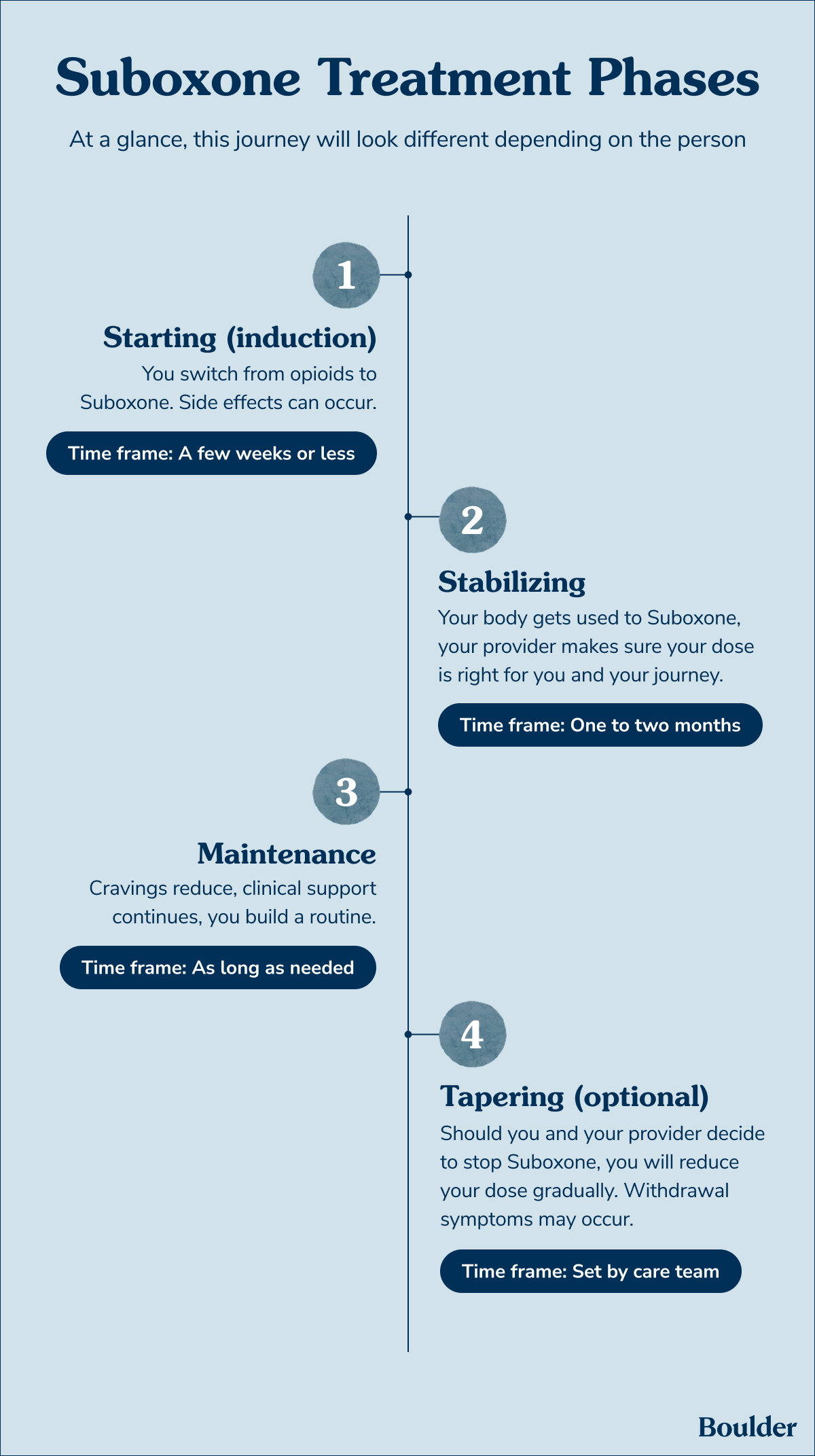
You might choose to stay on Suboxone long-term because of benefits such as reducing cravings and overdose risk.
The American Psychiatric Association (APA) defines opioid use disorder as a chronic condition. As is the case with other chronic disorders, you might choose to stay on medication — and potentially receive treatment — for an indefinite amount of time.
Taking Suboxone for an extended period can provide ongoing relief from cravings and withdrawal symptoms, along with giving you time and space to rebuild healthy routines.
It’s all about deciding what’s right for you. “Just as with an antidepressant medication, you can weigh the risks and benefits of continuing Suboxone for the long term,” says Dr. Martin.
“You may have had overdoses or other harms and want to be as sure as you can that these harms don’t happen. You may have been on Suboxone before and returned to opioid use each time you discontinued it. Or you could just want a life that is safer and more predictable,” he explains.
The journal Annals of Medicine explains that physical dependence isn’t addiction. Yes, your body might adapt to taking Suboxone as time passes, but that doesn’t mean it’s a substitute for opioids.
Physical dependence can occur with many medications, but that is different from compulsively using something that can harm you.
Yes, and it’s not uncommon for people to stay on it long term. As the Journal of Addiction research showed, taking Suboxone for four to five years can significantly reduce your risk of death. Suboxone has proven to be safe to take for years and can continually help with cravings and withdrawal symptoms.
Side effects, such as headaches, vomiting, fever, and insomnia, can occur while taking Suboxone and might be disruptive, according to the Substance Abuse and Mental Health Services Administration (SAMHSA). Suboxone side effects can fade as your body adjusts to the medication.
However, it’s possible to experience long-term side effects such as constipation and drowsiness.
Taking Suboxone orally also comes with a long-term risk of dental problems, the Food and Drug Administration (FDA) reports. Dental problems can include tooth decay, oral infections, and loss of teeth. That said, good dental hygiene can reduce this risk.
Just because side effects are possible, it doesn’t mean you have to grin and bear them. Your care team should be able to help you manage any ongoing side effects or change your dose as needed.
Factors such as co-occurring mental health conditions, day-to-day stability, personal goals, and support can all impact how long you stay on Suboxone. Here a few of the things to consider — and discuss with your care team — when deciding whether to keep taking Suboxone:
The day-to-day circumstances can be especially critical given how much our surroundings impact us.
As Dr. Martin points out, “If you are in a living situation where others are continuing to use opioids or other ongoing stressors have you worried about return to use, you can choose to stay on the medication until your life is safer.”
Deciding to taper off Suboxone is a personal decision that depends on a number of factors, including stability.
If you want to taper, Dr. Martin emphasizes his earlier statement on length and recommends looking at “if you have a year or more of successful, routine treatment with buprenorphine.” A JAMA Network Open study found that people who had completed at least one year of buprenorphine use were at a lower risk of opioid overdose.
There are no specific requirements for tapering off Suboxone — or a requirement to ever taper off — but the conversation around it should focus on your safety.
Some problems might make you feel like tapering is necessary, but they might be solvable while staying on Suboxone.
“You can have difficulties with insurance, side effects, drug testing, rules that are too strict, and care providers who express stigma,” says Dr. Martin.
“In these cases, the program is often at fault. If patients don’t have another option, it makes sense that you would stop going even though you risk overdose and other harms.”
Bellosi faced pressure to stop taking Suboxone while in a program. “For me, the decision to taper off wasn't entirely my own,” she explains. “It was required during my last inpatient rehab stay. At that time, Suboxone wasn't viewed or utilized the way it is today, and there was much more emphasis on eventually coming off medication rather than recognizing it as a long-term treatment option.”
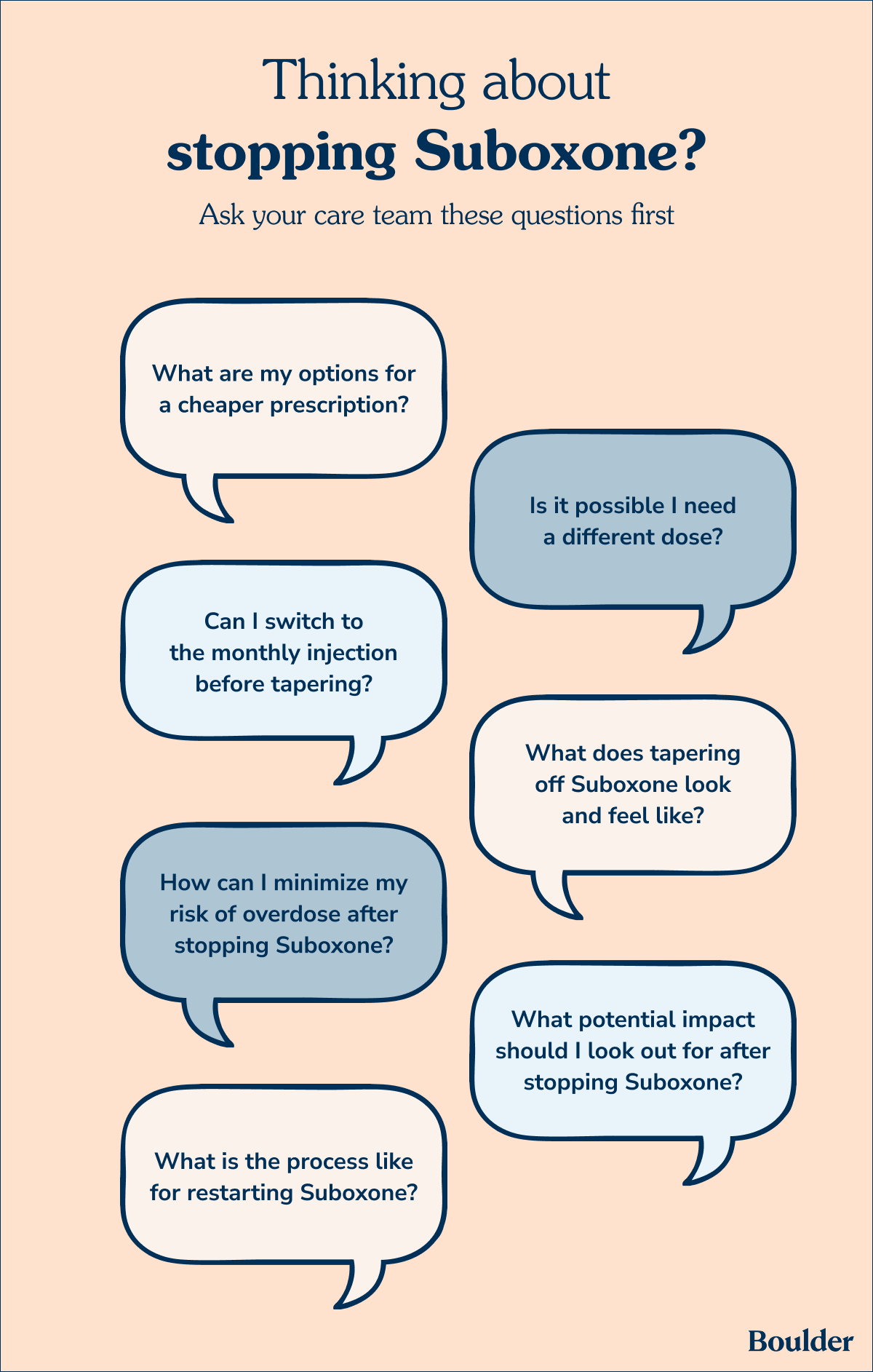
Stopping Suboxone can lead to risks such as recurring withdrawal symptoms and overdose — though there are ways to significantly diminish these risks.
Critically, after stopping Suboxone you are at a much higher risk of overdose. “Stopping Suboxone carries a serious risk of opioid overdose as you can lose your tolerance to potent opioids like fentanyl. If you return to use after stopping Suboxone, a small amount of fentanyl you used before could, because of a lower tolerance, lead to an overdose,” says Dr. Martin. “To reduce the risk of overdose, patients should keep a close connection with a supportive clinical team.”
Carrying Naloxone can also help keep you safe.
During Suboxone withdrawal you might experience symptoms such as cravings, depression, chills, and insomnia. These symptoms are generally less intense than when withdrawing from other opioids.
The amount of time you spend tapering can impact the severity of your withdrawal symptoms. Tapering over one to two weeks can lead to more severe side effects than tapering over four weeks. A longer taper can allow you to gradually stop Suboxone use and avoid a sharp rise in symptoms after your last dose. Tapering under the supervision of your care team can also help you manage symptoms and adjust your process as needed.
It’s worth pointing out that your decision to stop Suboxone doesn’t have to be a permanent one. You can always go back on the medication with the help of a care team.
You will decide, with the support of your care team, how long you will take Suboxone. Good shared decision-making should involve open conversations between you and your provider. Providers should not set arbitrary deadlines or pressure you to continue or stop Suboxone.
“Looking back, I think the most important thing is that people feel stable, supported, and empowered to make decisions about their medication alongside their medical provider,” says Bellosi. “No one should feel pressured to taper off or feel that their recovery needs to follow a specific timeline.”
Boulder Care offers telehealth appointments focused on removing barriers to access and making sure your needs are met. We do not set time limits on treatment or discharge people for returning to use, tapering medicine, or restarting treatment.
Learn more about our services here or call (888) 608-0836 to talk to a Boulder Care team member.
“Ultimately, recovery isn't defined by how long someone stays on medication or whether they take it at all. It's about finding what works for them, supports their well-being, and allows them to build the life they want for themselves," says Bellosi.
How long people take Suboxone is incredibly varied. Some people will be on it for a few months while other people will take it for years or indefinitely. The key is having open conversations with your provider and proceeding however is right for you.
Yes, you can always restart Suboxone after stopping. Taking it again requires the same steps as it initially did: Stopping opioid use at least 12 to 24 hours beforehand to help prevent precipitated withdrawal.
Yes, if you are taking Suboxone as a daily film or tablet then you can switch to a monthly injection. Some people prefer the injection so they don’t have to remember to take medicine each day.
At Boulder Care, we’re committed to providing clear, evidence-based information about opioid and alcohol use disorder recovery. Learn more about our editorial standards and medical review process.

Our mission is to improve the lives of people with substance use disorders. We provide medication, resources, and support to help our patients succeed on their own terms, wherever they are.
Now covered by Medicaid in Oregon and Washington – Schedule an online visit.