Published:
June 16, 2026
|
Last Updated:
June 15, 2026

How to Recognize an Opioid Overdose Fast

Key Takeaways

  • The key signs of an opioid overdose are very slow or stopped breathing, unresponsiveness, and lips or fingertips that look blue or gray.
  • If you believe someone is overdosing, call 911 immediately, administer naloxone if you have it, and stay with the person until help arrives.
  • Fentanyl overdoses can happen within seconds and may need more than one dose of naloxone to reverse.

If you think someone is overdosing, always call 911 right away and ask around the area to see if anyone has Narcan (naloxone) to immediately give them. Roll the person on their side in recovery position with their top knee bent and wait for medical help to arrive.

There won’t be time to read a whole article before helping someone who is overdosing, but you can still save this information for future situations. This guide will walk you through the key signs to watch for and the steps to follow so you can offer the help someone needs. 

This is potentially life-saving knowledge and worth remembering — even if you don’t personally know anyone who uses opioids.

Our program is based on your goals, not our rules.
Whether you want to reduce use or stop altogether, your care team has your back.
Learn more about Boulder

What are the signs of an opioid overdose?

Here’s how to tell if someone is overdosing, according to Dr. Stephen A. Martin, MD, medical director for research, education, and quality at Boulder Care and the SAMHSA Overdose Prevention and Response Toolkit:

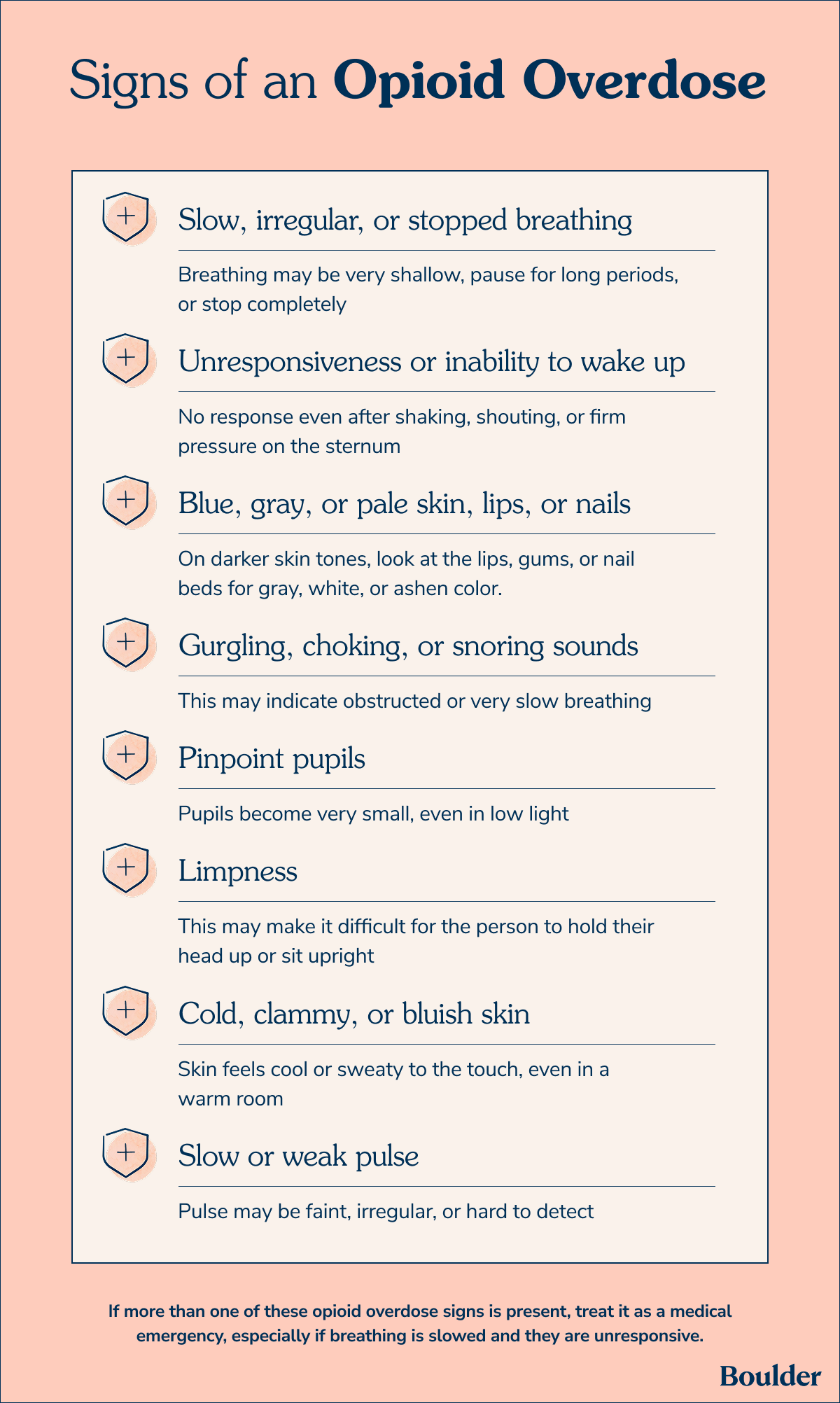
  • Slow, irregular, or stopped breathing that may be very shallow, pause for long periods, or stop completely.
  • Unresponsiveness or inability to wake up in response to shaking, shouting, or firm pressure on the sternum.
  • Blue, gray, or pale skin, lips, or nails; on darker skin tones, look at the lips, gums, or nail beds for gray, white, or ashen color.
  • Gurgling, choking, or snoring sounds that indicate obstructed or very slow breathing.
  • Pinpoint pupils that become very small, even in low light.
  • Limpness may make it difficult for the person to hold their head up or sit upright.
  • Cold, clammy, or bluish skin that feels cool or sweaty to the touch, even in a warm room.
  • Slow or weak pulse that may be faint, irregular, or hard to detect.

If more than one of these opioid overdose signs is present, treat it as a medical emergency, especially if breathing is slowed and they are unresponsive.

What to do if someone is overdosing: Step-by-step

The most important thing to do when someone is overdosing is to call 911 immediately, give them naloxone (Narcan) if you have it, and keep them breathing until help arrives. 

Staying calm is also key, says Wesley Brewington, a certified peer recovery support specialist at Boulder Care. "Panic can delay getting someone the help they need," he says. 

Step 1: Call 911 right away

Call 911 immediately and tell them the person is not responding and is possibly overdosing. Make the call, even if you're not 100% sure it's an overdose. Remain on the line so you can follow their instructions for what to do next.

Step 2: Give naloxone (if available)

  • Nasal spray (Narcan or similar): Lay the person on their back and tilt their head back. Insert the tip into one nostril. Press the plunger firmly to give a dose. Remove the nozzle from their nose after administering the dose.
  • Injectable naloxone: Remove the cap from the vial and stick the needle through the rubber stopper. Draw all the fluid into the plunger. Inject into the shoulder muscle (like a flu shot) or the front of the thigh, through clothing if needed. If there is no response after 2 to 3 minutes, give a second dose.

Step 3: Start rescue breathing (if they are not breathing)

Tilt their head back, lift their chin, and give 1 breath every 5 to 6 seconds. Watch their chest to ensure it is rising with each breath you give. Continue until they start breathing on their own or help arrives.

Step 4: Put them in the recovery position (if they are breathing)

If the person is unconscious but breathing, roll them onto their side with their top knee bent and head tilted slightly back. This helps keep the airway clear and reduces the risk of choking.

Step 5: Stay with them

Do not leave them alone. "An overdose can worsen. Some people may quickly need additional doses of Narcan," Brewington says.

Step 6: Be ready to give more naloxone if needed

If they stop breathing or become unresponsive again, give them another dose of naloxone and continue rescue breathing. 

"If the person doesn’t respond to a first naloxone dose, naloxone should be given every 2-3 minutes until the person responds," says Dr. Martin. "You can’t give someone too much Naloxone if they are in this situation." 

Step 7: Wait for help and share what you know

Tell emergency responders what they took (if you know), how much naloxone was given, and when. Stay until they take over care. 

In some cases, administering naloxone can lead to sudden opioid withdrawal symptoms, so informing responders can help them determine what steps may be needed to address symptoms of precipitated withdrawal.

Get the medication you need, and the support you deserve.
We provide FDA-approved medications for alcohol and opioid addiction — and support services to help you stay on track and reach your recovery goals.
Learn more about our services

How to tell the difference between "very high" and overdosing

The best way to tell the difference between someone who is very high and someone who is overdosing is to look at whether they can still breathe and respond normally.

Signs someone is very high

  • Breathing: Slowed, but still steady and ongoing
  • Responsiveness: Drowsy or "out of it," but still responds to voice and touch
  • Sounds: Mumbling or talking slowly
  • Pupils: Small but still changes with light
  • Movement: Able to shift position, sit up, or react slowly
  • Skin color: Normal, flushed, or sweaty

Signs someone is overdosing

  • Breathing: Very slow, irregular, or stopped completely
  • Responsiveness: Does not wake to shouting, shaking, or sternum rub
  • Sounds: Gurgling, choking, loud snoring sounds, or complete silence
  • Pupils: Very small pinpoints that don't respond much to light
  • Movement: Limp body, minimal movement
  • Skin color: Pale, gray, blue, or ashen; easier to see on lips, gums, inside of mouth, or nail beds

When in doubt, treat it as an overdose. Administering Narcan and acting early is much safer than waiting to see if it gets worse. "It's better to be wrong than to wait too long," Brewington says.

What does an opioid overdose look like? Signs and symptoms explained

During an opioid overdose, breathing slows down so much that oxygen levels drop. As oxygen falls, the brain and body begin to shut down, leading to opioid overdose symptoms like small pupils, lack of responsiveness, and blue or gray lips and fingertips.

Breathing changes

While breathing is an automatic reflex, it becomes very slow or may stop completely during an overdose. "Opioids can turn down or even turn off this breathing reflex," says Dr. Martin. "During an opioid overdose, though a person may appear to be just asleep, their brain is actually starving for oxygen."

Gurgling and loud snoring are key warning signs. While often mistaken for sleep, they mean that the airway is partially blocked. “Don't assume a person will sleep it off,” Brewington says. “Slowed or stopped breathing is a medical emergency.”

Responsiveness

During an overdose, a person becomes difficult or impossible to wake up. Assess responsiveness by shaking them, shouting their name, or physically stimulating them. You can perform a sternum rub by pressing your knuckles vigorously up and down the center of the chest for several seconds. Dr. Martin also says you can rub your knuckles on their upper lip or pinch the back of their arm to assess responsiveness.

Skin, lips, or nail color changes

Breathing changes cause blood oxygen levels to drop, leading to visible changes in color. Skin may turn pale, gray, or bluish. On darker skin, these changes are often easier to see on the lips, gums, inside the mouth, or nail beds than in overall skin color. This is one of the most visible signs that oxygen levels are dangerously low.

Pupil and eye changes

Opioids affect pupil size because they act on the part of the brain that controls the muscles of the pupils. Pupils become very small, like a pinpoint, and respond less to changes in light.

Why fentanyl changes the overdose picture

Fentanyl is powerful and fast-acting, which means it can cause an overdose even at very small doses. Signs of fentanyl overdose are the same as those of other opioids, but a person can lose consciousness within seconds to minutes. 

"Fentanyl causes more overdoses because it is much stronger at stopping the breathing reflex, with a potency 100 times that of morphine and 30-50 times that of heroin," Dr. Martin explains. "Fentanyl also crosses into the brain much more quickly than other opioids. A person using fentanyl can have their breathing reflex turned down or off far more quickly and powerfully, creating an overdose."

This potency means a single dose of naloxone may not be enough. If the person doesn't start breathing or wake up within 2 to 3 minutes, you should give them another dose and continue rescue breathing.

It's also common for fentanyl to be mixed into other drugs without people knowing. Having fentanyl test strips on hand can help detect the drug in other substances before use, reducing the risk of harm. They are inexpensive and available through many local health departments and harm reduction programs.

Who is at highest risk for opioid overdose?

People are at the highest risk for opioid overdose after a break from opioid use, when mixing opioids with other substances, or when using drugs that may contain fentanyl. Overdose risk can increase as opioid use becomes more frequent or severe. Recognizing the signs of opioid use disorder may help people seek support before an overdose occurs.

Losing tolerance after a break from opioids increases the risk of overdose. After days or weeks without opioids, the body becomes less used to them, so a previously familiar dose becomes dangerous. This risk can be high after detox or rehab, release from jail or prison, hospitalization, or any other period of reduced use.

Mixing opioids with alcohol, benzodiazepines (like Xanax or Valium), or other central nervous depressants that slow breathing also greatly increases the risk of overdose. Dr. Martin notes that using alone presents the highest risk for fatal overdose.

Good Samaritan laws: Your legal protection when you call for help

Fear of legal consequences is a common reason why people hesitate to call 911 during an overdose. "People hesitate because they're afraid of legal consequences from saying the wrong thing or making a mistake. The biggest mistake is usually doing nothing," Brewington explains. "Calling for help or staying with the person can make all the difference."

He suggests knowing the Good Samaritan laws in your state, which provide legal protection for certain drug possession charges for people seeking emergency help.

Protections vary by state, but most U.S. states have some form of overdose-related immunity law.

  • Strong protections (protection from arrest, charges, and prosecution for possession/paraphernalia for both the caller and the overdose victim: Connecticut, Delaware, Maryland, Nevada, New Jersey, New Mexico, Rhode Island, Vermont, Washington
  • Moderate protections (broad protections, but may not cover arrest, paraphernalia, or both people involved): California, Colorado, Illinois, Kentucky, Massachusetts, Minnesota, New York, Oregon, Pennsylvania, Virginia, Wisconsin
  • Limited protections (usually protect against prosecution only, or only apply to the caller): Alabama, Alaska, Arkansas, Florida, Idaho, Iowa, Kansas, Mississippi, South Dakota, Texas, Wyoming

There are also additional protections for the use of naloxone. People who administer naloxone in good faith are protected from liability in most states.

However, laws can change, and the details vary by state. You can check your state's current protections in the DopaGE Good Samaritan law database.

Where to get naloxone and how to be prepared

Naloxone nasal spray is widely available throughout the U.S., often free or low-cost through harm reduction and public health programs, most commonly under the brand name Narcan. Nightclubs and bars frequently have a stock of Narcan available to use when overdose emergencies occur.

Brewington suggests keeping some on hand and learning how to use it before you ever need it. This can help save lives by reversing overdoses before emergency help can get there.

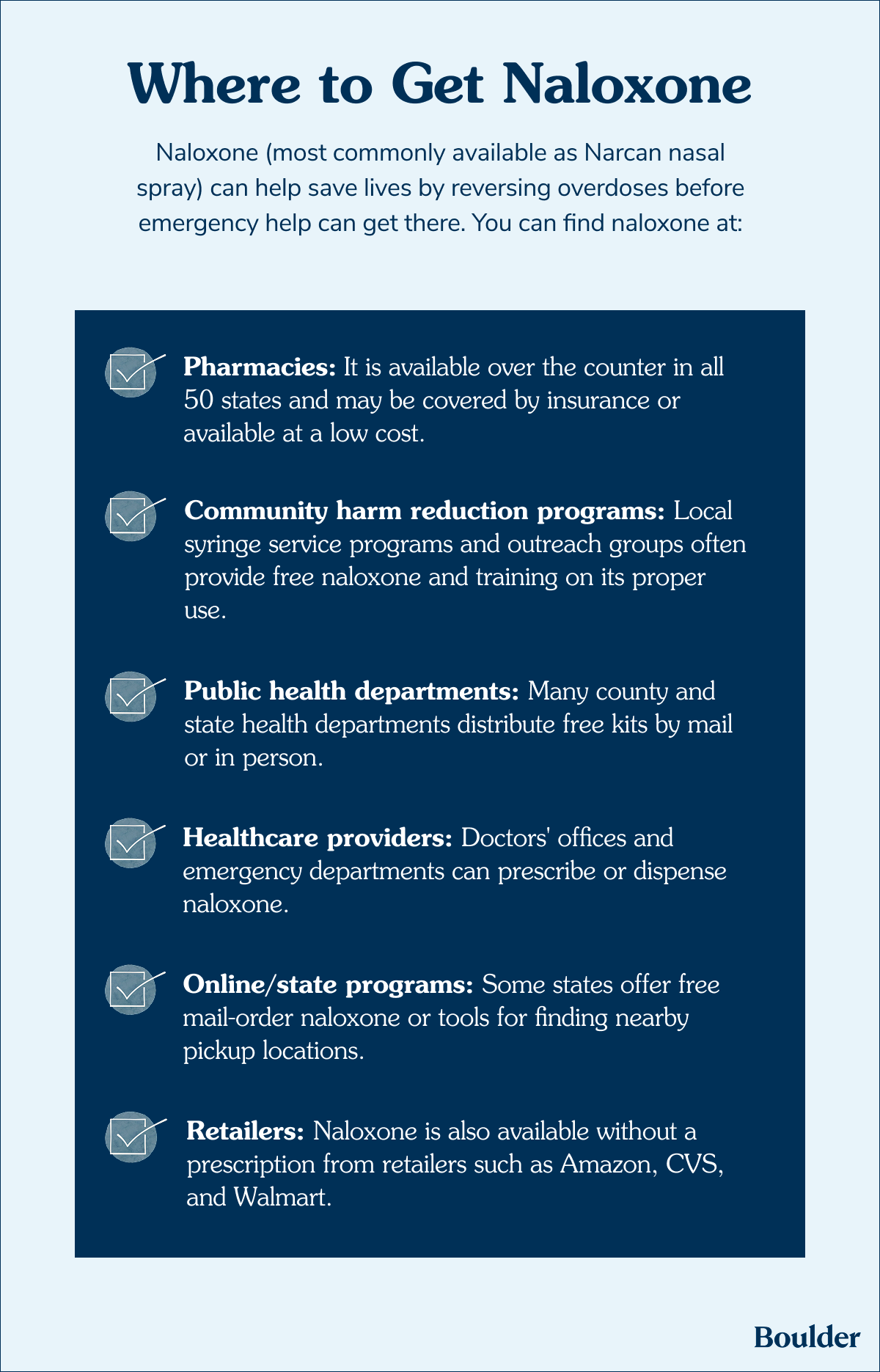
You can find naloxone at:

  • Pharmacies: It is available over the counter in all 50 states and may be covered by insurance or available at a low cost.
  • Community harm reduction programs: Local syringe service programs and outreach groups often provide free naloxone and training on its proper use.
  • Public health departments: Many county and state health departments distribute free kits by mail or in person.
  • Healthcare providers: Doctors' offices and emergency departments can prescribe or dispense naloxone.
  • Online/state programs: Some states offer free mail-order naloxone or tools for finding nearby pickup locations.
  • Retailers: Naloxone is also available without a prescription from retailers such as Amazon, CVS, and Walmart.

Naloxone is just one part of overdose prevention. Additional overdose awareness resources from Boulder Care can help you learn how to recognize and respond to an overdose effectively.

The bottom line

The most common signs of an opioid overdose are slowed or stopped breathing and an inability to wake the person. It's a medical emergency that can happen quickly, especially with fentanyl or after a break in use. If you suspect an overdose, call 911, give naloxone if you have it, perform rescue breathing, and stay with the person until help arrives.

"The most important thing is keeping someone alive long enough to have another chance. Recovery is possible, but only if they survive the moment in front of them,"  Brewington says.

For people struggling with opioid use disorder, treatment can also reduce the risk of future overdoses. Call 888-422-6530 to speak with a care team member and learn more about available options, including buprenorphine, the Sublocade shot, and naltrexone.

Deep dive recommendations

Substance Abuse and Mental Health Services Administration (SAMHSA). Overdose Prevention and Response Toolkit.

Frequently Asked Questions

What happens during an overdose?

During an overdose, opioids cause sedation that slows breathing and heart rate to dangerously low levels. Oxygen levels drop, causing them to lose consciousness, stop responding, and eventually stop breathing altogether. This can quickly lead to brain damage or death without quick opioid overdose treatments, such as naloxone. Naloxone works quickly by stopping opioids from attaching to brain receptors, which can restore normal breathing patterns.

Can you overdose on opioids the first time you use them?

Yes, a person can overdose on opioids even if it is their first time taking them. This is especially true with fentanyl, since it is such a powerful drug. The risk of overdose is also higher when taking opioids for the first time if they are combined with alcohol or other sedatives, which also affect breathing.

How many doses of naloxone does it take to reverse an overdose?

People often respond to one dose. However, Dr. Martin says that a person may not respond to a single dose of naloxone because the opioid causing the overdose is too strong or because something else has caused them to stop breathing. In this situation, call 911, give rescue breathing, and continue administering naloxone every 2 to 3 minutes until they wake and help arrives. It is safe to keep giving doses, and you may need to use all of the doses in the pack.

On-demand, online addiction care from home — on your terms.
Access our care team directly through an app on your phone.
Get started in the Boulder Care app

Editorial Policy

At Boulder Care, we’re committed to providing clear, evidence-based information about opioid and alcohol use disorder recovery. Learn more about our editorial standards and medical review process.