Published:
|
Last Updated:
June 29, 2026
You've got people now.


Rarely is the dosing for any medication one-size-fits-all. This is true whether you’re taking an over-the-counter medication for seasonal allergies, a prescription statin for controlling high cholesterol, or a medication for opioid use disorder (MOUD), such as Suboxone.
Suboxone is an evidence-based medication that can be used in recovery from opioid use disorder (OUD). It acts on your opioid receptors to prevent cravings and ease symptoms of withdrawal from harmful opioids. Yours or a loved one’s dose may be different from that of someone else because many factors and circumstances impact what dose is right for each person.
If you are starting Suboxone as part of a recovery journey, you might experience some trial and error before you land on the right dose for you, or your dose may change over time. Any changes should be made under the guidance of your prescribing provider. Suboxone should help medically stabilize your opioid receptors so that you can focus on the bigger picture of OUD recovery—and minimize those withdrawal symptoms that keep you stuck in survival mode. The key is to listen to your body and alert your provider if your dose doesn’t feel right.
In this article, we explore the signs that your Suboxone dose is too low and what you can do. However, you should not adjust your dose before discussing it with your provider.
Your Suboxone dose may be too low if you continue to experience cravings or withdrawal symptoms, or if these issues return before you take your next scheduled dose.
“When starting a patient on buprenorphine, I always ask them to let their body guide them and our shared decision-making on what dose works best,” says Mike Winer, MD, the associate director of addiction medicine and NYC Health + Hospitals.
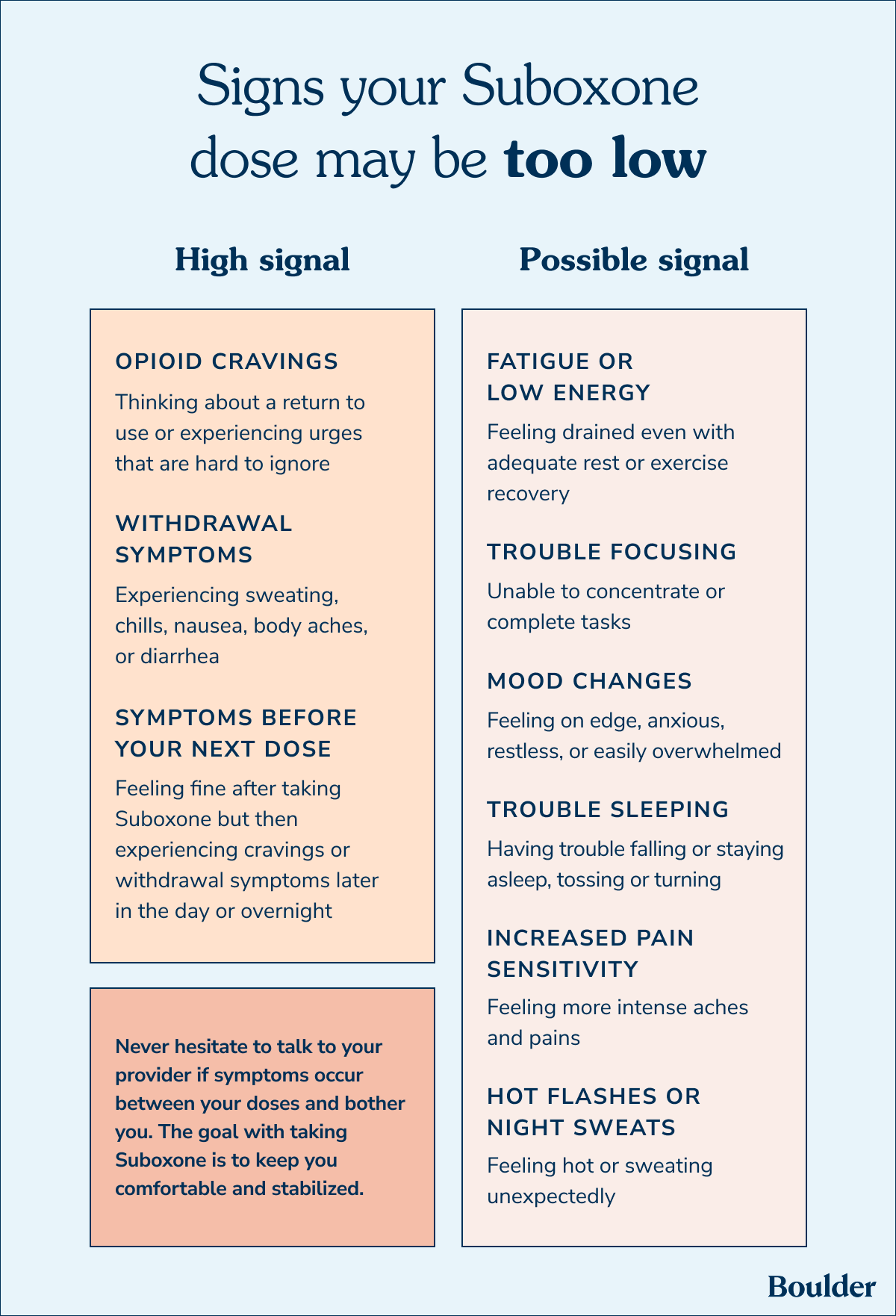
The following are the strongest bodily signals that may indicate your dose is not right for you and that you may need your provider to adjust it.
Keep in mind that these symptoms can result from factors other than dosage. If you’re experiencing these symptoms, talk to your provider about how you are taking your medication. Taking Suboxone as directed is crucial.
Withdrawal symptoms are not the same for each person. Some symptoms can be subtle or mimic other health concerns.
“Withdrawal can mean different things for different people,” Dr. Winer says. “Common withdrawal symptoms I investigate with patients include sweating, nausea, chills, muscle aches, and/or loose stool or diarrhea.”
Here are the symptoms that may be less obvious but could indicate the need for a dose adjustment. Never hesitate to talk to your provider if they occur between your doses and bother you. Again, the goal with taking Suboxone is to keep you comfortable and stabilized.
Symptoms that show your Suboxone dose may need adjusting
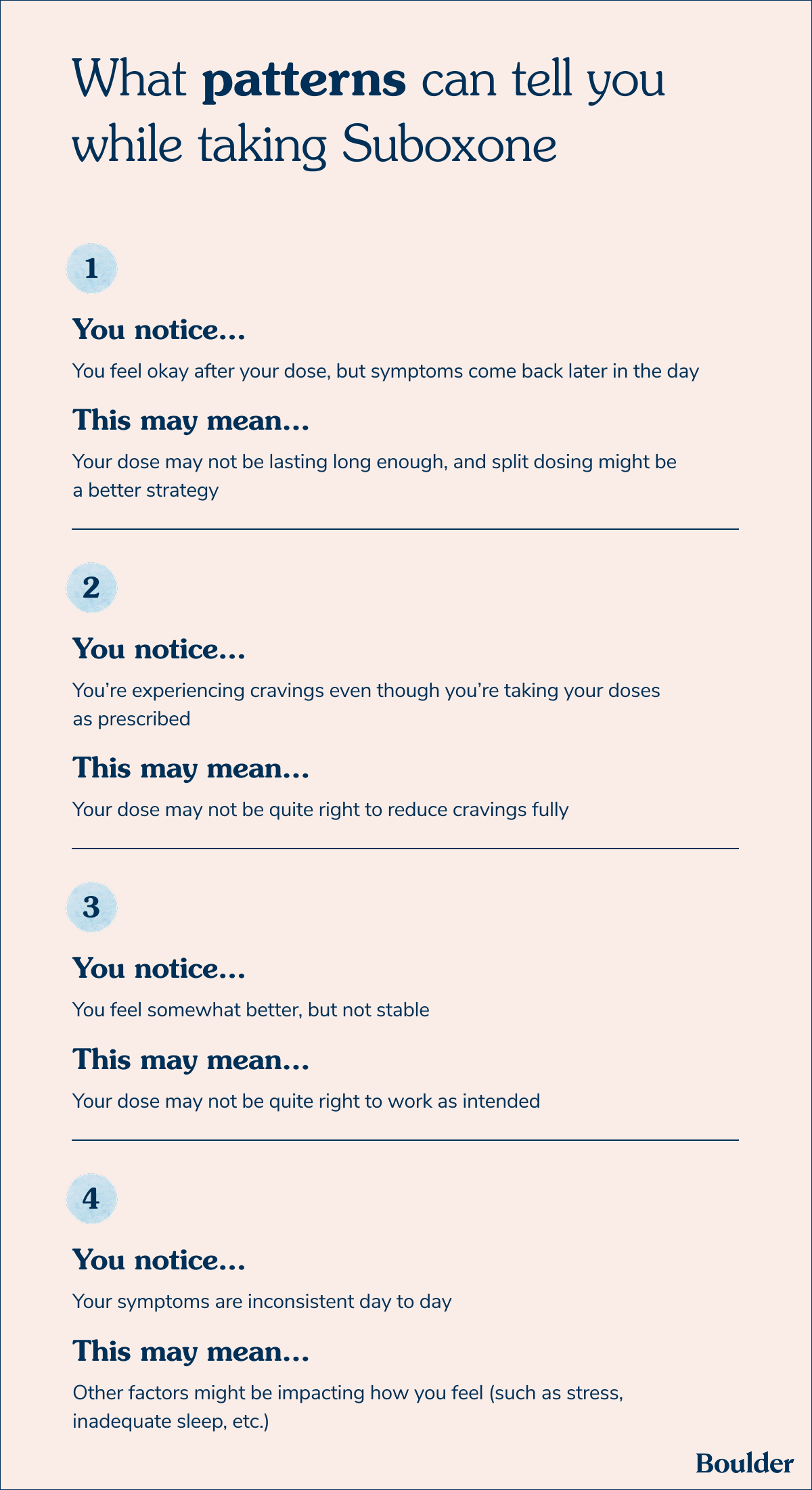
While taking Suboxone, you might notice patterns that could indicate that your dose needs adjusting. Remember that Suboxone is intended to reduce withdrawal symptoms and cravings and to stabilize you.
“A first goal is getting patients to a dose where they do not have any withdrawal symptoms for the entire day,” Dr. Winer says. “This includes overnight or sleep...If you feel like you are waking up in the middle of the night with withdrawal symptoms or restlessness, or if you are feeling withdrawal in the morning until you have had your next dose, then you should inform your provider."
He adds, “The second goal is to get the dose to a place where you do not feel like you have cravings during the day or evening.”
If hard-to-ignore cravings come up for you, your provider can tailor strategies around your dosing pattern.
“Some patients find benefit from their current dose when divided through the day—twice a day or up to four times a day,” Dr. Winer says.
“Some other patients find a bigger dose in the morning, combined with smaller afternoon or evening doses, is the best strategy.” Split dosing can also be a strategy to address chronic pain, he notes.
Keeping a log to track symptoms and side effects can be helpful, especially when you’re starting Suboxone.
If you think your Suboxone dose isn’t working for you, talk to your provider. You don't have to wait.
Suboxone contains buprenorphine, a long-acting opioid that aids recovery by appeasing opioid receptors that have been desensitized by the problematic use of opioids over time. If you’re experiencing withdrawal symptoms or intense cravings while taking Suboxone, then your dose may not be right for you. But that doesn’t mean that you’ve somehow “failed” the medication.
“I always share with my patients not to focus on the number but on their body,” Dr. Winer says. “Some patients are worried that if they are needing higher doses, they are doing something wrong.”
Just like other medications, dosing is about finding what works for you: “If someone’s blood pressure is elevated despite being on a certain dose of a blood pressure medication,” he says, “they often need a dose increase that best suits their needs. The same is true about buprenorphine.”
The key thing to understand is that the dose that satisfies someone else’s opioid receptors may not keep your receptors calm and content. You might need a different dose for the following reasons:
Never hesitate to talk to your provider if you think your Suboxone dose is too low. They can help you analyze patterns related to your cravings and symptoms. Do not try to adjust your dose or how often you take Suboxone on your own.
Write down what you’re experiencing as best you can. Include what symptoms you’re noticing, their severity, and when they tend to occur.
Your provider might use the Clinical Opiate Withdrawal Scale (COWS). COWS is an 11-factor assessment to objectively evaluate opioid withdrawal severity. It helps your provider tally a score based on factors such as heart rate, pupil size, tremors, gooseflesh, sweating, anxiety, and body aches.
“The higher the number,” Dr. Winer says, “the more withdrawal symptoms someone is likely experiencing. This can inform us that more of your opioid receptors need support. As we increase the dose of the buprenorphine, we often see the COWS score go down, which signifies that your comfort level is improving.”
Suboxone is a powerful tool that leads to better recovery outcomes. But it is not one-size-fits-all. If your dose is off, you may experience cravings or withdrawal symptoms. The goal of Suboxone is to keep you comfortable and stable in recovery so that you can focus on building the life you want.
If you do not feel stable, your provider can evaluate you and figure out a better dosing strategy that is right for you.
“Overall, the right dose is the one that allows you to thrive, wake up, spend time with your loved ones, and not worry about feeling or becoming sick,” Dr. Winer says.
If you're curious about whether Suboxone could be a good fit, Boulder is here to help. Call 888-422-6530 to speak with a care team member and learn more about getting started.
Yes, your Suboxone dose can be too low even if you’re taking it as prescribed. The right dose for you is one that prevents withdrawal symptoms and intense cravings. If you’re experiencing these issues, talk to your provider. You might need a higher dose or a different dosing schedule.
Yes, opioid withdrawal symptoms may come back between Suboxone doses. But if this happens, you may need a different dose or dosing schedule. Suboxone is intended to stabilize you in recovery by preventing withdrawal symptoms and intense cravings. If these issues occur, talk to your prescribing provider.
A Suboxone dose that is too low is not dangerous, but if it is not enough to keep intense cravings or withdrawal symptoms at bay, then a danger exists for a return to use. That’s why you should always talk to your provider if you notice these concerns. They can adjust your dose to a level that keeps you more comfortable and stable during recovery.
The lowest manufactured dose of Suboxone is 2 milligrams of buprenorphine and 0.5 milligrams of naloxone. However, taking a lower dose is possible by splitting the medication, but this should only be done through shared decision-making with your provider.
At Boulder Care, we’re committed to providing clear, evidence-based information about opioid and alcohol use disorder recovery. Learn more about our editorial standards and medical review process.

Our mission is to improve the lives of people with substance use disorders. We provide medication, resources, and support to help our patients succeed on their own terms, wherever they are.
Now covered by Medicaid in Oregon and Washington – Schedule an online visit.

