Published:
August 31, 2026
|
Last Updated:
September 16, 2026
You've got people now.


The science around substance use disorder treatment and recovery has come a long way over the past two decades. But that doesn’t mean people’s opinions of what they think recovery is, or should be, have fully caught up. Substance use stigma still runs rampant.
The latest science shows that medication-assisted treatment (MAT) is more effective than abstinence-based treatment.
MAT is what it sounds like: using FDA-approved evidence-based medications, such as Suboxone to help treat addiction. These medications help reduce cravings and withdrawal symptoms in people with opioid use disorders. They can be lifesaving medications that aid recovery and boost quality of life.
You can’t construct a strong house without a sturdy foundation. If you’ve taken the steps to start MOUD, think of the process as setting a solid foundation that you can build your life on throughout recovery. You can even use this analogy as a jumping-off point to explain your care decision to loved ones. MOUD is the most effective type of substance use treatment.
If you have decided to embark on this treatment journey, you might find yourself wondering how to talk to your family about your addiction. You might even have to myth-bust. Many people have outdated, stigmatizing views on substance use disorders and MOUD. This article is designed to help you educate them about these medications, if helpful to you.
“These are among the most effective treatments we have for opioid use disorder, and they reduce the risk of death,” says Ayesha Appa, MD, the senior vice president of medical affairs at Boulder Health. “We should be making it easier for people to use treatments that work, not making them feel ashamed for doing so.”
The term MAT can be a bit misleading, though it’s still sometimes used, which is why we're mentioning it in this article. However, Boulder Care clinicians prefer the term “medications for opioid use disorder (MOUD).”
For a long time, addiction and recovery science focused on abstinence from all intoxicating substances. The science has since changed, as a better understanding of harm reduction has emerged.
Newer research shows that MOUD — medications such as buprenorphine, methadone, and naltrexone — is the gold standard in treating OUD. But, of course, not everyone has heard of MOUD. So when you first mention medications for opioid use disorder to friends and family, you’re bound to get some questions.
“I think a lot of it comes from the deeply ingrained idea that recovery only ‘counts’ if someone is completely abstinent from every substance,” Dr. Appa says, “and from decades of treating addiction as a moral failing rather than a medical condition.”
Let’s stick to that topic above for a second. Substance use disorder is a chronic medical condition, just as diabetes is. Someone with diabetes needs medications to stabilize their blood sugar. If you have opioid use disorder, you may need treatments that help stabilize your brain chemistry, which has to do with neurotransmitters, their receptors, and reward and motivation pathways.
“The point of taking a medication like buprenorphine or methadone is to help someone achieve their goal of stopping or reducing their opioid use,” Dr. Appa says. “These medications create stability. They reduce cravings and withdrawal, so someone isn’t spending their day trying not to feel sick or thinking about when they’re going to use next.”
She adds, “That stability makes it easier to stop using opioids, helps people get there faster, and makes it more likely that they’ll be able to stick with it. And importantly, these medications substantially reduce the risk of dying from an overdose.”
The following are some common questions and easy-to-understand answers to hopefully help your loved ones get on your level about MOUD. A strong support network is an essential part of recovery, and ideally this can help your friends and family understand why this treatment method is so important.
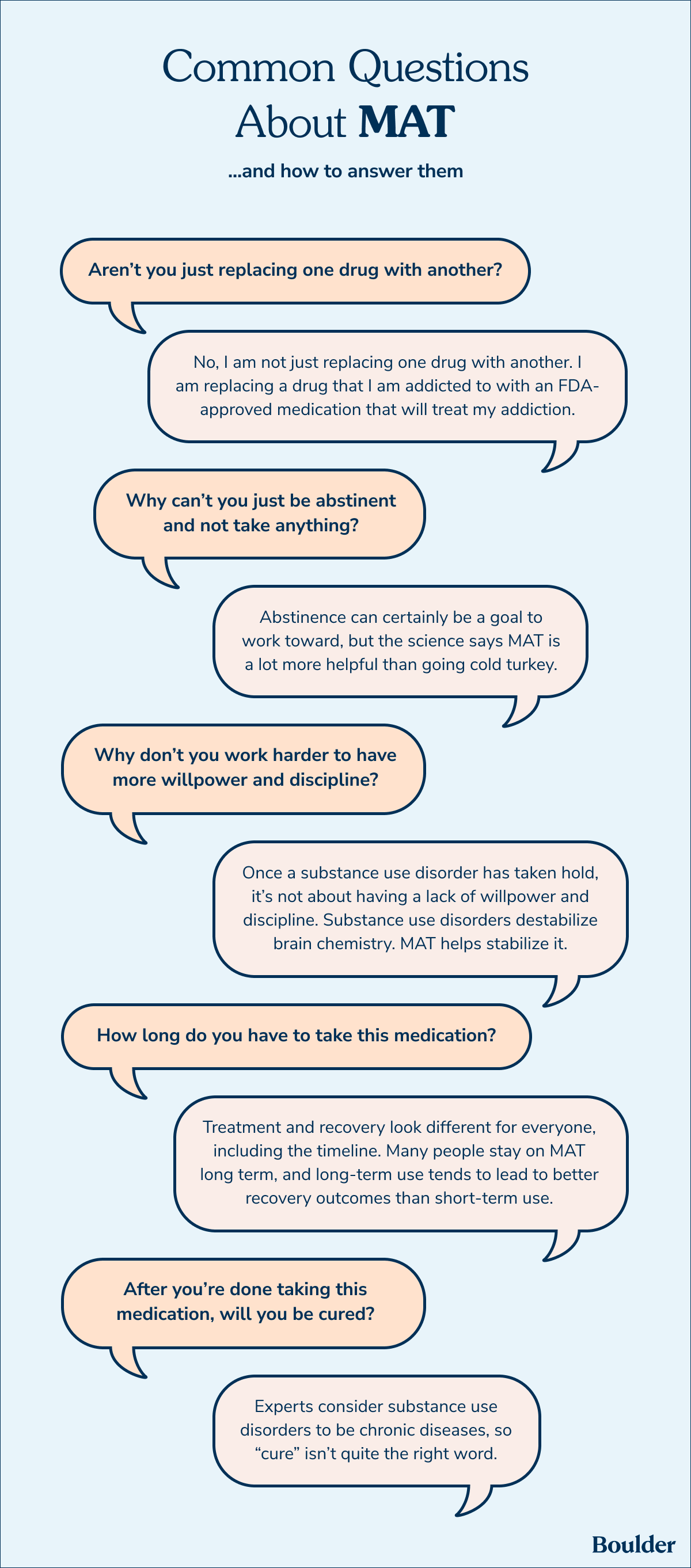
Short answer: No, I am not just replacing one drug with another. I am replacing a drug that I am addicted to with an FDA-approved medication that will treat my addiction.
More context: addiction vs. physical dependence
Yes, I am (or will be) physically dependent on the FDA-approved medication because suddenly stopping it will lead to withdrawal symptoms. But I am not (or will not be) “addicted” to it.
Addiction is different from physical dependence on a medication. For example, people with depression commonly take an antidepressant, which leads to physical dependence in that their body will rely on it after adapting to it. However, antidepressants, when taken as directed, are not “addictive.”
The same is true for medications for opioid use disorder. My body has adapted (or will adapt) to taking the medication, which is designed to help stabilize my brain chemistry. The medication won’t get me “high” or sedate me. And once I become more stable and the cravings stop, I’ll have an easier time engaging in all the other aspects of recovery.
Short answer: Once a substance use disorder has taken hold, it’s not about having a lack of willpower and discipline. Substance use disorders destabilize brain chemistry. MOUD helps stabilize it.
More context: Is addiction a disease or a choice?
My brain has come to rely on opioids. They have changed my motivation and reward pathways and my neurotransmitters and their receptors. Without the opioids in my system, I go through debilitating withdrawal symptoms.
Early on, I chose to use an opioid. But my use quickly turned from seeking a “high” to just trying to stave off feeling sick from withdrawal because of these changes to my brain chemistry. These changes are why experts now classify addiction as a disease. I am now choosing to treat this disease by choosing the most evidence-based option for recovery.
Withdrawal symptoms put me in “survival mode.” As a simple example, we’re hardwired to drink water for survival. If you try to go without fluids, your body will react in every possible way to get you to hydrate yourself for safety reasons, and it does so by causing illness symptoms as an alarm.
When I’m in survival mode, with my body and brain sending out alarms to seek more opioids, I can’t focus on the other aspects of recovery, including therapy.
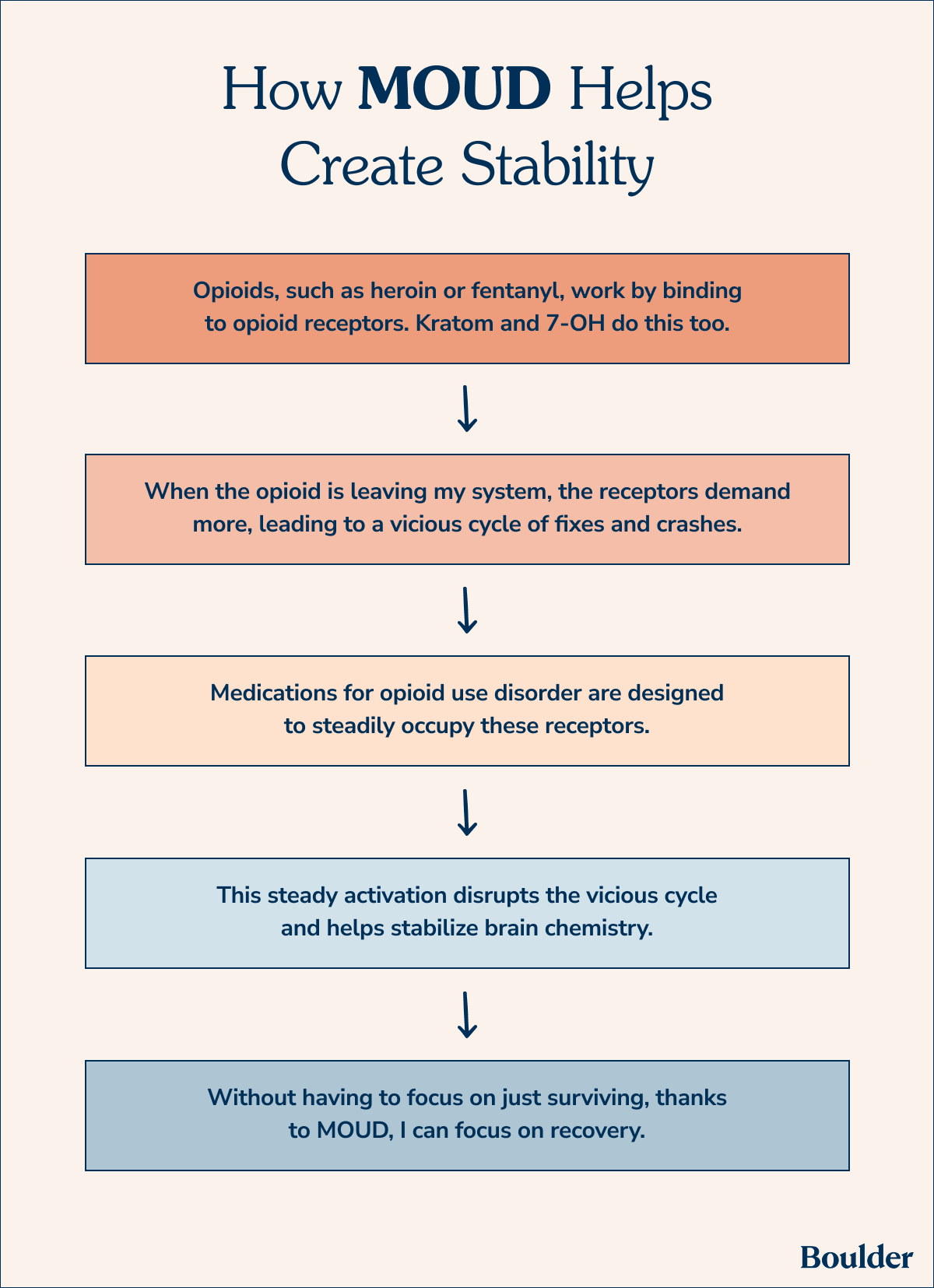
Opioids, such as heroin or fentanyl, work by binding to opioid receptors. When the opioid is leaving my system, the receptors demand more, leading to a vicious cycle of fixes and crashes. Kratom and 7-OH, while not technically opioids, bind to the same receptors in the brain, creating opioid-like effects.
Medications for opioid use disorder are designed to steadily occupy these receptors, either partially or fully, depending on the specific medication. This steady activation disrupts the cycle and stabilizes my brain chemistry. With my medication, I can focus on recovery, instead of merely surviving.
Short answer: Abstinence can certainly be a goal to work toward, but the science says MAT is a lot more helpful than going cold turkey.
More context: evidence-based addiction treatment
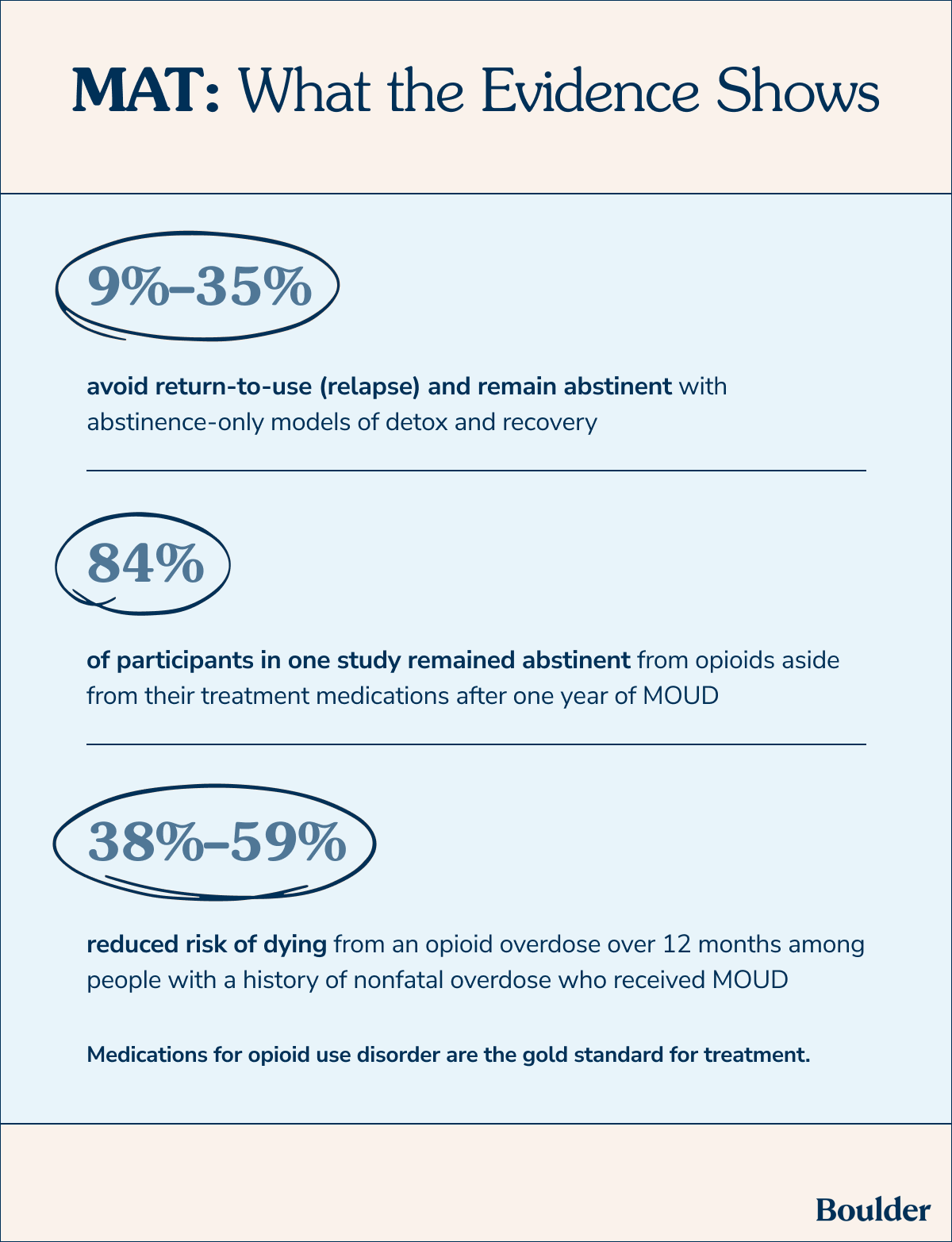
Abstinence-only models of detox and recovery have a 65% to 91% return-to-use (relapse) rate. By comparison, one study found that 84% of participants enrolled in a MOUD program for a year were able to stay off opioids aside from their treatment medications. In other words, people who tried MOUD instead of abstinence-only methods were better at staying off opioids overall.
Although I won’t be abstinent from my medication to treat opioid use disorder, the goal of taking it is to be abstinent (or reduce use) of the stronger or illicit opioids that keep me locked in a cycle of addiction. I want to set myself up for success by using MOUD. Additionally, MOUD can save lives.
In one study, people with a history of nonfatal overdose who received MOUD had a 38% to 59% reduced risk of dying from an opioid overdose over 12 months, when compared with those who did not receive MOUD.
Short answer: Treatment and recovery look different for everyone, including the timeline. Many people stay on MOUD long term, and long-term use tends to lead to better recovery outcomes than short-term use.
More context: taking recovery one day at a time
I am working carefully with my clinical provider to make the best decisions for me. But depending on how my recovery progresses, the amount of medication I need could change. That’s why I can’t give you an exact answer right now. However, I’ll probably be on MOUD for the foreseeable future to keep myself safe and healthy so I can focus on recovery.
Short answer: Experts consider substance use disorders to be chronic diseases, so “cure” isn’t the right word.
More context: substance use disorder as a chronic disease
Chronic conditions, such as asthma, migraine, and rheumatoid arthritis, don’t have a cure. Instead, the focus shifts from curing to treating and managing the condition.
Likewise, substance use disorders are lifelong conditions. But a person with a substance use disorder can be in “long-term recovery” or even considered “in remission.”
Treatment for chronic conditions — again, think of migraine — looks a little different for each person depending on their symptoms and other factors. Treatment for substance use disorder operates in the same way. I’m opting to use MOUD as a treatment strategy. I may be on MOUD long term, just as someone takes a preventive medicine for migraines long term.
Short answer: Yes, I am working closely with my care team, which includes a prescribing clinician and other medical professionals who understand the complexities of recovery and how MAT works.
Hopefully, arming yourself with answers to the common questions above can help you explain to loved ones why you’ve started (or are considering) MOUD if they are curious.
“There is still a lot of misinformation about medications for opioid use disorder,” Dr. Appa says.
She adds, “I completely understand why family members or friends want to be involved and understand what their loved one’s treatment looks like. Usually that comes from a place of caring about them and wanting to know that they’re safe and getting better. And if a loved one has concerns about a medication, I think it’s reasonable to ask questions.”
However, the decision to use MOUD belongs to you, with guidance from your recovery care team.
“Someone doesn’t need their family or friends to agree with their treatment in order to receive it,” Dr. Appa says. “Ultimately, this is a medical decision between a patient and their healthcare provider. My hope is always that we can bring loved ones along, but their understanding and support shouldn’t be a prerequisite for someone getting effective treatment.”
If you’re considering MOUD, Boulder Care can help. Boulder Care offers online substance use treatment with MAT options and telehealth addiction therapy. You can call 503-445-3528 to talk to a Boulder Care team member and learn more.
Care is delivered via a secure app, and you’ll work with a dedicated team of addiction medicine specialists and people with lived experience of recovery.
Your care team will work together to build a treatment and recovery plan that’s tailored to your unique needs. Enroll in the app now.
At Boulder Care, we’re committed to providing clear, evidence-based information about opioid and alcohol use disorder recovery. Learn more about our editorial standards and medical review process.

Our mission is to improve the lives of people with substance use disorders. We provide medication, resources, and support to help our patients succeed on their own terms, wherever they are.
Now covered by Medicaid in Oregon and Washington – Schedule an online visit.