Published:
July 1, 2026
|
Last Updated:
June 30, 2026

What Are Harm Reduction Strategies and How Do They Improve Safety?

Illustrated icons of harm reduction tools (hand-washing, band-aid, seat belt, face mask)

Key Takeaways

  • Harm reduction is all about reducing risk and improving health and safety for people who use drugs.
  • Harm reduction strategies include naloxone (Narcan), syringe services, drug checking, safer use planning, and more.
  • Evidence shows that many harm reduction strategies improve safety, including reduced overdose and infection.
  • Harm reduction works alongside treatment or recovery goals.
  • Harm reduction isn’t linked to an increase in substance use.

The experience of using substances (or drugs) is different for everyone, and everyone deserves the chance to be safe while doing so.

Harm reduction is an evidence-based set of strategies that considers drug use to be morally neutral, respects autonomy, and focuses on improving health and safety unconditionally.

Let's be clear, it's not about encouraging drug use, but when people who use drugs are cared for, they are more likely to one day seek treatment. As stated by Maia Szalavitz in reporting by The New York Times, "Most people recover from addiction. But no one recovers from death."

And, as a 2025 review in the Harm Reduction Journal puts it: “The harm reduction model centers the people who use substances as experts in what positive change may look like, with the goal of improving health and wellbeing overall.” It's a different approach from focusing on abstinence that honors the complex reality of lived experience.

Below, you'll find all the information you need about harm reduction techniques, from what they are to how to find support resources.

Our program is based on your goals, not our rules.
Whether you want to reduce use or stop altogether, your care team has your back.
Learn more about Boulder

What is harm reduction?

Harm reduction is a public health approach that supports people in reducing the risks of drug use without requiring them to stop using completely.

Harm reduction strategies can include naloxone, syringe services, drug checking, safer use planning, medications for opioid use disorder (MOUD), and support that meets people where they are.

What are the core principles of harm reduction?

The key values of harm reduction emphasize that people who use drugs deserve care and support, non-judgment, and dignity. The goal of harm reduction is to improve health and safety without pushing abstinence as the only option.

According to the National Harm Reduction Coalition, Johns Hopkins University, and the Recovery Research Institute, harm reduction means: 

Non-judgemental / non-coercive: Not placing moral judgement on people who use, or requiring cessation or treatment as a condition for receiving support or life-saving resources

Dignity and respect: Honoring the rights and autonomy of people who use drugs and focusing on compassionate care without denigrating the behavior.

Safety and evidence: Focus is on evidence-based care strategies that keep people safe and healthy while managing risk. and manage risk, regardless of how often they use drugs

Inclusion: Working alongside people with lived experience to create the best policies, while acknowledging that people who use substances come from a variety of races, genders and socioeconomic statuses. 

Opposing stigma: Accepting that drug use is often a reality in this world that begins for a wide variety of reasons. Care should reduce shame around substance use, without directly encouraging it.

Who can benefit from harm reduction?

Harm reduction strategies and education can help everyone, from people who use drugs to healthcare professionals. Learning more about harm reduction can benefit

  • People who aren't ready to stop using
  • People trying to reduce their use
  • People in recovery who want overdose prevention tools
  • Family members of people who use substances
  • Healthcare professionals
  • Communities trying to reduce deaths and disease

What are the most common harm reduction programs and tools?

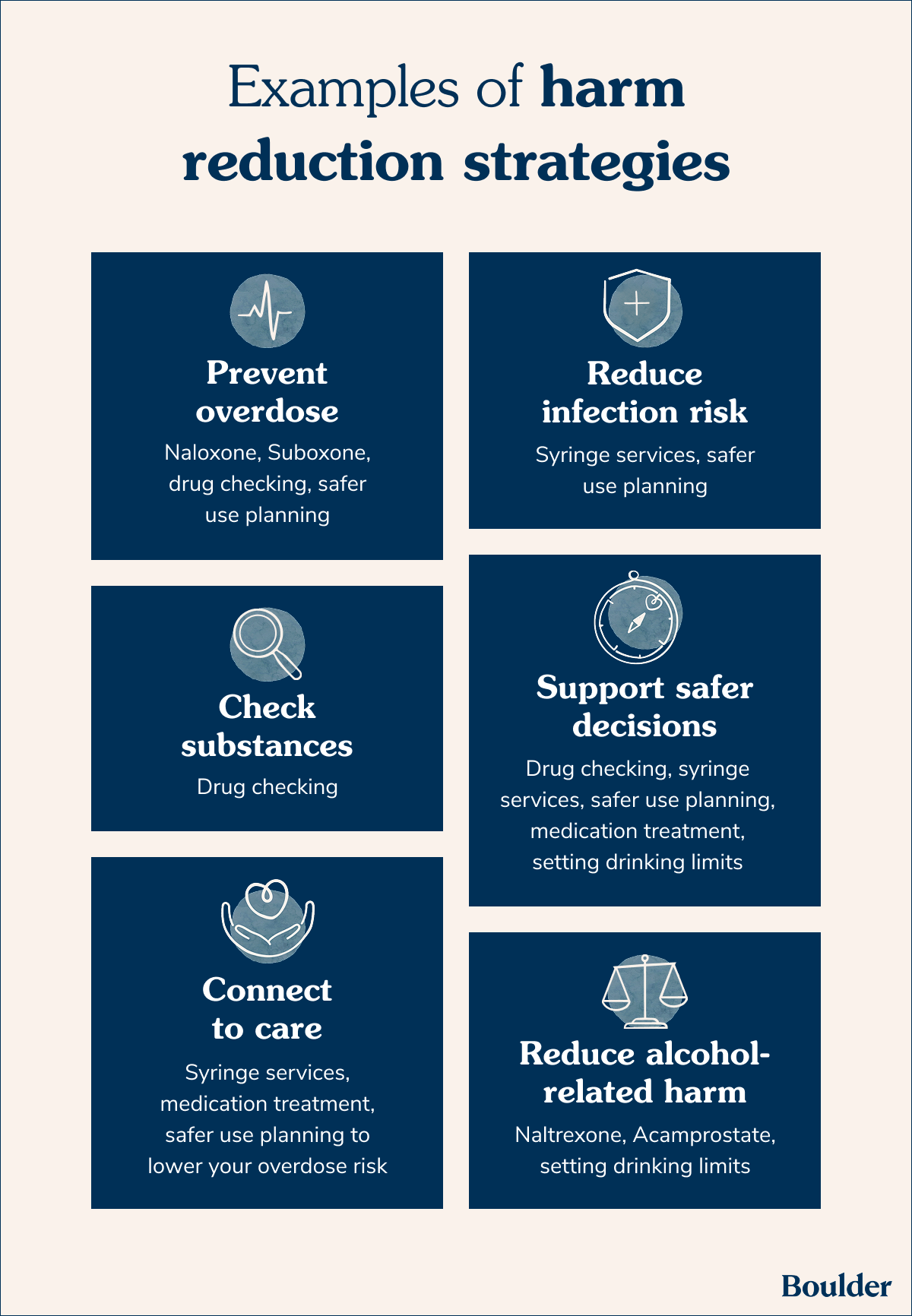
Examples of harm reduction programs and tools include naloxone distribution, medication for treating opioid use disorder and alcohol use disorder, syringe services programs, drug checking tests, and more. 

Prevent overdose: Naloxone, Suboxone, drug checking, safer use planning, 

Reduce infection risk: Syringe services, safer use planning

Check substances: Drug checking

Support safer decisions: Drug checking, syringe services, safer use planning, medication treatment, setting drinking limits

Connect to care:  Syringe services, medication treatment, safer use planning

Reduce alcohol-related harm: Naltrexone, Acamprostate, setting drinking limits

Naloxone distribution

Naloxone is a medication that can reverse an opioid overdose. In fact, it can restore someone’s breathing back to normal in just two to three minutes of use. “When it comes to people using opioids like fentanyl, one of the most important offerings is Naloxone — trade name Narcan,” says Dr. Stephen Martin, an addiction medicine physician at Boulder Care.

It’s available as both a nasal spray and an injectable medication — easy to carry around and could be compared to an epi-pen. Plus, it’s available over the counter in every state, at community-based naloxone programs, and at many syringe service programs. 

Dan Bigg, a harm-reduction advocate and co-founder of the Chicago Recovery Alliance, pushed for Naloxone use starting in the 1990s. “He took the revolutionary step then — one that has become routine now — of making this medication available to anyone who needed it,” says Dr. Martin. “That action has saved countless lives and contributed to the harm reduction movement.”

Medication treatment for opioid and alcohol use disorder

A harm reduction approach can also include medications for opioid use disorder and alcohol use disorder.

These medications include buprenorphine (commonly prescribed in the form of Suboxone), methadone, naltrexone, and acamprosate — all approved by the Food and Drug Administration (FDA). 

Buprenorphine

Buprenorphine is a medication approved for treating opioid use disorder. It can lower your feelings of physical dependency to opioids, reduce your risk of misuse, and improve your safety if you overdose. Suboxone contains buprenorphine and naloxone, helping with cravings and overdose risk. 

Methadone

Then there’s methadone, which can also reduce your dependency — both physically and psychologically — on opioids.

Naltrexone

Naltrexone is unique in that it’s FDA-approved for treating opioid use disorder and alcohol use disorder. It blocks the effects of these substances, minimizing your desire to take them. 

Acamprostate

Acamprostate is approved for treating alcohol use disorder. It helps reduce your alcohol cravings, often leading to a decrease in heavy drinking or engaging in abstinence. 

Medication can work toward your specific goals, whether that’s reducing your use, minimizing risks, or stopping all use. They are each available with a prescription from your provider. 

Syringe services programs (SSPs)

SSPs are a type of community-based prevention program that provide people with everything from clean needles to HIV testing. Services at an SSP include: 

  • Access and disposal of sterile syringes and injection equipment
  • Linkage to substance use disorder treatment
  • Naloxone distribution 
  • Vaccination, testing, and linkage to treatment for infectious diseases, including HIV and hepatitis B and C
  • Education about overdose prevention and safer injection practices
  • Abscess and wound care
  • Social, mental health, and other medical services referral 

Notably, SSPs have been associated with cutting HIV and hepatitis C incidences in about half. 

“People who inject drugs benefit from safe syringe supplies and people who smoke drugs can obtain safe smoking supplies,” says Dr. Martin. “Many states also allow for syringes and needles to be purchased without a prescription.” 

Supervised consumption sites

Another harm reduction strategy comes in the form of supervised consumption sites, also known as overdose prevention centers. These sites provide a safe space for someone to use their own drugs in the presence of trained individuals — no drugs are provided at these centers. 

These sites can reduce the risk of accidental overdose and the spread of infectious diseases. They can also provide: 

  • Clean drug use equipment and disposal
  • Testing of drugs for harmful substances
  • Wound care
  • Emergency care
  • Education 
  • MOUD
  • Referrals to social services and drug treatment

Supervised consumption sites are not very common yet in the United States. Rhode Island was the first state to authorize a site, opening the center in 2024. New York City also has two overdose prevention centers.

While these centers are legally run on a state level, they remain federally illegal due to 21 U.S.C. Section 856. The statute says it’s unlawful to “knowingly open, lease, rent, use, or maintain any place, whether permanently or temporarily, for the purpose of manufacturing, distributing, or using any controlled substance,” among other points.

States like Vermont have also pushed to open supervised consumption sites. 

However, over 100 sites are now available for use across 11 countries worldwide. In Canada, for instance, there are more than 30 supervised consumption sites available throughout its provinces. 

Drug checking tools (fentanyl and xylazine test strips)

Knowing what’s in your drugs is a critical part of harm reduction. Substances like fentanyl and xylazine now have tailored test strips available.

These portable tests give you the power to know if your drugs have either substance in them. You can follow step-by-step guides (for example this one) to use fentanyl test strips or xylazine test strips. 

You can use fentanyl test strips to test pills, powders, and injectable substances. 

It's important to remember that while test strips are helpful, they're not foolproof. You shouldn't rely on test strips alone to keep you safe while using drugs.

As of December 2023, fentanyl test strips are legal in 45 states across the country and Washington D.C. The only states where these tests are illegal are Idaho, Iowa, Indiana, North Dakota, and Texas. 

Safer use planning

Harm reduction can also mean taking critical steps to lower your overdose risk. If you choose to use substances then keep these safer choices in mind:

  • Carry naloxone
  • Avoid using alone
  • Test drugs when possible
  • Start with using a smaller amount
  • Have a safety plan in case of an overdose
Get the medication you need, and the support you deserve.
We provide FDA-approved medications for alcohol and opioid addiction — and support services to help you stay on track and reach your recovery goals.
Learn more about our services

Harm reduction strategies by substance

It can also help to think about harm reduction techniques based on which substances you use. Here’s what to keep in mind for harm reduction based on the substance. 

Opioids

Harm reduction strategies for opioids are critical for preventing fatal overdoses. Awareness around fentanyl contamination is a significant part of this, as it has a potency about 100 times that of morphine. 

With that in mind, steps include:

  • Carrying naloxone
  • Never using alone
  • Testing opioids with fentanyl and xylazine test strips
  • Listening to your body, such as hydrating, eating and resting
  • Snorting or smoking instead of injecting substances
  • Going slow and using less

These strategies can make a significant difference in reducing your risks while using opioids. 

Alcohol

Like opioids, alcohol treatment often comes with the caveat that total abstinence is necessary for success. Yet, harm reduction methods can help you seek care and support even if you don’t want to fully abstain.

Harm reduction research has shown that lowering the amount you drink can lead to benefits like improved mental health, blood pressure, and liver function. 

Alcohol harm reduction strategies include:

  • Drinking in a safe place
  • Eating 
  • Drinking water
  • Spacing drinks
  • Counting drinks 
  • Not mixing with other substances

FDA-approved medications like naltrexone or acamprostate can also help reduce risks by minimizing alcohol cravings.

Stimulants

Stimulants include legal prescriptions like amphetamine, Adderall, and Ritalin, along with illicit substances like methamphetamine and cocaine.

Stimulants have fewer pharmacological harm reduction tools than opioids, meaning behavioral and social strategies are all the more critical for keeping you safe. 

Harm reduction strategies for stimulant use include:

  • Testing of drugs for harmful substances
  • Carrying naloxone 
  • Providing education on overdose prevention 
  • Offering safe spaces and support for basic needs
  • Testing for viruses like HIV

Other substances and situations

You can implement harm reduction strategies across so many substances and situations like cannabis, substance use, synthetic drugs like MDMA and more. The key is to understand the risks, reduce the most serious harms first, and find support.  

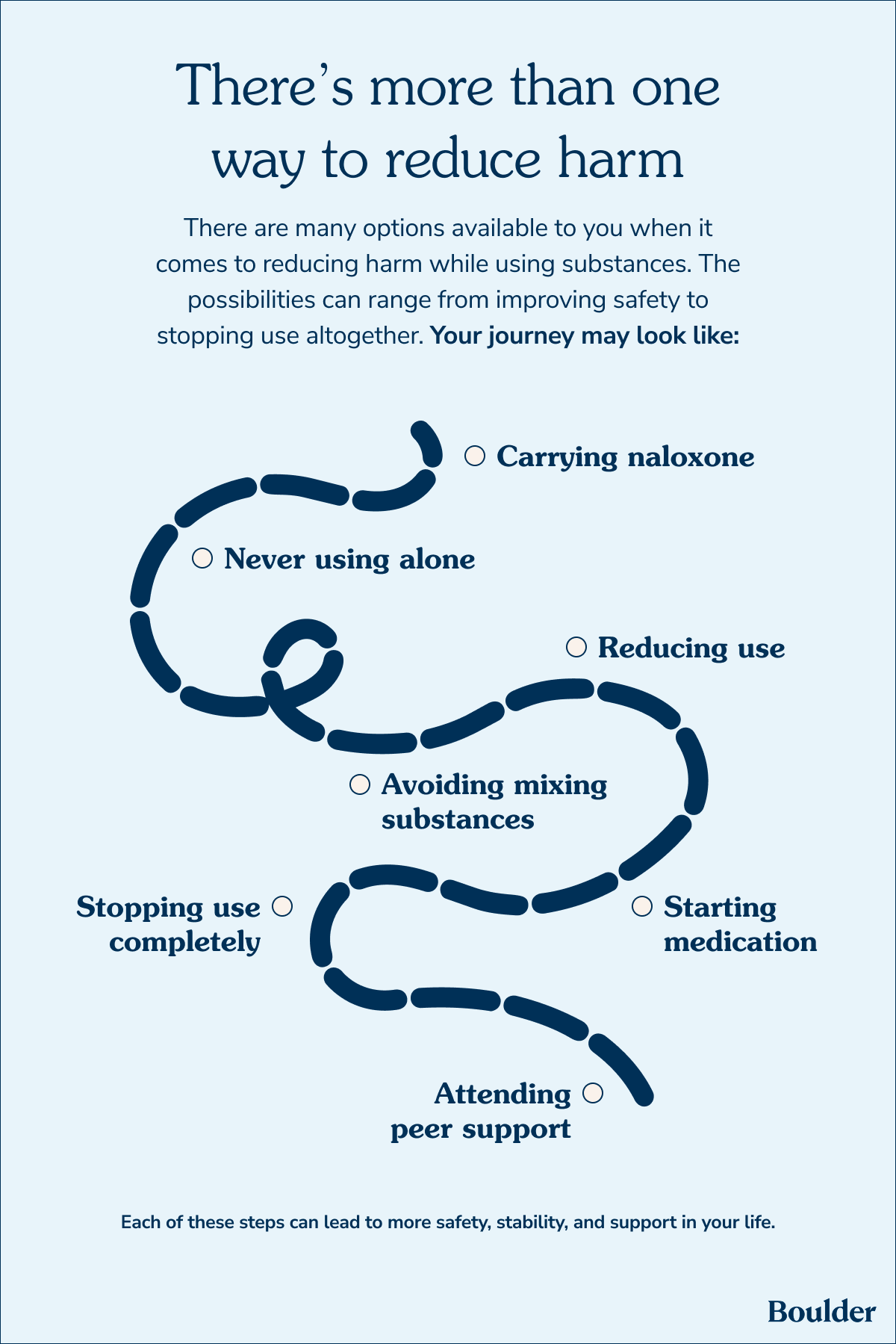
There are so many options available to you when it comes to reducing harm with substance use. Your goal can range from improving your safety to stopping use altogether. Along the way that may look like:

  • Carrying naloxone
  • Never using alone
  • Avoiding mixing substances
  • Reducing use
  • Starting medication 
  • Attending peer support
  • Stopping use completely

Each of these steps can lead to more safety, stability, and support in your life. 

Does harm reduction enable drug use? Addressing the most common criticism

No, harm reduction doesn’t enable drug use, but it offers protections for people who choose to use drugs, whatever their reasoning. Harm reduction may not make substance use risk-free, but it doesn’t ignore these harms either. It also keeps the door open to treatment and recovery.

“Decades of experience and research have found that harm reduction does not enable drug use,” says Dr. Martin. “Instead, it supports existing use — making it safer and less harmful by reducing overdoses and infections.” 

A body of harm reduction research supports the idea that it doesn’t enable drug use. For instance, studies have shown that using fentanyl testing strips correlates with safer drug use, including asking someone to check on them, using a lower quantity, and doing a tester shot. 

The results are also positive when looking at research on SSPs. These programs have been linked to an increase in entering substance use treatment, even starting buprenorphine treatment at the SSP.

Similarly, research has shown that naloxone isn’t linked to an increase in opioid use or overdose. 

Researchers have also looked at community safety rates in response to harm reduction strategies. For instance, a study looked at arrest reports, criminal court summonses, 911 calls, and 311 calls in the area following New York City’s opening of two overdose prevention centers. There was no significant change in any of these factors.

Yes, some individuals believe abstinence is the only ethical and safe option if you use substances. The debate around this is challenging and reflects real value differences when it comes to public health, understanding risk, individual responsibility, and community safety.

Myth What evidence suggests
Harm reduction encourages drug use Research shows harm reduction can actually reduce drug use.
Harm reduction and recovery are opposites You can use harm reduction strategies alongside treatment or recovery goals.
Harm reduction makes substance use safe Substance use still comes with risk, but harm reduction strategies can reduce that risk.
Harm reduction removes rules and accountability Harm reduction focuses on minimizing risks, safety, well-being, and personal goals.

What does the evidence say about harm reduction outcomes?

Critically, research has also found that harm reduction can bring safer outcomes that improve quality of life. As we mentioned above, one of the ways is through connecting you to MOUD treatment, which offers benefits for reducing overdose risk, minimizing use, or stopping substance use altogether — it all depends on your individual goal. 

On top of that, harm reduction has been linked to a decrease in:

“Anyone working with people who use drugs knows how both the ethic and practice of harm reduction are invaluable,” says Dr. Martin. “The increased safety and sense of solidarity provided by harm reduction helps so many people  in their day to day lives. People live better, safer lives because of harm reduction.” 

How does harm reduction differ from abstinence-based treatment?

There’s one key difference between abstinence-based treatment and harm reduction: Abstinence requires a person to stop using drugs completely. This form of treatment characterizes success as fully stopping the use of the substance.

In contrast, harm reduction’s success is about improving someone’s health, safety, and overall well-being, even if they’re still using drugs.

“Abstinence-based treatment takes the approach that no use should happen and thus does not account for ways to reduce harm,” says Dr. Martin. “People who are using drugs may have a goal of abstinence. In this case, harm reduction helps to keep them safe in the meantime.” 

Is harm reduction the same as treatment?

The short answer is no. As we’ve discussed, harm reduction tools might act as a step toward treatment. This might be through care while taking a medication like Suboxone, or by starting treatment at a SSP. 

But, critically, harm reduction is not only a step toward treatment. Harm reduction might be a long-term approach for you, and that is just fine. Reducing your risks while using substances is a success.

Boulder Care’s mission sits at the intersection of the benefits of harm reduction and treatment. We want to help you do what’s best for you. Our mixed offerings include peer support, clinical care, medication and more.

How to find harm reduction programs near you

Understanding how to find harm reduction programs — both in your area and virtually — can help you greatly reduce your risks while using substances. Below, we break down types of programs and what to expect when visiting a harm reduction center.

Types of programs and where to find them

Harm reduction programs exist across a number of spaces. You might find them in places such as:

  • Federal or state health centers
  • Community health centers
  • Syringe services programs (SSPs)
  • Pharmacies
  • Telehealth providers

Resources like the confidential and anonymous FindTreatment.gov are available to help you locate harm reduction centers near you. Local and state health departments also have resources on harm reduction tools and where to get support.

Similarly, there’s the North American Syringe Exchange Network (NASEN), which shows the location of over 580 SSPs across the country. You can search for options such as fentanyl test strips, LGBTQ services, naloxone distribution, and STI testing. 

Another resource is Never Use Alone, the country’s national overdose prevention line. You can call any time or day and speak to an operator with lived experience. They will take your information and contact emergency medical services if you use a substance and then stop responding. 

What to expect when you access harm reduction services

It’s understandable to be nervous about accessing harm reduction services, but these spaces should be judgment-free zones filled with people who want you to be safe and feel understood.

“Especially important is that someone accessing harm reduction services can expect an overall experience of dignity, compassion, and respect for their goals,” says Dr. Martin. “People providing harm reduction services are especially committed to the individuals they care for.” 

Each harm reduction service will be different, so it's worth reading more about the specific location you intend to visit to feel more prepared.  You can also give them a call to run through what the process will be like, along with what you might need to bring with you. 

Doing your research can also help lower any costs. For instance, the cost of naloxone often starts at more than $40, but many community programs offer it for free. 

How telehealth can support harm reduction and treatment access

Accessing care in person can come with so many barriers like transportation, work, childcare, and limited services in your area. Telehealth can be a tremendous option for certain forms of harm reduction. You can use virtual care — like what's offered at Boulder Care — to speak with a provider, get prescriptions, and explore your options.

The bottom line

Harm reduction is all about keeping you safe, not deciding what your goals should be. It allows you to seek support and reduce risk even if you don’t want to completely stop using drugs.

Boulder Care is here to support you in exploring your options. We believe in collaborative, flexible care that works toward your goals and safety. We pride ourselves on creating a judgment-free space where you feel understood. Boulder offers on-demand care — contact us at 866-901-4860 from 8 AM to 6 PM, Monday to Friday.

Frequently Asked Questions

How can families practice harm reduction?

There are ways you can practice harm reduction if your loved one is using drugs. Families can carry naloxone, help them explore resources, accompany them to SSPs, and support them through their experience. It’s not about enabling drug use, but, instead, ensuring your loved one is as safe as they can be with the risk they’re taking. Overall, you can understand that reducing serious harm is the current goal, rather than pushing for abstinence. 

Does harm reduction mean you never have to stop using drugs?

Harm reduction isn't about encouraging or discouraging drug use. It's simply a set of strategies for those who decide to use, regardless of their longer-term goals. The ultimate goal of harm reduction is to improve safety, health, and well-being. It understands that the choice to stop using drugs is a significant one, with providers available to help you pursue it if you so choose. 

Can harm reduction work alongside recovery or sobriety goals?

Harm reduction can exist alongside recovery and sobriety goals if that’s what you want. Some harm reduction centers, like SSPs, even have treatment options available for anyone interested in pursuing them.

On-demand, online addiction care from home — on your terms.
Access our care team directly through an app on your phone.
Get started in the Boulder Care app

Editorial Policy

At Boulder Care, we’re committed to providing clear, evidence-based information about opioid and alcohol use disorder recovery. Learn more about our editorial standards and medical review process.