If you are about to start Suboxone, it's normal to wonder how much you'll take and how your dose might change over time. Suboxone dosage isn't the same for everyone. Finding the right dose is often a gradual process that involves careful adjustments to find what works best for you.
You might start at a low dose, but your prescriber may adjust it to find the right balance. This includes relieving withdrawal symptoms, controlling cravings, and preventing a return to opioid use.
"The patient’s experience is most important. When patients feel 'more themselves' or 'normal again,' that is likely the best dose," says Dr. Stephen A. Martin, MD, medical director for research, education, and quality at Boulder Care.
"If patients have ongoing withdrawal symptoms or are still feeling they want to use in a chaotic way, then a dose increase can be a significant help," Dr. Martin says.
In this article, we'll explain how Suboxone dosing works, including common starting doses, how providers determine the right maintenance dose, and signs that your current dose might need reevaluation.
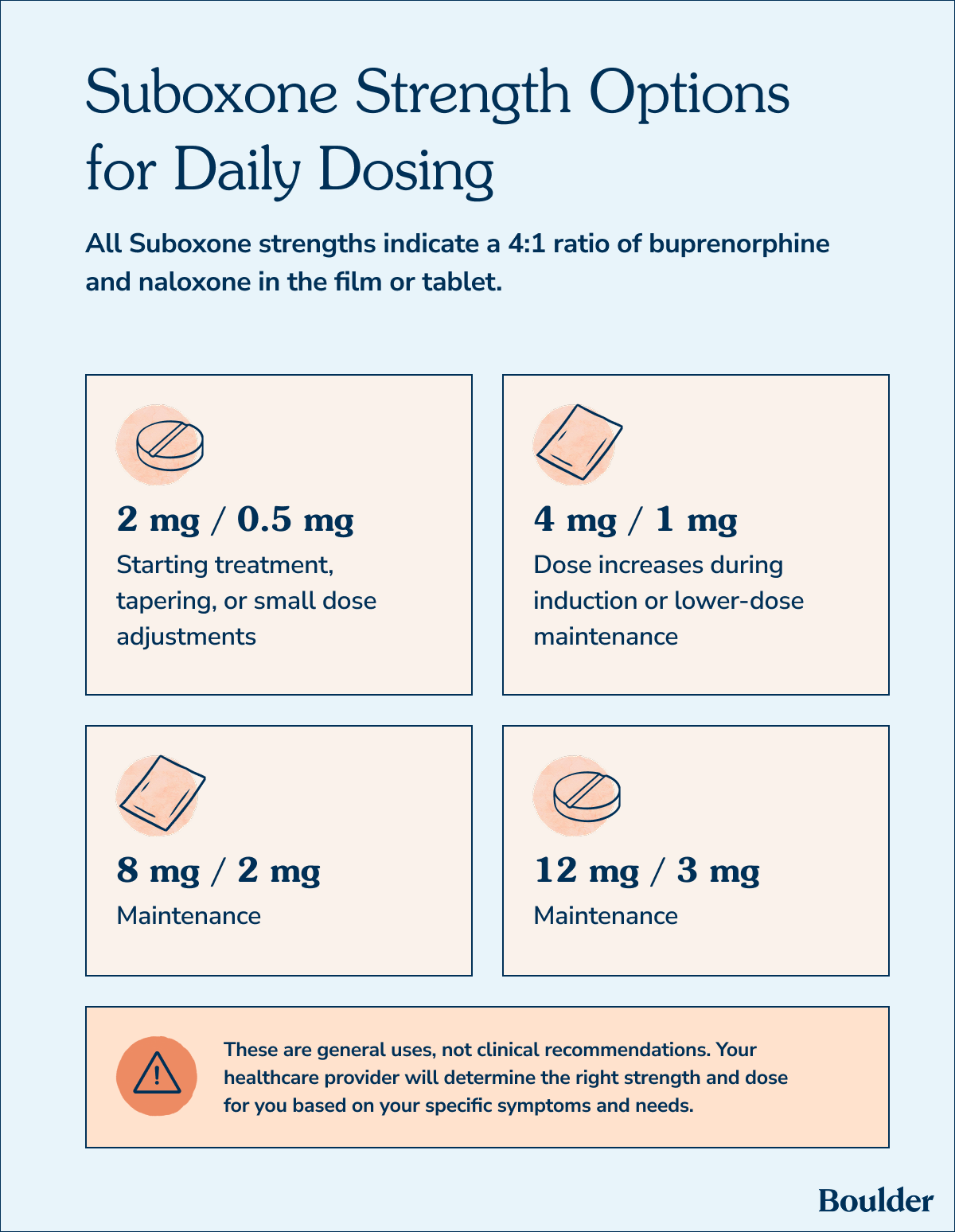
Suboxone contains two medications: buprenorphine and naloxone. Your prescription label will list both ingredients in a format such as 8 mg / 2 mg, meaning the film contains 8 milligrams of buprenorphine and 2 milligrams of naloxone. Buprenorphine is the active ingredient, so it's what helps control withdrawal symptoms and opioid cravings.
Sublingual films come in four Suboxone strengths listed in the medication guide:
Naloxone is included to discourage misuse. When Suboxone is taken as prescribed under the tongue, very little naloxone is absorbed. If injected, the naloxone becomes more active and may cause precipitated withdrawal if someone is physically dependent on opioids. That's why it's important to only take Suboxone as prescribed.

According to the the Substance Abuse and Mental Health Services Administration (SAMHSA), when it comes to Suboxone dosing, there's no one-size-fits-all approach, and it usually changes over time.
The dose that's right for you when you start treatment is often different from the dose you need during maintenance. Adjustments are a normal part of treatment. Making these changes helps keep withdrawal symptoms and cravings under control, while keeping side effects of Suboxone to a minimum.
Talking to your provider about how you're feeling is key to finding what’s right for you, but that’s not always easy. "It took time to figure out what worked best for me, and if I'm being honest, stigma often kept me from having open conversations about what I was experiencing or what I needed,” says Danielle Bellosi, a peer recovery supervisor at Boulder Care.
That’s why Bellosi encourages people to talk openly with their care team. "You don't have to have all the answers, and you don't have to figure it out by yourself," she says. "Recovery is a process, and finding the right dose is simply one part of that journey."
Buprenorphine treatment typically progresses through induction, stabilization, and maintenance, with dose adjustments along the way based on how a person responds, according to SAMHSA. The Suboxone dosage chart below provides a general overview of what dosing can look like at each phase.
The process of actually starting Suboxone is called induction. Typically, you'll start with a low dose because the goal is to safely relieve your symptoms while monitoring your body's response to make adjustments as needed.
Oftentimes, you'll take your first dose after you've already started to experience moderate opioid withdrawal symptoms because starting Suboxone before moderate withdrawal has developed can trigger precipitated withdrawal.
However, another induction method is available that allows you to start at a lower dose without first being in moderate withdrawal.
The stabilization phase is all about finding the dose that works consistently for you.
Being stabilized means you can go about your daily life without feeling sick from withdrawal symptoms, thinking about opioids, or experiencing unmanageable side effects from the medication.
Maintenance is the phase that starts once you've found the dose that works for you. This stage isn't just a temporary step that inevitably leads to tapering off Suboxone.
In fact, the Journal of Addiction Medicine states that long-term treatment with buprenorphine can improve outcomes and lower the risk of return to use and overdose.
Some people eventually decide to reduce or stop Suboxone, but tapering should always be done gradually and with medical supervision.
Stopping abruptly can be uncomfortable and lead to Suboxone withdrawal, increasing the risk of returning to opioid use.
It might seem like taking a higher dose of Suboxone would produce stronger effects, but that's not always the case. Buprenorphine has a ceiling effect on respiratory depression, making it safer than full opioid agonists.
Although increasing the dose beyond a certain point tends to have diminishing effects, some people continue to experience improvements in cravings and withdrawal symptoms at higher doses.
The goal isn't to prescribe a standard dose, but to find the dose that works best to control cravings and withdrawal with the fewest side effects.
Dr. Martin notes that people who primarily use fentanyl often require higher doses of Suboxone than people treated for dependence on prescription opioids since fentanyl is much more potent.
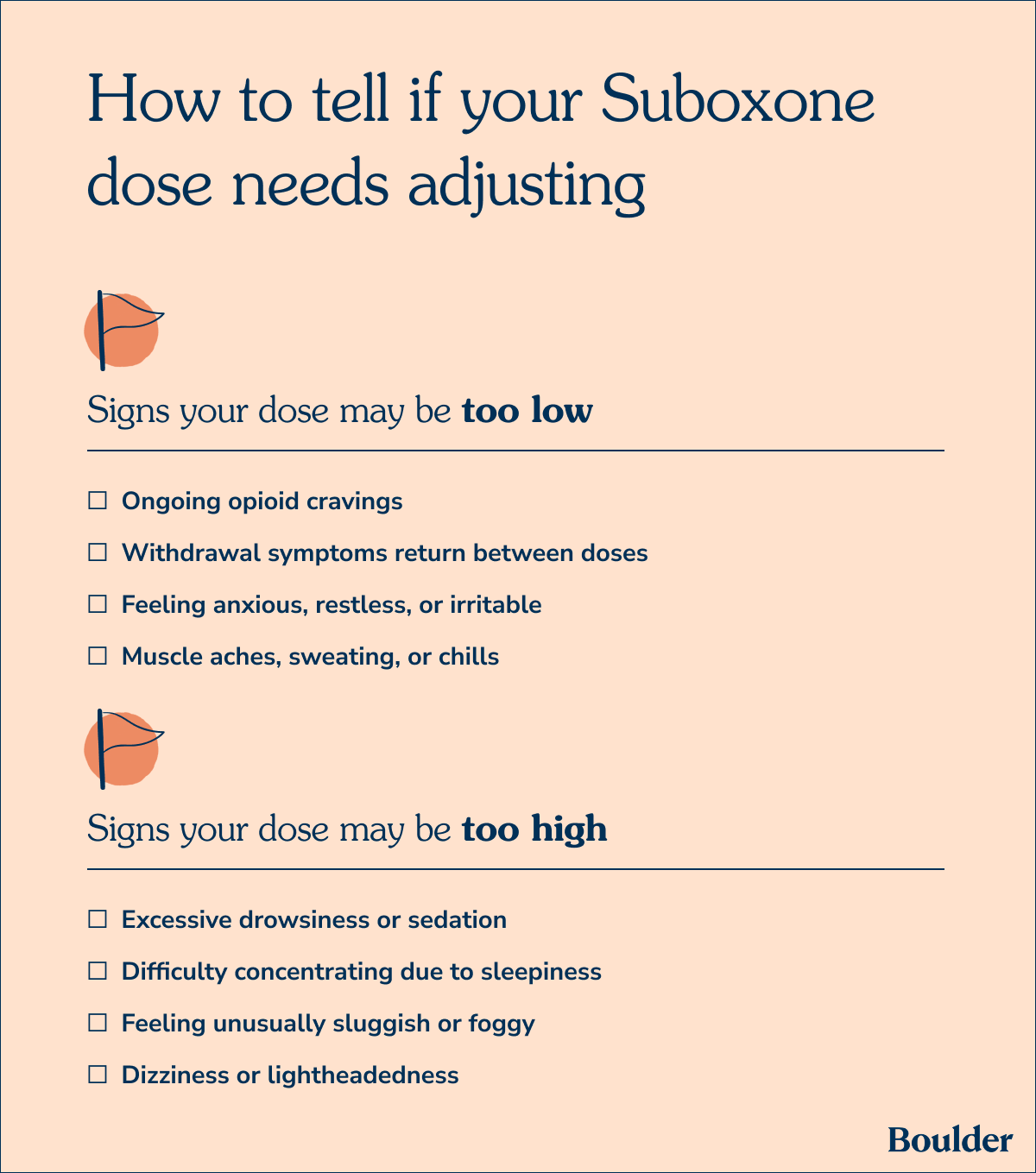
The right Suboxone dose should help control withdrawal symptoms and cravings. If you're still experiencing symptoms, it might be a sign that your dose is too low or too high and needs to be reevaluated.
"The goal for treatment that includes Suboxone is that a person feels more like themselves and is able to be in long-term recovery the way they want," Dr. Martin says. "If someone’s recovery isn’t progressing, it’s an important time to talk with their care team and try to figure out what’s getting in the way."
These symptoms may have causes other than Suboxone, so your provider can evaluate your overall health and any other medications you're taking before deciding whether to change your dose.
Always tell your provider about your symptoms before you make any changes to your medication.
Buprenorphine stays active in the body for a long time, which means people can often get steady symptom relief taking it once a day. However, there are situations where splitting the dose might make more sense.
"Each patient figures out a daily frequency that works best for them," says Dr. Martin. For some people, that means taking Suboxone once a day, while others do better with two or even three doses each day. Split dosing may also help people using Suboxone to manage chronic pain.
If once-daily dosing keeps your withdrawal at bay, there's usually no need to change it. But if symptoms return before your next dose, talk to your provider about whether split-dosing might be a better fit for you.
But the reality is that adjusting your dose is a routine, expected part of treatment. Dr. Martin compares it to treating other medical conditions. Just as someone may need a certain dose of antibiotics or supplemental oxygen to recover, taking less medication than your body needs isn't helpful and can even be harmful.
Your provider expects these conversations and wants to know if you are experiencing withdrawal symptoms, cravings, or side effects so they can make adjustments as needed. "The goal isn't to get to the lowest dose as quickly as possible — it's to find the dose that helps you feel stable, healthy, and able to focus on your life," Bellosi explains.

If you don't feel comfortable talking to your current provider, it may be worth seeking additional support. At Boulder Care, clinicians collaborate with patients to make informed decisions about their medication, dosing, and recovery goals.
Call 911 immediately if someone is difficult to wake, not breathing, or unresponsive after taking opioids or Suboxone. Getting immediate medical attention can save someone's life.
Signs of an opioid overdose include:
If you think someone is overdosing, the CDC says to call 911, give them naloxone (Narcan) if you have it, and stay with them until help arrives. Naloxone can reverse an opioid overdose and is widely available without a prescription in many areas.
The right Suboxone dose isn't the same for everyone; it's the one that controls your withdrawal symptoms and cravings consistently so you are able to function normally and stick to your recovery goals. That might mean making adjustments during treatment or staying on a stable maintenance dose for months or years.
"Recovery isn't about meeting someone else's expectations or proving anything to anyone. It's about finding what supports your well-being, honoring your own journey, and moving forward at a pace that feels right for you," Bellosi says.
If you're looking for personalized guidance on Suboxone treatment, or wondering if Suboxone could be a good fit, Boulder Care can help. Call 888-422-6530 to speak with a care team member and learn more about getting started.
No, you should not take more Suboxone than directed without talking to your healthcare provider first. Continuing to experience withdrawal symptoms or cravings means your dose might need to be adjusted, but there might also be another reason why your treatment isn't working as expected. Talking with your provider is the best way to figure out whether your dose or dosing schedule needs to be changed.
Missing doses increases cravings, withdrawal, and risk of returning to opioid use. If you do miss a dose, follow your provider's instructions or the Suboxone dosing guidelines in the insert that came with your prescription. Don't take extra medicine to make up for a missed dose unless your provider tells you to. Buprenorphine stays in the body for a relatively long time, so many people won't notice symptoms right away, but others may notice cravings or withdrawal symptoms sooner.
There's no standard length of time that people stay on Suboxone. Some people take it for several months, while others use a stable maintenance dose for years. For many people, staying on buprenorphine long-term is the best way to support lasting recovery. Talk to your provider about when or if tapering is right for you, but don't feel pressured to stop taking Suboxone if it's working well for you. Bellosi emphasizes that recovery doesn't follow a single path. "Some stay on medication for years, and others eventually decide to taper. Every path is valid if it's supporting your recovery," she says.
At Boulder Care, we’re committed to providing clear, evidence-based information about opioid and alcohol use disorder recovery. Learn more about our editorial standards and medical review process.
Now covered by Medicaid in Oregon and Washington – Schedule an online visit.