Taking medication can play a big role in managing opioid addiction or dependence. If your goal is to stop using, then you might choose to take Suboxone which is approved by the Food and Drug Administration (FDA) as one of the gold-standard Medications for Opioid Use Disorder (MOUD).
So, when can you take Suboxone after using opioids? Suboxone wait times are dependent on your method and timing. There are a few ways to initiate Suboxone use, most of which are dependent on when you last used opioids.
“‘Knowing’ that you are ready for your first dose of suboxone is really dependent on your induction method,” says Eduard Breytman, FNP-C, CARN-AP, a clinician supervisor at Boulder Care. “If we are talking about mentally prepared, it really varies from person to person. The first step is seeking care, and wanting help.”
The mental aspect is also important. Stopping opioid use and starting to take Suboxone is a big change. “It's not just about how many hours have passed since your last use, but also about how your body is feeling and whether you're ready to start,” says Danielle Bellosi, a peer recovery supervisor at Boulder Care, who took Suboxone from 2009 to 2011.
This article should answer all your questions, from how long to wait before taking Suboxone, to how to prepare for your first dose.
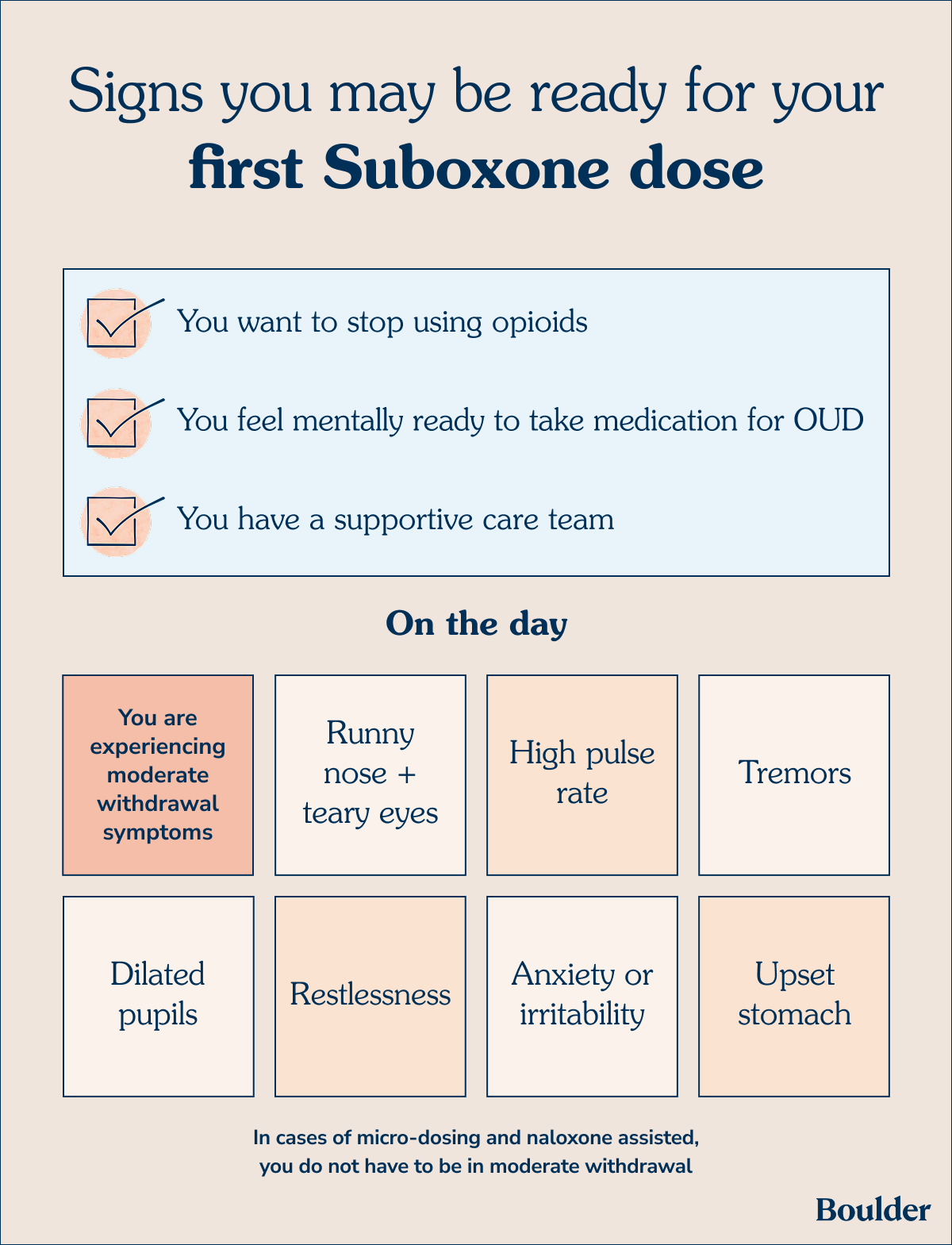
Typically, you need to be experiencing moderate withdrawal symptoms to take Suboxone.
The timeline for when moderate withdrawal symptoms occur depends on which opioids you’ve been taking.
Some opioids have an extended-release duration of action, while others are short-acting. Then there are opioids like fentanyl, which can stay in your body for longer than their effect.
It’s worth emphasizing that you don’t have to start taking Suboxone just because you’ve reached the typical minimum wait time.
Each person is different, and your signs of withdrawal — as well as mental readiness — are the best indication of when to begin.
Timing your first Suboxone dose right is critical to avoid precipitated withdrawal.
Basically, if you take Suboxone too soon, it will bind to your opioid receptors and rapidly push the opioids off of them. In response, you will experience severe, sudden withdrawal symptoms.
While a provider will do their best to prevent you from experiencing precipitated withdrawal, it can happen. These withdrawal symptoms are temporary, and you don’t have to endure them alone.
Your care team can help you manage symptoms, adjust your dose if necessary, and get you feeling more comfortable as soon as possible. With that in mind, contact your provider immediately if you experience precipitated withdrawal. Don’t take any additional medication on your own.
Knowing that you’re ready to start Suboxone involves stopping opioid use, assessing your emotional state, and thinking about your access to support.
As we just discussed, timing is critical to avoid precipitated withdrawal. “One of the most important things I learned when transitioning from opioids to Suboxone is that timing matters,” says Bellosi. “It's not just about how many hours have passed since your last use, but also about how your body is feeling and whether you're ready to start.”
Bellosi continues: “There's also the emotional side of preparing for that first dose. Someone may already be experiencing withdrawal, feeling anxious, or worrying about whether they're doing everything correctly. That uncertainty can be overwhelming.”
Then there’s the clinical side of things. Your care team can help you evaluate how taking Suboxone will fit into your life.
“Typically what we assess for in terms of readiness to start treatment includes: living situation, social support networks, access to food and water, safe environment for induction, access to pharmacy, current usage habits, last usage, and mental state,” says Breytman.
Breytman continues, “With all these various puzzle pieces put together the care team helps the person come up with a plan that will be most successful for them.”
Moderate opioid withdrawal, the threshold for starting standard Suboxone initiation, is characterized by physical and emotional symptoms such as:
Your care team will also likely use the Clinical Opiate Withdrawal Scale (COWS) when the time comes to assess your level of withdrawal.
This 11-point scale looks at symptoms such as restlessness, joint aches, and anxiety to assess how far you are into opioid withdrawal.
It provides a rating for each item and scores you as having mild, moderate, moderately severe, or severe withdrawal.
Self-report scales are also available for you to assess your withdrawal level at home.

Opioids stay in your system for different amounts of time. Ones like heroin and codeine leave your system quickly, meaning the waiting period before taking Suboxone is shorter.
In contrast, fentanyl, extended-release opioids, and newly popular substances like 7-OH might linger in your system longer, preventing you from starting Suboxone without experiencing precipitated withdrawal.
Taking Suboxone after fentanyl use requires extra consideration and caution. Fentanyl is a strange case because it’s a short-acting opioid in terms of effect, but it can stay in your body much longer than other opioids.
This occurrence is because fentanyl is very lipophilic, meaning it will stick to your tissues and fat, according to the Journal of Addiction Medicine. You might also experience something called “fentanyl rebound,” in which you feel a second peak of the substance.
Critically, you might have fentanyl in your system even if you didn’t choose to take it. Street drugs ranging from cannabis to opioids can be laced with fentanyl.
Take one 2024 study from the journal The Lancet Regional Health - Americas, which looked at nearly 12 million samples from drug reports nationwide. Researchers found fentanyl co-occurrence is about 50% for the heroin samples, and about 1.8% of the samples overall.
The National Institute on Drug Abuse (NIDA) recommends using fentanyl test strips to see if the substance is present. However, it’s possible that the sample you tested is fentanyl-free and that fentanyl is still present in other parts of the drug.
Taking Suboxone after methadone or extended-release opioids is similar to fentanyl. Long-acting opioids such as methadone, oxycodone hydrochloride, and morphine ER (extended release) can all take longer to leave the body than short-acting opioids.
This difference means that, if you’ve taken a long-acting opioid, you will have to wait longer for it to leave the body to follow the standard process of starting Suboxone. Otherwise, you can experience precipitated withdrawal.
Kratom, 7-OH, and tianeptine are “gas station” drugs that are marketed as supplements and sold in gas stations — hence the name — and convenience stores.
Despite their “supplement” label, these substances act on opioid receptors, are typically synthetic, and are not regulated by the Food and Drug Administration (FDA).
Notably, the FDA has referred to tianeptine as “gas station heroin,” with the journal Pain and Therapy explaining that the drug mimics opioids and has contributed to overdoses.
The unregulated nature of kratom, 7-OH, and tianeptine means their product strength is inconsistent. This uncertainty, combined with their risks, makes it harder to know how long they’ll last in your system. It also makes starting Suboxone after kratom, 7-OH, or tianeptine use trickier.
Suboxone has proven to be effective in managing kratom, 7-OH, and tianeptine withdrawal but knowing when to start the medication is tricky.
Each of these types of substances make the standard practice of withdrawal and starting Suboxone challenging, drawing out how long a person needs to wait until beginning the medication.
Thankfully, providers have responded to this, developing new ways to start Suboxone.
Alternative options to the standard approach exist that involve starting Suboxone on a quicker timeline. These are especially helpful in cases where you might have used fentanyl. We explain these options below.
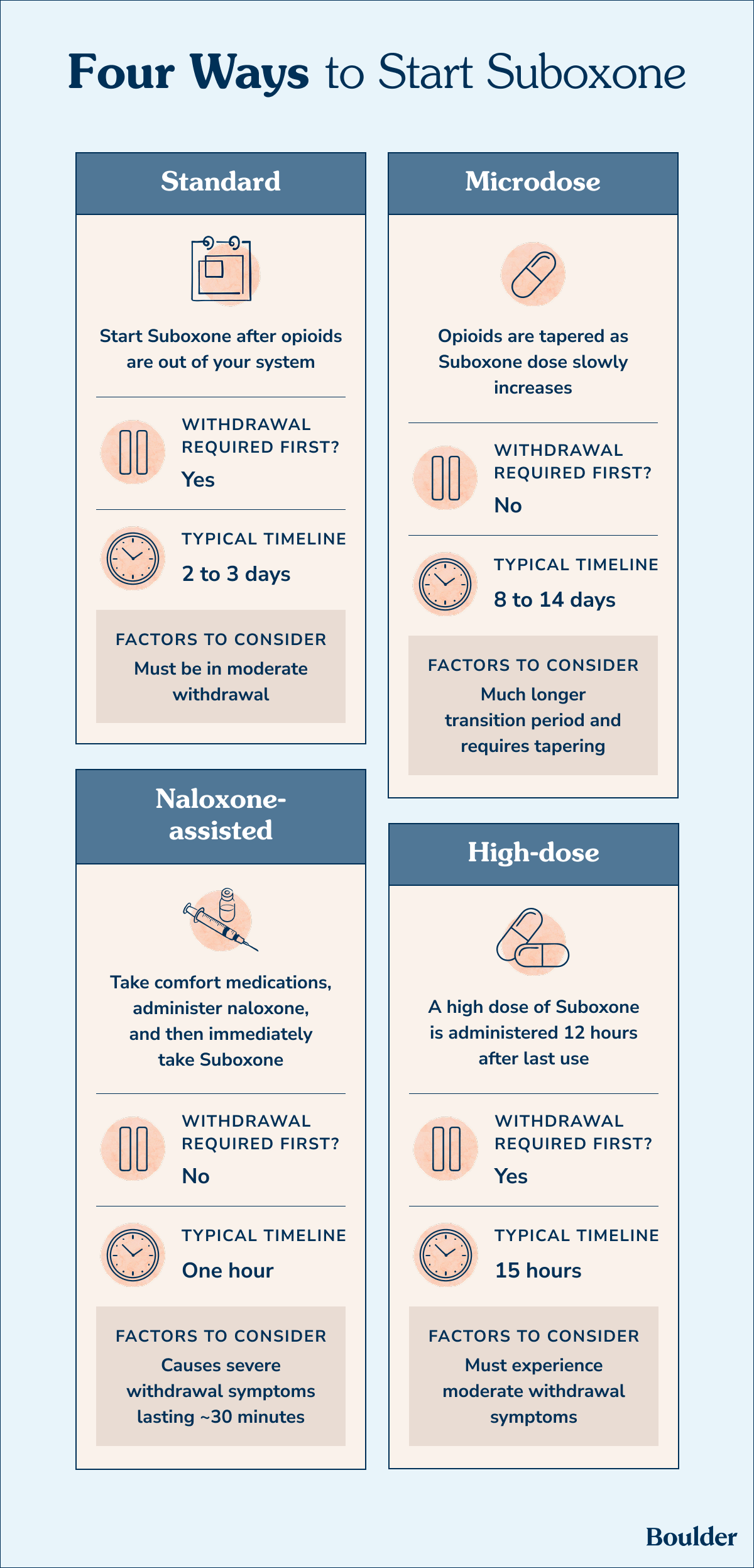
The idea of going through withdrawal can be overwhelming, which is why a microdosing Suboxone initiation (something known as the Bernese method) can be a great option.
Over the course of about a week, you would begin to take very small amounts of Suboxone while simultaneously tapering off opioids, according to the International Journal of Environmental Research and Public Health.
As Breytman explains it, “Microdose is much more drawn out, up to seven days of slowly increasing the dosage; during which time you can be decreasing your opiate use.”
The entire process is a delicate balancing act that requires close coordination with a provider to make the transition as comfortable for you as possible. The goal is that you shouldn’t have to experience any significant withdrawal symptoms.
High-dose initiation of Suboxone can also cut your waiting time between last use and taking the medication.
In this case, you typically have to wait about 12 hours before taking Suboxone. The idea with this option is that you cut the amount of time you’re in withdrawal and suppress the symptoms associated with it.
Research published in the Journal of Addiction Medicine found that high-dose initiation was a safe option. However, it requires close monitoring during the process and can cause symptoms such as nausea, vomiting, or hypertension.
Naloxone-assisted starts are available if you want to quickly switch from opioid use to taking Suboxone.
It works by using naloxone (commonly known as Narcan) to quickly clear your opioid receptors.
This process means you don’t have to wait for opioids to leave your system to start Suboxone. Instead, you can immediately take Suboxone following the naloxone. At Boulder Care, we offer this process through our QuickStart method.
There’s one big drawback to a naloxone-assisted start. While it means you don’t need to naturally enter moderate withdrawal for an extended period, it does bring on short but severe withdrawal symptoms, typically lasting about a half hour.
Your care team can provide you with medications to help ease these withdrawal symptoms. Overall, the entire process takes about an hour.

Here at Boulder Care, we pride ourselves on helping people choose the right path for their goals. We know starting Suboxone doesn’t look the same for everyone and we provide judgment-free support as you navigate treatment.
You can set up a treatment plan with your care team and go over which Suboxone initiation option is best for you.
“What you would experience for your first dosage is very highly dependent on your usage history, substance, last use, dosage, duration, as well as what transition method you are utilizing,” says Breytman. “This will vary your withdrawal symptoms, severity, and more, so this would have to be a discussion with the clinician you are seeing.”
Here’s what you should share with your provider before starting Suboxone:
If you choose a method other than microdosing, then you might experience withdrawal symptoms.
Ask your provider about ways you can manage symptoms during the wait to start Suboxone. They might be able to provide comfort medication, suggest changes to your routine, or offer other forms of support.
When the time comes, you might take your first Suboxone dose at home or with your provider. What option you choose can depend on the type of care you’re receiving, such as telehealth versus in-patient care, and your comfort levels.
Your provider will go over the correct Suboxone dosage with you and guide you on how to take Suboxone film or tablet.
Having a support system around you can make a big difference when taking your first dose of Suboxone, especially when following a faster route and choosing to start Suboxone at home.
“You should ensure that you are in a safe environment, and maybe if you can have a friend or family member with you when you decide to do the QuickStart method that would be helpful,” says Breytman.
Entering withdrawal and waiting to start Suboxone can be an incredibly vulnerable time. You might experience a strong urge to use again so it’s critical to have safety precautions available.
These steps include not using alone, keeping naloxone on hand, and calling 911 if you or a loved one exhibits signs of an opioid overdose.
The timeline around starting Suboxone after using opioids is unique, based on which opioid was used, the chosen initiation method, and how you feel.
If you think you're ready to start Suboxone, or further explore your options, you can call (503) 342-7894 to talk to a Boulder Care team member. Or learn about our services here.
“Having access to different treatment options, a supportive care team, and people who understand the process can make a meaningful difference,” says Bellosi.
“Especially with how dangerous and unpredictable the drug supply has become, access to timely, safe, judgment-free treatment can truly change and save lives.”
How long after oxycodone can you take Suboxone?
When you can take Suboxone is very dependent on whether you took oxycodone that is short-acting or long-acting, as there are multiple types. Typically, you have to wait six to 12 hours to start Suboxone after using a short-acting opioid. It’s usually a minimum of 24 hours for extended-release opioids.
Can I take Suboxone after taking 7-OH?
Suboxone has proven to be effective in helping people stop taking 7-OH. Unfortunately, 7-OH’s unregulated nature — and wrongful marketing as a supplement — means that you can’t gauge its exact product strength. As a result, your provider might want you to wait slightly longer before taking Suboxone to avoid precipitated withdrawal. They might also pursue an option such as a naloxone-assisted start to avoid this problem.
Can you start Suboxone at home?
Yes, you might choose to start Suboxone at home. You might choose to have a friend or family with you as a support. You can also ask your provider for comfort medication, especially if doing a naloxone-assisted start.
At Boulder Care, we’re committed to providing clear, evidence-based information about opioid and alcohol use disorder recovery. Learn more about our editorial standards and medical review process.
Now covered by Medicaid in Oregon and Washington – Schedule an online visit.