Published:
October 9, 2026
|
Last Updated:
October 9, 2026
You've got people now.

Kratom has become a widely used substance, but many of its risks are still unknown. And while pure kratom is a naturally occurring plant, there's been a recent, significant rise in synthetic, kratom-mimicking products.
The most prominent form is a highly concentrated semi-synthetic compound found in kratom known as 7-OH (7-hydroxymitragynine). This drug is synthesized from only 2% of actual kratom’s composition, according to the Food and Drug Administration (FDA).
There's also a big difference in potency. “Artificial 7-OH has recently been made in a lab and is 50 times as strong as natural kratom,” says Dr. Stephen Martin, an addiction medicine physician at Boulder Care.
But whichever form you're taking, if you stop, you'll likely go through withdrawal. This is because kratom and 7-OH can both activate the brain’s opioid receptors.
As is the case with classic opioids, the body and brain can get used to the feeling of these receptors being activated. So when use is reduced, the withdrawal symptoms follow.
Fortunately, support and medication are available to help keep you safe while using kratom or 7-OH and if you're in withdrawal. You can speak to a provider in-person or through telehealth to get personalized care.
Below, we dive into what kratom and 7-OH withdrawal look like, how to get through them safely, and what treatment options are available to you.
You might experience kratom withdrawal when suddenly stopping kratom or lowering the dose of kratom you’ve been taking. According to the FDA, kratom and 7-OH bind to receptors in your brain — just like opioids do.
Your brain gets used to the receptors being activated, creating a physical dependence. The shift means your body will go into withdrawal if kratom or 7-OH use stops.
Physical dependence is different from addiction, which might occur during use, according to the National Library of Medicine.
Kratom can have effects such as pain relief, elevated mood, and increased energy. Each of these could encourage you to take more kratom or 7-OH and potentially develop an addiction.
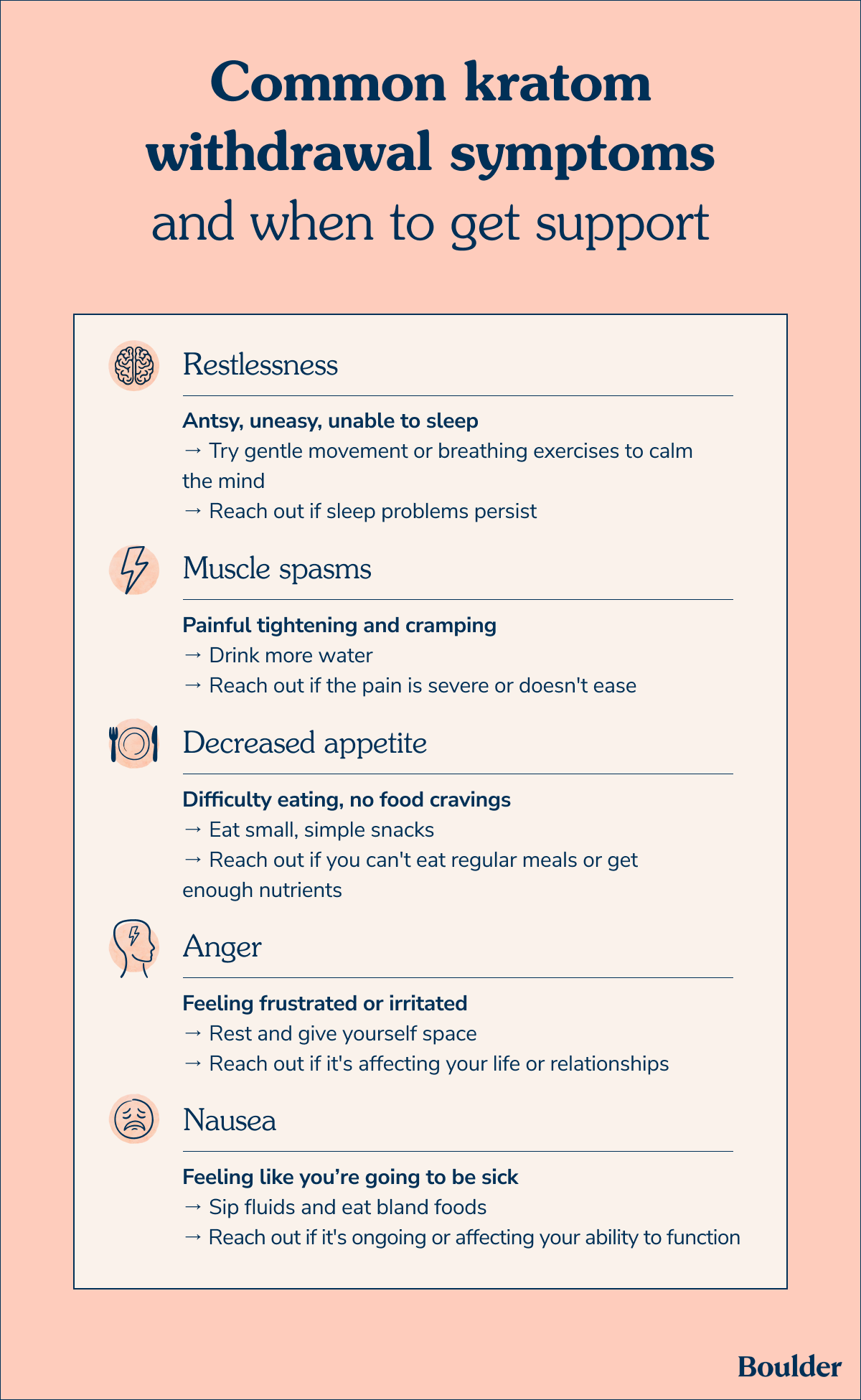
According to the Journal of Drug and Alcohol Dependence, physical symptoms of kratom withdrawal include:
While physical symptoms might be more visible, emotional and psychological symptoms are just as real a part of kratom and 7-OH withdrawal. These include:
Withdrawal symptoms can be even more severe when reducing 7-OH use.
"Because 7-OH is relatively new, we are all still learning about its effects,” says Dr. Martin.
“What we know so far is that 7-OH can lead to much more complicated withdrawal that is very similar to withdrawal from opioids like morphine, fentanyl, oxycodone, and hydrocodone, with symptoms such as nausea, diarrhea, abdominal cramping, restlessness, chills or clamminess, and anxiety.”
The kratom withdrawal timeline is different from person to person, lasting from days to weeks, depending on someone's level of dependence and care. “When kratom withdrawal occurs, consumers usually characterize it as mild to moderate,” explains Dr. Martin.
"Withdrawal from the natural Kratom leaf is generally mild, though it can lead to disruptions such as frequent use and use shortly after waking to avoid withdrawal symptoms.”
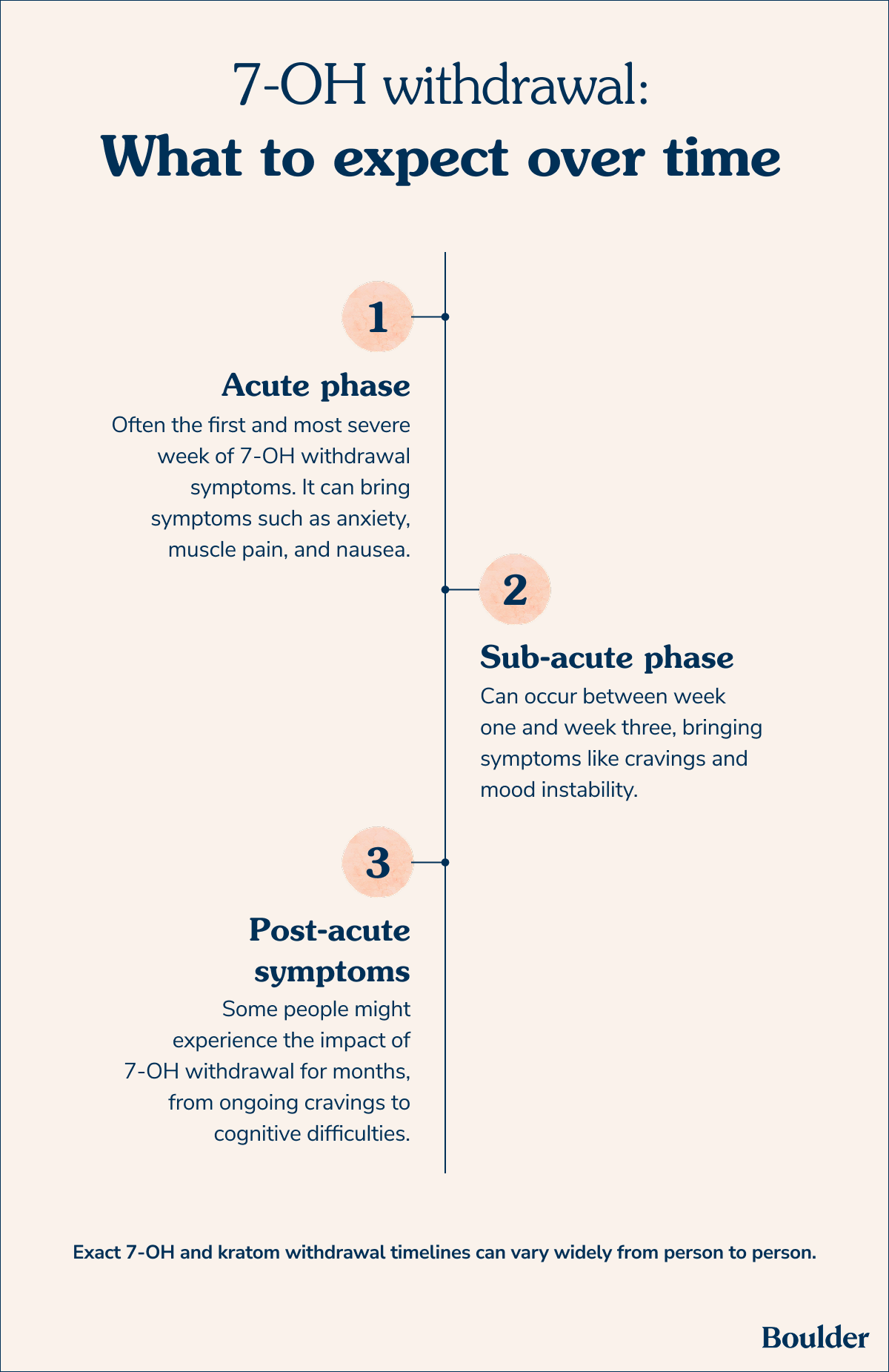
Withdrawal from 7-OH might come on faster and feel more intense. According to the International Society of Substance Use Professionals (ISSUP), 7-OH withdrawal can last between three weeks and multiple months. It can include three phases:
These timelines are not exact and will be different depending on the person and how much of the drug they were taking.
Getting through kratom or 7-OH withdrawal safely involves a mix of physician care, support, and harm reduction strategies.
Stopping use suddenly and without any support can be dangerous. This is, in part, because breaks from kratom or 7-OH work the same way as breaks from opioids: Your tolerance of the substance will be lower after a period of not using it.
This shift means you run the risk of feeling the drug's effects more strongly than expected or even experiencing an overdose if you use the same amount as before the break.
Support can be a critical aspect of getting through kratom withdrawal safely. Medical support can offer you the care and knowledge you need to manage withdrawal symptoms and reduce your risk of an accidental overdose.
Alongside medical care, trusted loved ones and support groups can offer additional judgment-free spaces — because there’s no room for judgment or blame here. You deserve to have safe and supportive people around you as you navigate kratom withdrawal.
Kratom dependence and 7-OH dependence can be treated with the same FDA-approved medications for opioid use disorder (MOUD), including Suboxone (buprenorphine) and methadone.
Taking Suboxone for kratom withdrawal can reduce withdrawal symptoms and kratom cravings, making the transition off kratom a lot more manageable.
Treating 7-OH dependence, specifically, can be more challenging. Dr. Martin explains that “7-OH treatment requires much more use of MOUD than kratom dependence.”
Dr. Martin continues: “When severe, this withdrawal may require medical help. Medications for opioid use disorder such as buprenorphine and methadone have been found to be helpful for first stopping 7-OH and, when things are better, discontinuing these medications.”
Notably, taking buprenorphine requires you to stop taking any opioid-acting substance to not trigger precipitated withdrawal.
Pursuing treatment can also be helpful if you use kratom to manage opioid withdrawal or pain. Harm reduction strategies like syringe services programs (SSPs) and drug checking tools can provide support for safe opioid use.
These options, alongside clinical providers, are beneficial whether you want to use more safely, reduce use, or stop using opioids and kratom altogether.
Care should be accessible and on your own terms. Recovery is about making a positive change that aligns with your own personal goals.
Medicare and other insurance plans may cover part or all of your treatment costs. You can also consider what type of treatment works best for you, whether that's telehealth or in-person care.
A judgment-free space that supports your goals can help you navigate withdrawal. If you’re interested in telehealth care, then Boulder Care could be a good option to explore. Learn more about our services here or call 503-445-3528 to talk to a Boulder Care team member.
Experiencing withdrawal from kratom or 7-OH isn’t a sign of weakness or failure. The way kratom activates opioid receptors naturally creates dependence and, subsequently, withdrawal symptoms.
Going through withdrawal can be a lot more manageable with support and access to effective treatment.
Kratom withdrawal can be dangerous, especially if you stop using it suddenly or without any support. However, kratom in its truly natural form shouldn’t have the same impact as synthetic versions such as 7-OH.
Yes, stopping kratom or 7-OH use suddenly can cause you to experience withdrawal symptoms like anxiety and restlessness. A medical provider or harm reduction center can support you in safety reducing kratom or 7-OH use and managing withdrawal symptoms.
Some people use kratom to help with opioid withdrawal as it might ease symptoms. With that said, kratom is still a substance that can bring its own withdrawal symptoms. The words “kratom” and “natural” are also frequent labels on substances that are at least sem-synthetic and contain much more 7-OH than a kratom leaf.
Taking Suboxone or other medications for opioid use disorder (MOUD) can help you treat kratom dependence. Suboxone (a brand-name version of buprenorphine) has shown to treat kratom and 7-OH dependencies. Taking Suboxone can reduce any kratom cravings or withdrawal symptoms you’re experiencing.
At Boulder Care, we’re committed to providing clear, evidence-based information about opioid and alcohol use disorder recovery. Learn more about our editorial standards and medical review process.

Our mission is to improve the lives of people with substance use disorders. We provide medication, resources, and support to help our patients succeed on their own terms, wherever they are.
Now covered by Medicaid in Oregon and Washington – Schedule an online visit.

