7-OH, or more formally 7-hydroxymitragynine, is a highly concentrated, semi-synthetic version of an active compound found in the kratom plant. It's commonly sold as its own product in gas stations and smoke shops across the country.
Due to its opioid-like effects, 7-OH has become a common stand-in for stronger opioid drugs. People often use it hoping to ease withdrawal symptoms, manage their own OUD, or simply avoid starting on the stronger stuff.
Its popularity as a kind of “opioid alternative” has made 7-OH a smoke shop staple in many areas of the country under labels that claim it’s “natural.” But these 7-OH products are not the same as a traditional kratom leaf.
And while it’s not quite as strong as fentanyl or oxy, it still carries significant health risks, including addiction and overdose.
Now, due to concerns around the exploding use of 7-OH, the Drug Enforcement Agency (DEA) is moving to ban 7-OH and temporarily label it as a Schedule I substance. This could take effect as soon as August 5, 2026.
So if you or a loved one uses 7-OH, this article will clarify what it is exactly and how it differs from kratom, how upcoming legal changes could impact you, and what can be done to stay safe — or seek treatment, if that option feels right for you.
The substance 7-OH is an alkaloid naturally found in the kratom plant, but has recently become a popular commercial product in a concentrated and semi-synthetic form, according to the Food and Drug Administration (FDA). It has a strong effect on opioid receptors and can be addictive.
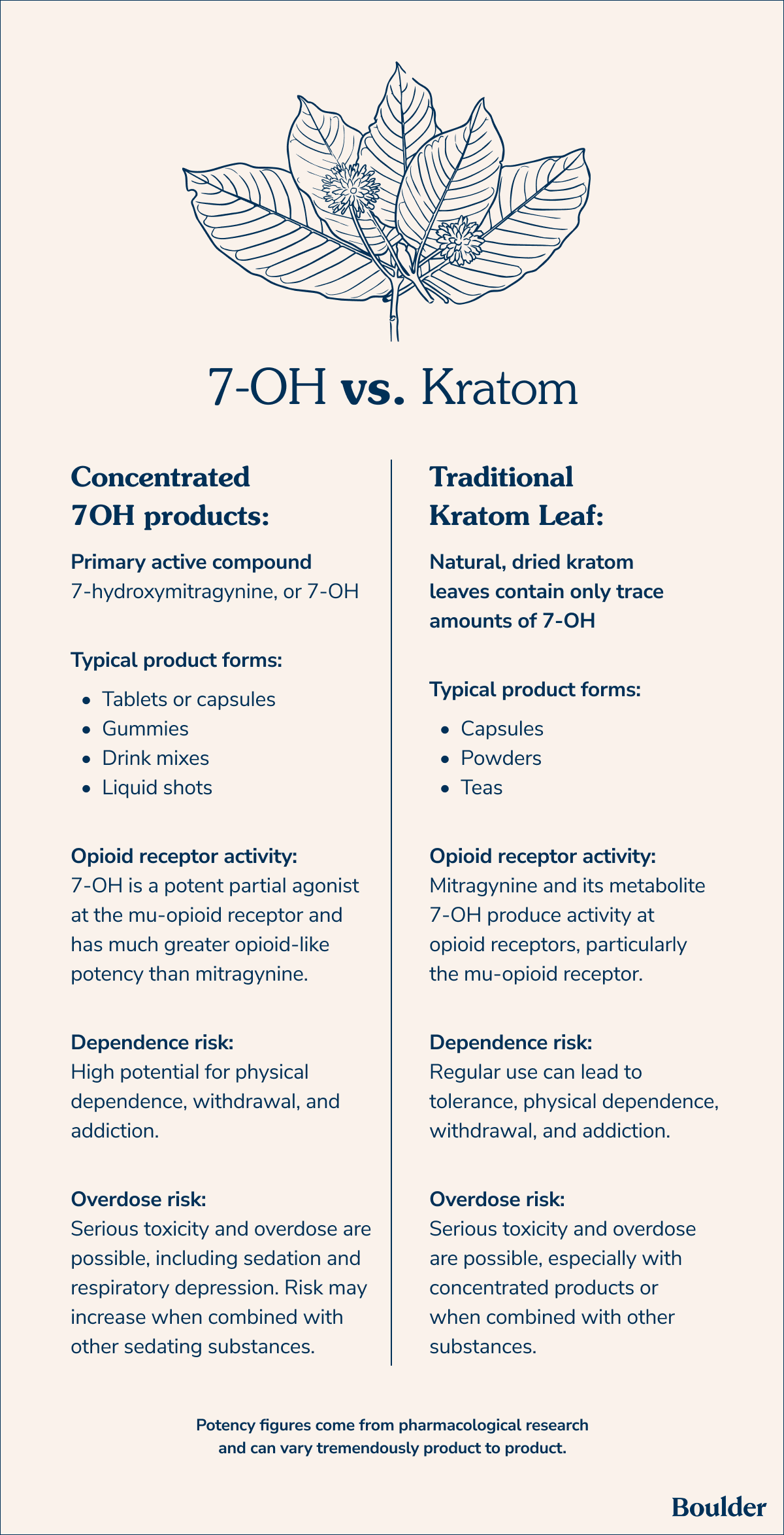
You might see 7-OH being sold as 7-OH drink powders, 7-OH gummies, 7-OH shots, or 7-OH tablets at places like smoke shops and gas stations. In each of these forms, 7-OH can be highly addictive.
Like many drugs, 7-OH can look attractive due to its promised benefits and enticing marketing and formulations — take gummies, for instance. According to University of Virginia (UVA) Health, the drug’s desired effects include:
The DEA’s decision also affects Mitragynine Pseudoindoxyl, MGM-15, and MGM-16, which are related to 7-OH. According to the FDA, each of these drugs is a semi-synthetic derivative of 7-OH. These substances have also been freely sold as everything from powders to tablets.
Kratom and 7-OH are easily confused, but it’s important to know the difference.
Regular kratom, Mitragyna speciosa is a plant of Southeast Asian origin that contains small amounts of 7-OH. According to the FDA, only 2% of kratom’s total makeup is 7-OH. Its other major chemical compound is mitragynine.
Kratom is commonly used as a stimulant in low doses or a sedative in high doses, as per the Drug Enforcement Administration (DEA) and Department of Justice report. It can be chewed, dried, powdered, put in a capsule, or made into a tea.
Despite its more natural form, kratom is also unregulated, and its exact composition can vary from product to product.
“7-OH is by far the most potent part of the kratom plant,” says Dr. Stephen Martin, an addiction medicine physician at Boulder Care. “Just as the active chemical in cannabis, THC, has been created in labs to increase its potency, labs are now making the chemical 7-OH to be used by itself. This has never been done before.”
In manufactured and natural forms, 7-OH works as a partial agonist, attaching to mu-opioid receptors more powerfully than full opioid antagonists, according to UVA Health. As a synthetic, concentrated version, 7-OH is much more powerful.
Studies looking at 7-OH versus morphine have found that 7-OH is about 13 times stronger than morphine, Texas Department of State Health Services reports. Meanwhile, UVA Health points to studies that show 7-OH could be between five and 22 times more powerful than mitragynine — the other main alkaloid found in kratom.
Danielle Bellosi, a peer recovery supervisor at Boulder Care, hasn’t taken 7-OH but has talked to and supports people who use it. “One thing I hear often is that many people didn't realize how potent it was compared to traditional kratom products,” says Bellosi. “It was marketed as something ‘legal’ or ‘natural,’ so they weren't expecting to develop physical dependence as quickly as they did.”

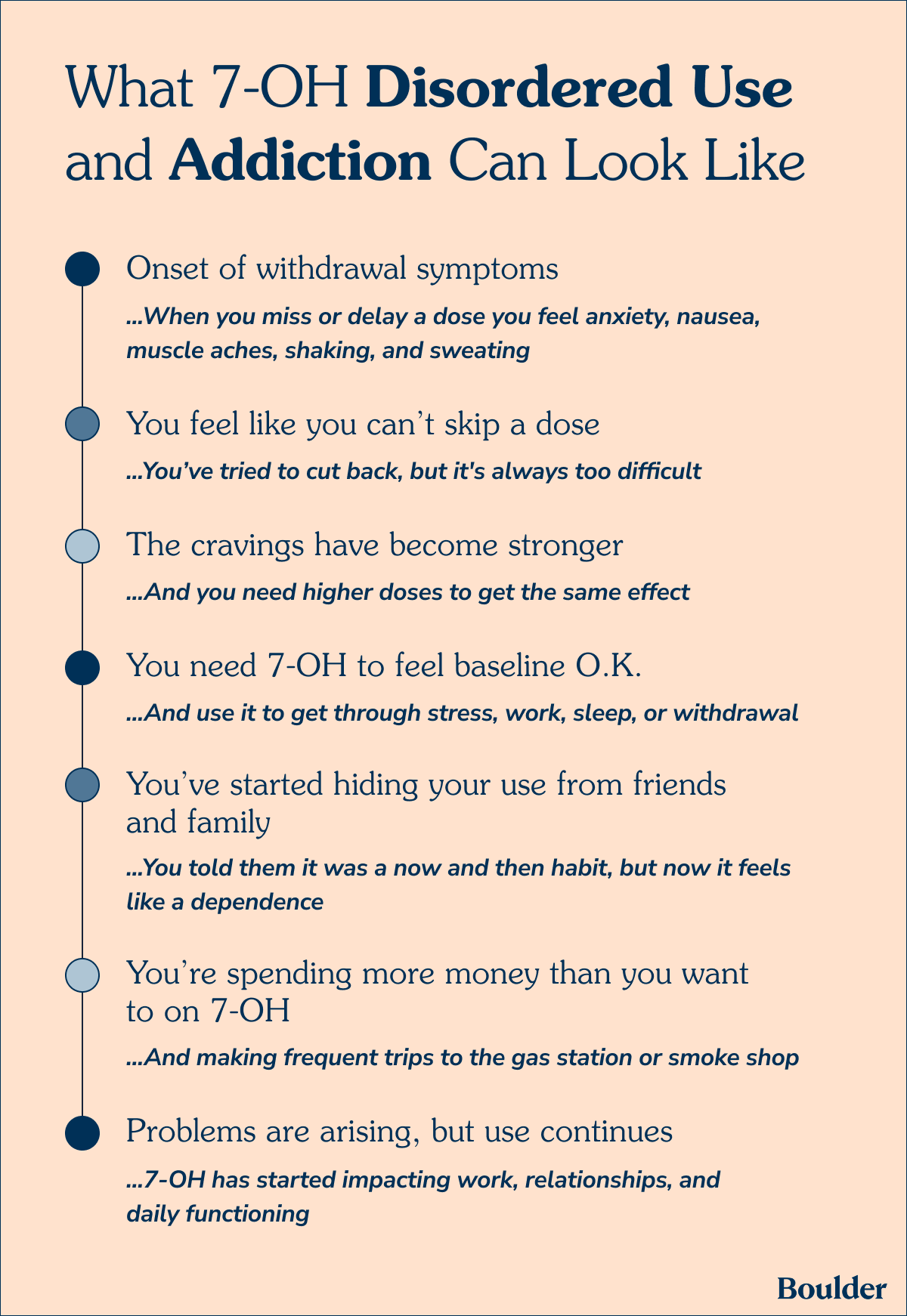
These feelings that 7-OH gives you can quickly become addictive. “Everyone's experience is different, but many people describe feeling like they can't get through the day without taking it,” says Bellosi. “They may find themselves needing more over time just to feel ‘normal’ and spending a lot of time thinking about when they'll take their next dose.”
While you might experience those effects, 7-OH can also bring a range of negative physiological and mental responses. According to the FDA and DEA, adverse effects of 7-OH include:
The government agencies also point to longer-term risks of 7-OH, such as:
A 7-OH overdose should be treated in the same way you’d react to any opioid overdose, including calling 911 and administering naloxone, explains the International Society of Substance Use Professionals (ISSUP).
There are specific ways to recognize an opioid overdose as it’s happening. According to the National Harm Reduction Coalition, signs of overdose include:
The Los Angeles County Department of Public Health specifically notes that 7-OH can lead to severe respiratory depression or death — especially when used with other substances. The currently unregulated nature of these products can also increase your risk of overdose.
Naloxone can reverse a 7-OH overdose in the same way it can reverse any opioid overdose, ISSUP reports. You should administer naloxone to anyone with 7-OH overdose symptoms — or those of any opioid. Critically, you might need to use naloxone more than once as 7-OH’s effect can outlast its dose.
Naloxone should be available at most pharmacies and harm reduction centers without any prescription. It’s sometimes referred to as the brand name Narcan.
Going through 7-OH withdrawal can mirror the experience of any opioid withdrawal, and include restlessness, irritability, and chills. According to ISSUP, withdrawal can last up to three weeks or even months.
Withdrawal can be an incredibly challenging time for both your physiological and mental health. Experiencing these symptoms is not a sign of weakness, but a normal response to stopping opioids.
Yes, 7-OH addiction is the same as opioid use disorder. It’s true that 7-OH products often market themselves as being “natural” and, as of this moment, aren’t illegal nationwide. However, these products are still often semi-synthetic opioids that can be addictive.
Clinical criteria for substance use disorder can clearly apply to regular 7-OH use. As Dr. Martin explains, “A person is diagnosed as having a substance use disorder if they have any two of 11 criteria. Three of the criteria are: impaired control over substance use, tolerance, and withdrawal.” You might experience any of these symptoms when using 7-OH.

On July 1, 2026, the DEA announced its intent to classify 7-OH as a Schedule I drug. This shift would put 7-OH in the same category as heroin, lysergic acid diethylamide (LSD), and cannabis on a national level (cannabis is legal in many states, just not federally).
In its statement, the DEA explained that 7-OH has “no accepted medical use and a high potential for abuse.” Again, the shift also affects Mitragynine Pseudoindoxyl, MGM-15, and MGM-16. It doesn’t apply to ordinary kratom leaf.
According to the Federal Register, the temporary scheduling could go into effect as early as August 5, 2026, and last for two years, with the possibility of extending another year. This sudden shift can occur when the Attorney General finds “that such action is necessary to avoid an imminent hazard to public safety.”
Once 7-OH is temporarily scheduled, its distribution, manufacturing, possession, and sale, will be “subject to criminal, civil, and administrative provisions of the Controlled Substances Act,” according to the DEA.
Schedule I is the only possible temporary classification in a case like this. For instance, fentanyl was labeled a Schedule I drug during temporary classification in 2020. Now, the drug is classified as Schedule II because it still has a high potential for abuse and dependence, but has some medical use.
The move to classify 7-OH as a Schedule I drug follows the same decision by six states: Alabama, Arkansas, Indiana, Kansas, Louisiana, Vermont, and Wisconsin. You should check current federal and state law to see the status of 7-OH in your area as it can change quickly.
Notably, the shift in legality of 7-OH could mean access to it quickly disappears where you live. A sudden stop in 7-OH use might bring significant risks, including severe withdrawal symptoms. But spaces such as substance use clinics and harm reduction centers can help keep you safe and supported during the adjustment.
For instance, they might prescribe medications used to manage opioid withdrawal, like buprenorphine. “If the person will lose access and is dependent or has difficult withdrawal symptoms on 7-OH, the safest approach could be to find and then work with a buprenorphine clinician in the area,” says Dr. Martin.
“These clinicians have likely helped others in the same situation and can guide someone who wants to shift from 7-OH to buprenorphine and then carefully come off buprenorphine.”
With that in mind, it might be comforting to know that 7-OH dependence can be treated with the same evidence-based care as any opioid use disorder.
Support for 7-OH dependence might come through in-person care, medication, support groups, and telehealth.
Buprenorphine is one of the Medications for Opioid Use Disorder (MOUD) approved by the FDA. It’s available as brand names such as Suboxone or Sublocade, along with generic versions.
Taking buprenorphine can help limit cravings and reduce withdrawal symptoms after stopping opioid use. It works as a partial opioid agonist, meaning it partially activates the mu-opioid receptors in your brain, but only enough to minimize symptoms.
Taking buprenorphine can also help you get off 7-OH. Critically, though, buprenorphine is a medication that is taken under medical guidance and with a dose tailored specifically to your needs. You can typically start taking buprenorphine about 12 to 24 hours after last using opioids. This waiting time is critical to avoid precipitated withdrawal.
Seeking treatment for OUD can feel intimidating, time-consuming, and costly. That’s why virtual care can be a great option. There are no waiting rooms, there’s flexible scheduling, and insurance often covers it. Medical professionals can virtually prescribe medication, provide care advice, and give judgment-free support without needing to meet face-to-face.
Boulder Care offers same-day OUD treatment, and might be a good option for you if you’re considering virtual care. Call 503-549-1222 to talk to a Boulder Care team member and learn more about your treatment options.
As Bellosi says, “Recovery doesn't have to happen perfectly. It starts with one conversation, one appointment, or one decision to reach out.”
Kratom and 7-OH are different products with unique risks and makeups. Educating yourself on the substances can help you make informed decisions about use and care.
“If you're struggling with 7-OH, you're very much not alone, and there's nothing to be ashamed of,” adds Bellosi. “Many people started taking it believing it was a safer alternative or not realizing how physically dependent they could become."
There will likely be significant changes to 7-OH soon. Keep an eye out on state and federal regulations to see how you could be impacted.
No, 7-OH makes up about 2% of kratom’s composition as one of its two main alkaloids. When you see 7-OH being sold in stores it’s likely to be a semi-synthetic concentrated version of the substance.
Naloxone can effectively reverse a 7-OH overdose. However, 7-OH might outlast the initial naloxone dose so additional doses might be needed.
A medical professional can prescribe buprenorphine to help you reduce cravings and withdrawal symptoms that accompany 7-OH dependence. As is the case with any opioid, buprenorphine should be taken under the guidance of a provider to maintain proper dosage and minimize your chances of precipitated withdrawal.
At Boulder Care, we’re committed to providing clear, evidence-based information about opioid and alcohol use disorder recovery. Learn more about our editorial standards and medical review process.
Now covered by Medicaid in Oregon and Washington – Schedule an online visit.