Published:
September 8, 2026
|
Last Updated:
October 23, 2026
You've got people now.

Information about the legality and availability of the substances mentioned in this article is constantly evolving. This article is updated as of September 8, 2026. We will do our best to keep facts current.
The drug supply is always evolving and changing, for many reasons. Over the last decade or so, a variety of new substances have shown up on gas station shelves due to legal loopholes. But “legal to sell” doesn’t always mean that a product is regulated or safe.
Likewise, sometimes drugs sold by individuals contain substances or active ingredients you didn’t intend to use.
As a result of either situation, you can develop an addiction or be at risk of an overdose.
The physical dependence that you or a loved one might develop from using a certain substance is not a personal failure or a sign of weak willpower. Instead, physical dependence involves a change in brain chemistry. Your brain adapts to the substance and then relies on it just to maintain function.
This article explores, without judgment, the current gas station drugs and synthetic sedatives in circulation and what’s important to know about each.
For a suspected overdose, administer naloxone and call 911.
Naloxone may reverse the opioid effects associated with substances such as tianeptine, 7-Oh, and nitazenes, but response can vary.
Nitazenes can be extremely potent, and multiple doses of naloxone may be needed.
Opioids are also often mixed into non-opioid drugs, such as xylazine or medetomidine. Naloxone will help and not harm if they are present.
Numbers to know: Poison Help Line: 800-222-1222 and the Suicide & Crisis Lifeline: 988
Gas station drugs are exactly what they sound like: substances sold at gas stations and some convenience stores.
“There is a misconception that if something is sitting on a store shelf, someone must have tested it and made sure it’s safe,” says Petricia Pechter, MD, collaborating physician at Boulder. “That’s not necessarily the case.”
Medications are a good example of rigorous FDA oversight. “Before a prescription medication is approved by the FDA,” Dr. Pechter says, “manufacturers have to provide evidence about its safety, effectiveness, manufacturing quality, and appropriate use.”
Dietary supplements are different. The FDA regulates them, but supplements do not undergo the same premarket approval process for safety and effectiveness as prescription medications.
“Gas station drugs, such as kratom,” Dr. Pechter says, “are not considered medications or supplements and are not regulated by the FDA. That distinction becomes especially important with products marketed for their drug-like effects, particularly when the packaging makes medical-sounding claims that haven’t been supported by the kind of evidence we expect for medications.”
Additionally, the potency and contents of gas station pills and other formulations might vary from package to package, even for the same product.
The following are some common gas station drugs.
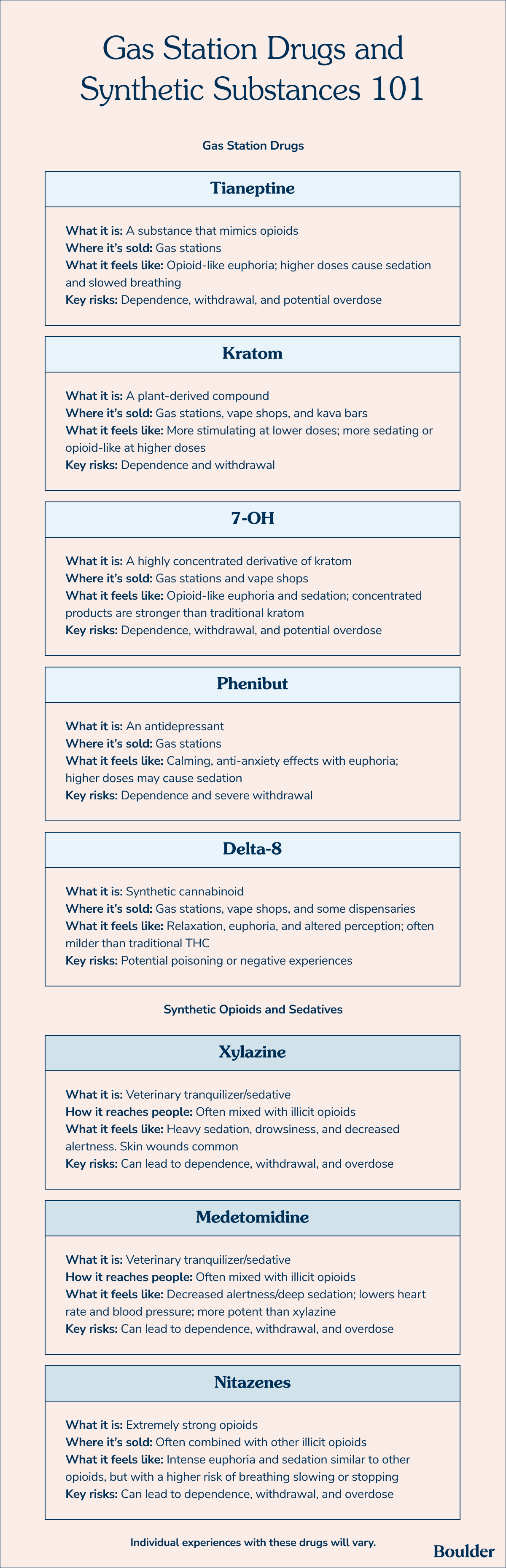
According to the journal Pain and Therapy, tianeptine, dubbed “gas station heroin,” is not a traditional opioid drug. But it still acts on opioid receptors to mimic opioids, such as heroin. It also changes various chemical messengers in the brain.
In other countries, doctors sometimes prescribe a regulated form of tianeptine as an antidepressant. But the FDA has not approved it in the United States and has issued a safety warning about its use. Several states have also banned its sale.
Gas stations and other retailers sell unregulated tianeptine under names such as ZaZa, Tianaa/Tianna, Pegasus, Neptune’s Fix, TD Red, or Red Dawn. Retailers market it as a “brain booster,” but it acts on opioid receptors, which is why dependence and opioid-like withdrawal symptoms can occur. Overdose is also a risk, especially if combined with other opioids or sedatives.
Kratom is a plant-derived substance that comes from a tree native to Southeast Asia.
7-OH is an abbreviation for 7-hydroxymitragynine, a specific active compound found in low doses in the kratom plant. 7-OH, sold in gas stations and elsewhere, is a synthetic, highly concentrated formulation of this compound.
Although it is not technically an opioid, 7-OH acts on opioid receptors, which can lead to dependence, and opioid-like withdrawal can occur. Overdose is also a risk.
The U.S. Drug Enforcement Administration (DEA) is currently considering placing 7-OH into Schedule I of the Controlled Substances Act.
Phenibut is a central nervous system depressant that acts on gamma-aminobutyric acid (GABA) receptors. GABA is a calming chemical messenger in the brain.
Manufacturers market phenibut as a way to calm anxiety or improve focus. But dependence and withdrawal can occur. Withdrawal symptoms can be severe enough that you or a loved one may need support.
Additionally, high doses can also cause severe intoxication or overdose, including profound sedation, altered mental status, respiratory depression, and in some cases, the need for mechanical ventilation.
Delta-8 is a cannabis-derived cannabinoid that causes a high by acting on the body’s cannabinoid receptors. Delta-8 is only present in small amounts in cannabis plants, but manufacturers can chemically convert cannabidiol (CBD) into delta-8.
Hemp-derived cannabis products are generally legal in the United States, even in some states that haven’t legalized recreational or medicinal marijuana-derived cannabis products. For this reason, delta-8 is marketed as “legal weed.”
The FDA does not regulate or approve delta-8 products, so potency varies widely. This means consumers can face difficulty in controlling their dosage. It also means the product might be contaminated with heavy metals or other unwanted substances. Poisonings have occurred.
K2 and Spice are brand names for other synthetic cannabinoids, which have been linked to health emergencies.
Nitazenes are a class of synthetic opioids that were developed in the 1950s but were never approved for medical use. They carry a heavy risk of overdose, with certain types that are more potent than fentanyl. Naloxone can reverse an overdose, though more than one dose may be required.
Nitazenes are frequently mixed with illicit drugs, so you might encounter them without intending to. Nitazenes can also lead to dependence and severe withdrawal symptoms.
Synthetic opioids and sedatives are drugs sold illicitly and outside of retail stores. They are often mixed into opioids, such as heroin or fentanyl, to intensify or prolong their effects, but you or a loved one may not know the drugs are there.
“These substances can enter the illicit supply through different pathways,” Dr. Pechter says. “Some may be diverted from legitimate veterinary or pharmaceutical sources, while others can be produced illicitly in clandestine laboratories. This is one of the reasons the current drug supply is so unpredictable and why harm-reduction strategies are so important.”
Below are some common synthetic sedatives.
Xylazine, also called “tranq” or “zombie drug,” is a non-opioid used as a tranquilizer or sedative in veterinary medicine. It is not FDA-approved for any use in humans. It works by stopping the release of norepinephrine, a chemical messenger that promotes alertness.
Xylazine is commonly mixed in with illicit fentanyl, so you or a loved one may encounter it without realizing it. It can cause severe sedation, overdose, and other health issues. It can also lead to dependence and severe withdrawal symptoms.
Medetomidine, also called “rhino tranq,” is a non-opioid used as a tranquilizer or sedative in veterinary medicine. It is not approved for any use in humans. Like xylazine, it works by inhibiting the release of norepinephrine, but it is 200 to 300 times more potent.
As with xylazine, medetomidine is commonly mixed with illicit opioids, such as fentanyl. It can cause severe sedation, overdose, and other health issues. And it can lead to dependence and severe withdrawal symptoms.
“With medetomidine in particular, evidence indicates that illicitly manufactured medetomidine is increasingly contributing to its presence in the U.S. drug supply.” Dr. Pechter says. “Someone can think they’re taking an opioid and unexpectedly be exposed to a powerful sedative as well.”
If you or a loved one uses any of the above drugs, you might be looking for harm-reduction methods. That’s what this section is about.
Physical dependence on a substance means the brain has adapted to the substance and has come to rely on it for normal functioning.
Physical dependence involves changes to brain chemistry, including to neurotransmitters (chemical messengers), their receptors, and brain pathways involved in pleasure, reward, and motivation.
A substance use disorder is a complex disease defined by compulsive use of a substance, despite negative consequences. Neither physical dependence nor a substance use disorder (addiction) is a character flaw.
You can become addicted to gas station drugs and synthetic sedatives just like you would become addicted to fentanyl or oxy.
Dr. Pechter shares some general signs that someone may be developing a substance use disorder:
For substances that act on opioid receptors, withdrawal can look and feel like opioid withdrawal, with intense physical and emotional symptoms. Stopping abruptly and independently is extremely difficult. Medical support can make the process safer and more comfortable with the help of medications.
For fentanyl, heroin, or 7-OH, Dr. Pechter says, “Withdrawal can include muscle aches, sweating, restlessness, irritability, nausea, vomiting, diarrhea, insomnia, anxiety, and very strong cravings. People often describe it as feeling like a severe flu combined with an overwhelming urge to use the drug again.”
Synthetic sedatives are different, especially in the case of medetomidine. “Medetomidine withdrawal can cause rapid heart rate, severe hypertension, agitation or anxiety, tremor, nausea and vomiting, and changes in alertness. In severe cases, withdrawal can result in serious cardiovascular complications and may require emergency or intensive medical care,” Dr. Pechter says.
.png)
Many treatment options and recovery methods exist, and they are not one-size-fits-all.
One of the most effective treatment options is medications for opioid use disorder (MOUD), which uses FDA-approved medications — such as Suboxone, which contains buprenorphine — to stabilize brain chemistry, prevent intense withdrawal symptoms, and help protect from fatal overdose in the event of a return to use. When stabilized, you or a loved one will be more able to engage in all the aspects of recovery.
MOUD can help with some of the gas station drugs mentioned in this article that act on opioid receptors. Timing of MOUD matters to avoid precipitated withdrawal (severe symptoms).
The synthetic sedatives mentioned in this article can complicate opioid withdrawal, but that doesn’t change that MOUD is an effective treatment method.
MOUD treatment is covered by Medicaid and most insurance plans. It is often available via telehealth for greater accessibility—allowing you to engage in recovery on your own terms.
Boulder offers MOUD via telehealth, judgment-free and with no requirement to have quit using a substance.
Yes, Suboxone can treat kratom, 7-OH, or tianeptine dependence. These “gas station drugs” are not traditional opioids, but they act on opioid receptors. So the same medications used to treat opioid use disorder can also treat the physical dependence of these other substances.
Naloxone (sold under the brand name Narcan) doesn’t work on xylazine alone, but xylazine is often mixed together with opioids, such as fentanyl. If fentanyl is present and causing an overdose, then naloxone will help reverse the overdose. If fentanyl is not present, administering naloxone will not cause harm.
Yes, naloxone (sold under the brand name Narcan) will work on an overdose caused by tianeptine or 7-OH, both of which act on opioid receptors.
At Boulder Care, we’re committed to providing clear, evidence-based information about opioid and alcohol use disorder recovery. Learn more about our editorial standards and medical review process.

Our mission is to improve the lives of people with substance use disorders. We provide medication, resources, and support to help our patients succeed on their own terms, wherever they are.
Now covered by Medicaid in Oregon and Washington – Schedule an online visit.