Published:
October 26, 2026
|
Last Updated:
October 26, 2026
You've got people now.

The drug supply is always evolving, making it difficult to stay safe. Take the 1990s and early 2000s, for example, when there was a surge in heroin use and overdose deaths. By the early 2010s, however, the synthetic opioid fentanyl drove the bulk of overdose deaths.
I lost a friend to a fentanyl overdose in 2017, and I’ve kept a close eye on what was happening with these drugs ever since. Now, the opioid use disorder (OUD) landscape is once again going through a dramatic shift due to the arrival of synthetic opioids and so-called “gas station drugs".
Substances like tianeptine, kratom/7-OH, and ultra-potent nitazenes are reshaping what people using drugs are encountering. Many of these drugs sold at gas stations are marketed as wellness supplements, rather than classic opioids. And most people are unaware of the potential dangers.
“It was 2018, and my mom had just passed away six months prior...I was not doing well at all,” recalls Melo Knight, operations coordinator at Boulder Care. “I wasn't able to see a doctor to get therapy or medication. I saw Kratom at a gas station, sold in powder form, and marketed as an ‘all-natural anti-anxiety supplement.’ I figured it couldn't be bad for me since it was being sold in stores, so I started using it every day.”
Melo adds, “After a few weeks of using it, I found that I needed higher and higher doses to maintain the same effect. If I didn't keep up with taking it regularly, I'd start to get headaches and become very agitated. It was slowly turning me into a different person that I did not like.”
And while Kratom isn't a synthetic opioid itself, its even more popular, chemically comparable counterpart, 7-OH, is.
Regulatory and policy changes are making the picture even more complex. Some of these substances, once legal and readily available, may soon become illegal and be taken off store shelves.
This could cause people who are dependent on these drugs to enter withdrawal, which could drive use of even more dangerous alternatives.
But it doesn't have to be that way. What more people should know is that Medications for opioid use disorder (MOUD), such as Suboxone (which contains buprenorphine and naloxone) and naltrexone, can be used to treat addiction to these new substances that mimic the effects of traditional opioids. We'll explain the options for care in this article to improve safety and recovery without judgment.
Many new substances in the drug supply are marketed as “safer” alternatives to opioids because they can legally be sold in stores in the U.S., often gas stations, hence the name “gas station drugs.”
Other newer street drugs are mixed in with standard fentanyl, increasing both the felt effects and the risks, according to the journal Drug Testing and Analysis.
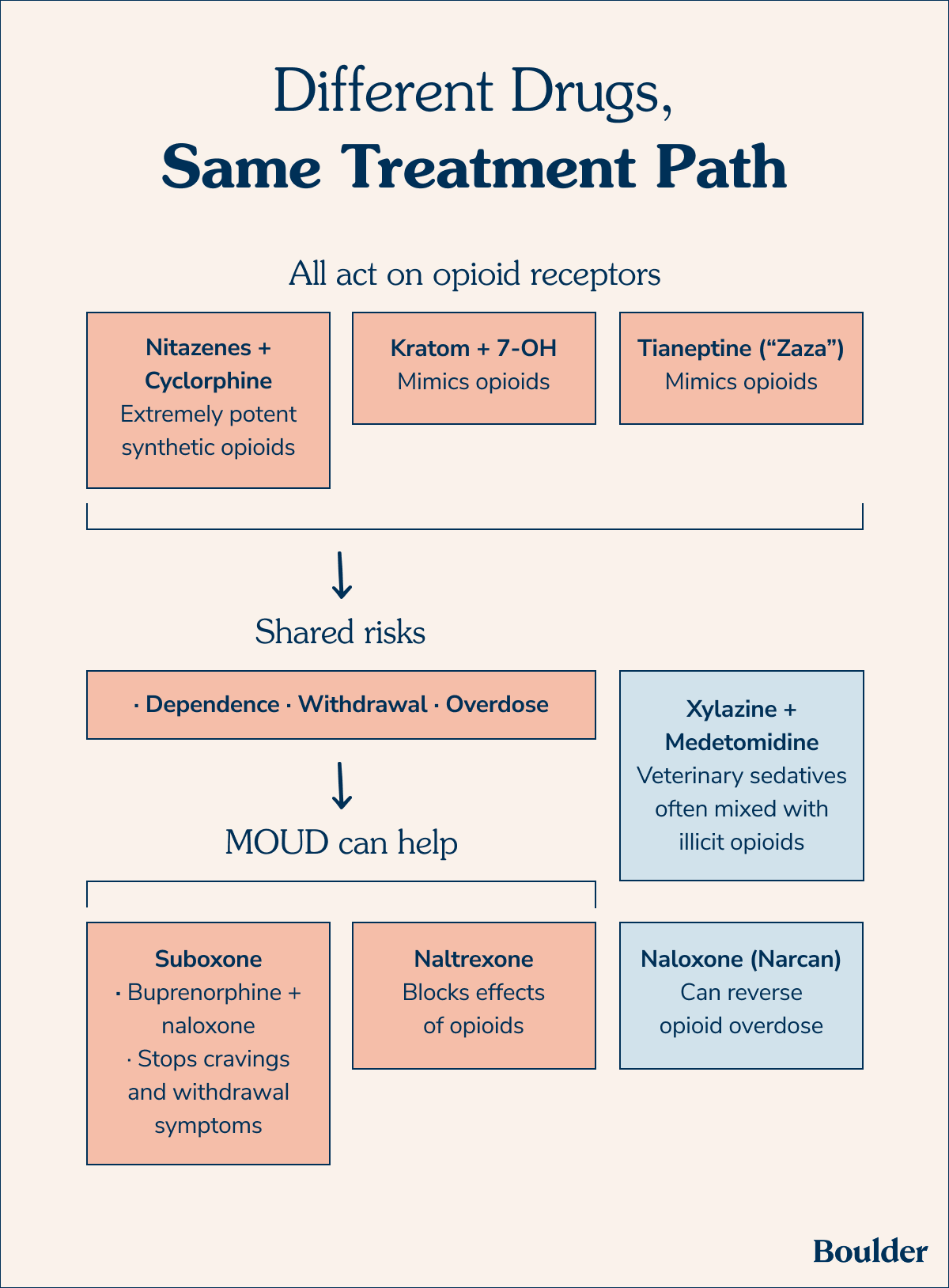
Nitazenes: a class of synthetic opioids frequently detected with other illicit drugs. They carry a serious risk of overdose, with certain types being even more potent than fentanyl.
Cychlorphine: A highly potent synthetic opioid that is 10 times as strong as fentanyl, according to the Journal of Pain Research. Often mixed with other illicit opioids — it is difficult to detect. Less common than the other substances in this article, it has recently been showing up more and more.
Kratom and 7-OH: Although natural kratom is plant-derived, many kratom products are more synthetic than people realize. 7-OH is a synthetic, highly concentrated formulation. It’s not technically an opioid but it acts on opioid receptors.
Other forms include 7-hydroxymitragynine (7-OH), mitragynine pseudoindoxyl, MGM-15, and MGM-16.
Tianeptine (“Zaza”): Tianeptine, often called “gas station heroin,” is technically an antidepressant prescribed in some countries, but it is not approved in the United States. Marketed as a "brain booster", many people don't know it is acting on their opioid receptors.
Dependence, withdrawal, and overdose is a risk with all these drugs. Narcan (naloxone) can reverse an overdose if administered correctly.
Synthetic sedatives: While not technically opioids, drugs like xylazine and medetomidine are veterinary tranquilizers that can cause deep sedation and dangerously slowed heartbeat. Xylazine can also cause necrotic skin wounds. They are often mixed in with traditional opioids.
As a general reminder, opioids, whether prescription medications (such as oxycodone), synthetic drugs (such as fentanyl), or illicit drugs (such as heroin), act on opioid receptors in your brain to block pain signals and release dopamine.
Opioids also slow bodily functions, such as your respiratory (breathing) rate, heart rate, and brain activity. This is where the danger comes in.
In high amounts or when used with other substances, opioids can lead to dangerous side effects or even death, as in the case of my friend.
And that’s what makes these drugs so dangerous—the fact that many act on opioid receptors in the brain themselves, and that they are often masked by other substances.
“[These new drugs] are synthetic opioids and/or opioid-like substances, carrying at least the same list of risks as traditional opioids,” Mossman says. “Each new addition to the drug supply brings unknowns. In real life, this may manifest as an unexpected interaction with other medications or an ineffective overdose response.”
“The drive behind drug supply changes remains the same — supply-chain disruptions, production costs, and access,” says Drew Mossman, PMHNP, FNP, clinical supervisor at Boulder Care.
“We’ve seen this many times before,” he adds. “Heroin increased significantly after “pill mills” were shut down in 2010, and fentanyl overtook heroin a few years later because it is much easier to produce and distribute. Both shifts coincided with massive increases in overdose deaths.”
Mossman says the shift to gas station drugs and synthetic opioids follows a similar pattern. “A key difference with tianeptine and 7-OH,” he notes, “is that they exploit legal loopholes, leading to unregulated access and misleading packaging.”
The U.S. Drug Enforcement Agency (DEA) and Department of Justice (DOJ) announced an emergency scheduling of mitragynine pseudoindoxyl, MGM-15, and MGM-16 in August 2026. The agencies are moving to temporarily place these drugs in Schedule I of the Controlled Substances Act, making them illegal to manufacture, distribute, or possess.
The DEA has also filed a notice of intent to temporarily place concentrated, isolated 7-OH products into Schedule I. Actual botanical kratom, which contains trace amounts of 7-OH, remains unscheduled at the federal level. Some states have banned kratom, however.
The legal status of these drugs is changing, but the health picture remains the same. Receptor activity, dependence, and withdrawal are serious concerns. Fortunately, clinical support is available for anyone who has developed dependence or addiction to these drugs.
One of the toughest realities is that people don’t always realize that these drugs are technically opioids. People may not seek addiction support in the same way. But some of the same treatments used to address — say, an addiction to heroin — can also be used to treat dependence on these newer drugs.
You might already be in recovery, or maybe you’re considering starting treatment for dependence on these drugs.
If you’re currently in treatment, talking to your care team about any history of use is a good idea. People have also commonly turned to some of these synthetic drugs as self-treatment for OUD. For example, the appearance of kratom, sold legally at various stores, may have seemed like an appealing alternative to heroin or fentanyl, especially since it’s a natural substance. But kratom use can also lead to dependency, and its effects are unpredictable.
Plus, 7-OH, the synthetic version of kratom, can be even more potent and more unpredictable. Instead of finding an off-ramp from the journey of opioid addiction, people are finding that they’ve traded one substance for another.
The risk of overdose or serious side effects is still there. Tolerance and withdrawal issues can be complex and hard to recognize.
“These substances complicate the picture,” Mossman says. “Regarding overdoses, Narcan may still help, but these substances are unpredictable due to varying strengths, additives, or different half-lives.” (A half-life is the time required before 50% of a drug leaves your system.)
“These same factors complicate detox, the transition to MOUD, and interactions with other medications, making open, honest conversations with trusted care providers imperative,” Mossman adds.
Tianeptine, kratom/7-OH, nitazenes, and cyclorphine all act on the opioid receptor system. So even if your story doesn’t look or feel like OUD, MOUD can help.
Suboxone (buprenorphine and naloxone) or naltrexone are key examples. But timing of MOUD matters to avoid precipitated withdrawal (severe symptoms).
“MOUD remains highly effective for these synthetic opioids,” Mossman says, “although dosing may differ based on the substance, the amount used over time, and individual variation. Transitioning from these opioids to MOUD may be more complicated (much like we saw when fentanyl replaced heroin), but it is very much achievable.”
Although xylazine and medetomidine aren’t gas station drugs or synthetic opioids, they are often mixed in with other opioids, so MOUD can be effective here too. And if overdose from these drugs is suspected, administering naloxone (Narcan) can help if opioids are present. There’s no harm in administering it if you’re unsure if an opioid is involved.
MOUD won’t necessarily treat addiction to xylazine and medetomidine themselves, however. But a knowledgeable care team can find solutions for easing your withdrawal symptoms that are specific to those drugs. Again, these specific drugs are often mixed with opioids, so MOUD treatment can address part of the battle.
Synthetic drugs are rapidly changing the OUD landscape. And even if they don't look like typical opioids, they can still be just as addictive and dangerous. Medications for opioid use disorder (MOUD) can step in as an effective, potentially life-saving treatment method.
“I stopped using kratom without medication, but I wish I had a doctor to help me or someone to talk to about what I was going through,” Melo says. I felt really scared and alone, and I felt ashamed for getting myself into that situation. Looking back, I can see now that I was grieving and just looking for some sort of relief. I put trust in how this product was marketed to me. Reading about others' experiences with it helped me feel normal and not so alone.”
If you are struggling with dependence on any of these synthetic substances or traditional opioids, help is available.
Contact Boulder Care for judgment-free virtual treatment. You can call (888) 608-0836 to speak with a team member and learn about your care options.
“Please know that you are not alone,” Melo says, “even when it feels like you are. You don't have to go through this on your own or wait until things get worse to admit that you could use a helping hand. There is support out there for you, and you deserve help, love, and honesty.”
At Boulder Care, we’re committed to providing clear, evidence-based information about opioid and alcohol use disorder recovery. Learn more about our editorial standards and medical review process.

Our mission is to improve the lives of people with substance use disorders. We provide medication, resources, and support to help our patients succeed on their own terms, wherever they are.
Now covered by Medicaid in Oregon and Washington – Schedule an online visit.