

Table of Contents
Published:
October 9, 2026
|
Last Updated:
October 9, 2026
You've got people now.


If you seek treatment for opioid use disorder (OUD), you might be prescribed one or more medications. Medications for opioid use disorder (MOUD) are increasingly used to treat opioid addiction because they help stabilize you or a loved one and get you out of survival mode.
A commonly prescribed MOUD is Suboxone, which is a combination of buprenorphine and naloxone. Sometimes providers prescribe additional medications in combination with Suboxone. Gabapentin, for example, is an anticonvulsant used to treat nerve pain and seizures. But sometimes it’s used “off-label” to ease anxiety and opioid withdrawal symptoms.
Taking gabapentin and Suboxone together requires medical supervision for safety reasons. Both medications can slow brain activity, heart rate, and breathing. Following your provider’s directions for taking these prescriptions is incredibly important.
In this article, we explore mixing gabapentin and Suboxone, why they help with OUD, and the potential side effects.
Yes, you can take gabapentin and Suboxone together when taken as directed by a licensed medical professional. Taking these medications only as directed is crucial. Both drugs are central nervous system depressants. This means they both slow brain activity, heart rate, and respiratory (breathing) rate.
Gabapentin is only approved by the Food and Drug Administration (FDA) to treat the uses noted above. However, sometimes doctors prescribe certain medications “off-label.” Prescribing off-label means using the medication for an unapproved use. When a provider prescribes gabapentin for OUD, they are doing so off-label.
Gabapentin and Suboxone at a glance
| Details | Gabapentin | Suboxone |
|---|---|---|
| What it treats | Partial onset seizures in patients 3 years or older and postherpetic neuralgia in adults | OUD |
| Medication type | Anticonvulsant | Narcotic analgesic combination; contains buprenorphine, which partially activates opioid receptors in the brain; contains naloxone, a full opioid antagonist to prevent misuse of the medication opioids |
| How it affects the body | Calms overactive nerve cells to ease pain and blocks seizure signals | Buprenorphine reduces cravings and withdrawal symptoms; helps preventWhy would a provider prescribe gabapentin with Suboxone?A provider might prescribe gabapentin with Suboxone to ease withdrawal symptoms or support overall recovery. “Gabapentin can act as a bridge between the last use of a substance and initiating buprenorphine,” explains Drew Mossman, PMHNP, FNP, clinical supervisor at Boulder Care. “Long term, it may reduce symptoms that may be triggers for using, such as pain.” Nerves can release “excitatory” chemicals when they are under distress. These excitatory chemicals can send messages to the brain about pain or trigger a seizure. Gabapentin works by helping to stop the release of those excitatory chemicals. For these reasons, gabapentin can help calm some of the withdrawal symptoms you or a loved one might experience when stopping opioids. A bridge between last opioid use and starting SuboxoneWhen starting Suboxone, timing matters. Starting the medication too soon after the last use of opioids can lead to precipitated withdrawal. Precipitated withdrawal means experiencing severe withdrawal symptoms. To avoid precipitated withdrawal, your provider will recommend the best timing for you to start taking Suboxone. But most situations require a 12- to 24-hour gap between the last use of an opioid and the first dose of Suboxone. Some withdrawal symptoms will occur during this gap. Your provider may prescribe gabapentin as a stopgap to ease these withdrawal symptoms until you can safely take Suboxone. Long-term useChronic pain may be a reason you or a loved one started using opioids. For example, sometimes doctors prescribe opioids to manage pain from a chronic condition or temporary pain, such as after an injury or procedure. If you or a loved one is stopping opioids, pain may return and be a trigger for a return to use. Gabapentin is a medication that can help with several types of pain. Because it has calming effects, it can also aid with sleep and anxiety. Suboxone also aids with pain and has calming effects. But a provider may prescribe gabapentin for additional relief. 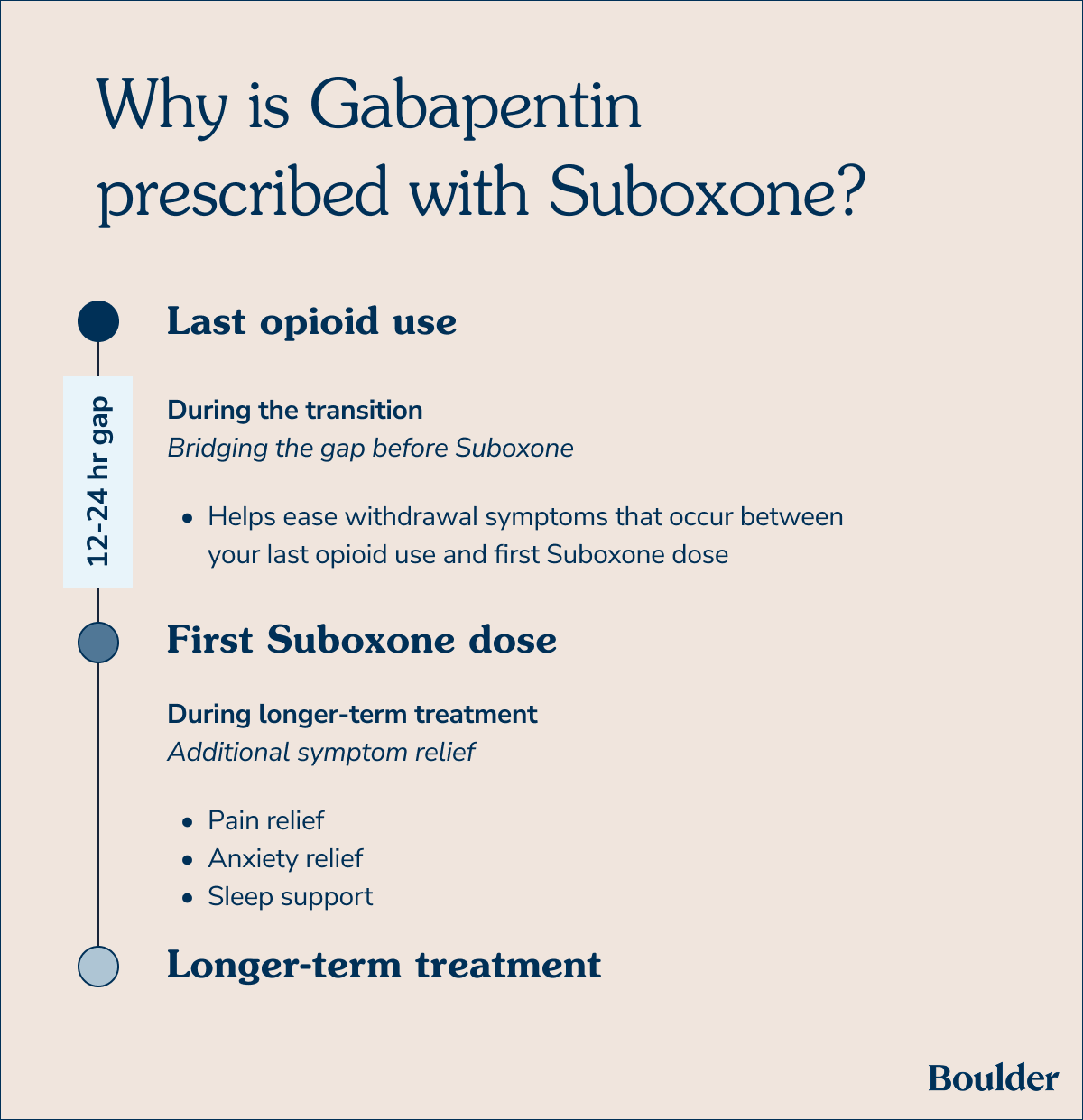 Off-label uses of gabapentinThe FDA approves medications, including gabapentin, for specific uses. But occasionally providers learn that a medication helps with conditions beyond these approved indications. So they may prescribe the medication for an off-label use. For example, because it can help block or ease nerve pain, doctors sometimes prescribe gabapentin off-label to prevent or treat migraine attacks. Taking gabapentin to help treat OUD is an off-label use. Gabapentin is commonly prescribed off-label for:
Get the medication you need, and the support you deserve. We provide FDA-approved medications for alcohol and opioid addiction — and support services to help you stay on track and reach your recovery goals. Learn more about our servicesWhat are the risks of combining Suboxone and gabapentin?Taking gabapentin with Suboxone does carry risks because both of these medications are central nervous system depressants. The concern largely has to do with the combination of gabapentin and buprenorphine, one of the medications in Suboxone. Possible respiratory depressionAny medication that activates opioid receptors can cause respiratory depression. Respiratory depression means breathing becomes slower and shallower, which reduces oxygen and carbon dioxide exchange. With full opioid agonists, such as morphine and fentanyl, higher doses can intensify these effects and lead to severe, life-threatening respiratory depression. Buprenorphine only partially activates opioid receptors. And it has a “ceiling effect.” This means that the medication’s maximum effect on respiratory depression is more limited than a drug that fully activates opioid receptors. The effect plateaus, even at higher doses. This is a safety mechanism that makes Suboxone so useful for treating OUD. Gabapentin can also suppress breathing. The risk of severe respiratory depression is present mainly when combining gabapentin with opioids or other medications that have a sedative effect. Possible sedation“Both medications can cause sedation,” Mossman says, “potentially leading to lethargy, confusion, slowed heart rate, risk of accidental overdose, and, in the worst-case scenario, life-threatening respiratory depression.” For these reasons, the use of gabapentin and Suboxone together should only occur under strict guidance from a healthcare provider. Mossman notes one additional concern about gabapentin. “Long-term use can lead to dependence,” he says. “So the risks and benefits should be thoughtfully weighed.” IN CASE OF EMERGENCY If you or a loved one experiences slowed or shallow breaths, difficulty breathing, dizziness, or a drop in blood pressure, call 911. Administer naloxone (brand name: Narcan) if opioids may be involved to help counteract a potential overdose. How to take gabapentin and Suboxone safelyIf a provider prescribes Suboxone and gabapentin to you or a loved one, follow their exact directions for taking both medications to avoid potentially dangerous drug interactions. “If initiating either medication while currently taking the other,” Mossman says, “a good rule is to start low and go slow regarding dosage and frequency. If you begin experiencing an interaction, tell your doctor immediately. Over-sedation or difficulty breathing should be treated as a medical emergency.” 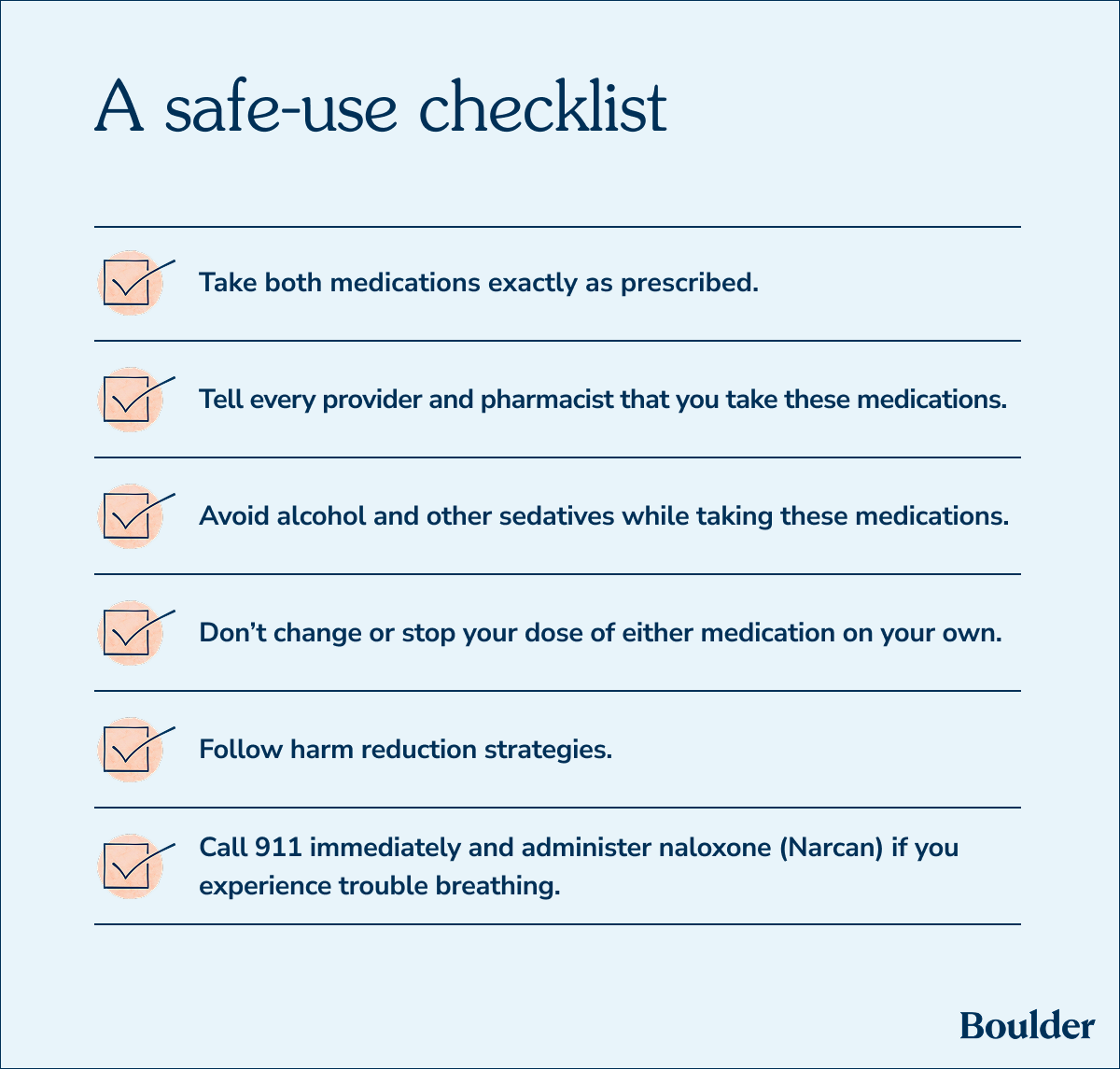 What to do if you’re worried about your useIf you have any questions about gabapentin or Suboxone use, talk to your prescribing provider. Gabapentin is a drug that can lead to dependence. For example, missing a dose can lead to an increase in pain or seizures or the onset of withdrawal symptoms. This is because the body can become physically dependent on it to keep nerve signals calm. Stopping it after long-term use can be difficult. Additionally, it’s a medication that is subject to misuse, such as taking more than prescribed. Gabapentin misuse occurs in about 1% of the general population, according to research published in 2017 in the journal Addiction. Misuse occurs in about 40% to 65% of people with prescriptions and in about 15% to 22% of people who misuse opioids. If you’re concerned about gabapentin or opioid misuse, help is available, and recovery is possible. Contact Boulder Care for judgment-free virtual OUD treatment options and resources. The bottom lineProviders sometimes prescribe gabapentin off-label to help treat OUD. The medication might be prescribed in combination with Suboxone, a MOUD. In some cases, gabapentin is prescribed as a temporary bridge between the last use of an opioid and the start of taking Suboxone, which contains buprenorphine. In other cases, gabapentin is prescribed long term in combination with Suboxone. Your provider will tell you the safest ways to take your medications. Taking these medications exactly as prescribed is important, as serious drug interactions can occur when they are combined. Frequently Asked QuestionsIs gabapentin a controlled substance?Whether gabapentin is a controlled substance will depend on where you live or travel. In the United States, gabapentin is not a controlled substance at the federal level. However, several states classify gabapentin as a Schedule V controlled substance. Some states do not classify the medication as controlled, but they require pharmacies to report all prescriptions to state monitoring programs. Does gabapentin help with opioid withdrawal?Gabapentin may help with opioid withdrawal by calming nerve pain signals and easing anxiety. Can buprenorphine and gabapentin be given together?Yes, gabapentin and buprenorphine are sometimes prescribed together for the treatment of opioid use disorder. But taking these medications together requires following all prescribing directions and undergoing close monitoring by a healthcare provider. On-demand, online addiction care from home — on your terms. Access our care team directly through an app on your phone. Get started in the Boulder Care appEditorial PolicyAt Boulder Care, we’re committed to providing clear, evidence-based information about opioid and alcohol use disorder recovery. Learn more about our editorial standards and medical review process.  Our mission is to improve the lives of people with substance use disorders. We provide medication, resources, and support to help our patients succeed on their own terms, wherever they are. Now covered by Medicaid in Oregon and Washington – Schedule an online visit. |