Published:
November 11, 2026
|
Last Updated:
You've got people now.


The following situation can be all too common for someone living with an addiction: your finances are taking a major hit, your family and friends have expressed concern, and you’re experiencing serious problems in your relationships. Maybe you've said or done things you aren’t proud of, like hiding your use, lying about it, or borrowing money you can’t pay back.
If you're recognizing these things, you may be coming to terms with the fact that the control you once thought you had over your drug use is slipping away. You're probably trying to make changes to set things right, but there's a good chance it's not going the way you'd like. Perhaps you've tried to limit your use, but now you're running into major roadblocks with withdrawal or cravings.
It’s common to think, “If things get worse, I will seek help. But right now, I’ve just gotta do X, Y, and Z, to get this under control.” Or it's possible you've heard someone say: “I know you won’t seek help until you hit ‘rock bottom’ and realize you need it.”
The rock-bottom concept is a common myth about addiction and recovery. But the truth is that you don’t need to wait for your life to completely fall apart before you seek help for opioid use disorder (OUD) or alcohol use disorder (AUD). You can seek help at any time. Waiting can cost jobs, homes, relationships, and, in the worst-case scenario, lives.
I lost a friend to a heroin-fentanyl overdose in 2017. At the time, one of his friends told me, “I never knew someone could just dabble in heroin like he did.”
The statement referred to the long-term occasional use my friend had engaged in while holding down a job, maintaining an apartment and car, going for long runs to stay in shape, and more. He was so “high-functioning” that I never even knew about his use until his death, as I lived in a different state.
In this instance, rock bottom for my friend meant the loss of his life. It was too late. But “too late” doesn’t have to come, because you can make changes as soon as you recognize your addiction. And life doesn’t have to get exponentially worse before it gets better.
The rock-bottom myth is the false notion that life has to get really rough and that you have to reach your worst point before being ready to seek help for OUD or AUD. The “worst point” or “hitting bottom” might mean losing housing, losing custody of children, entering the criminal justice system, or something else that feels equally dire.
To be clear, sometimes these things can motivate someone to seek treatment and recovery. But motivation can also come much earlier, when the early signs of problems surface, including relationship issues or declining health, or just when you recognize you’re not living the life you want to.
You might think the rock-bottom concept is true about yourself, that you need to get worse before you can get better. Or if you have a loved one struggling with substance use disorder (SUD), you might think they need to fully crash out before they’ll make a change.
“I think [it] can be really harmful because it suggests we should wait for things to get worse before offering help,” says Kara Tarr, MSN, PMHNP-BC, a psychiatric mental health nurse practitioner and clinical supervisor at Boulder.
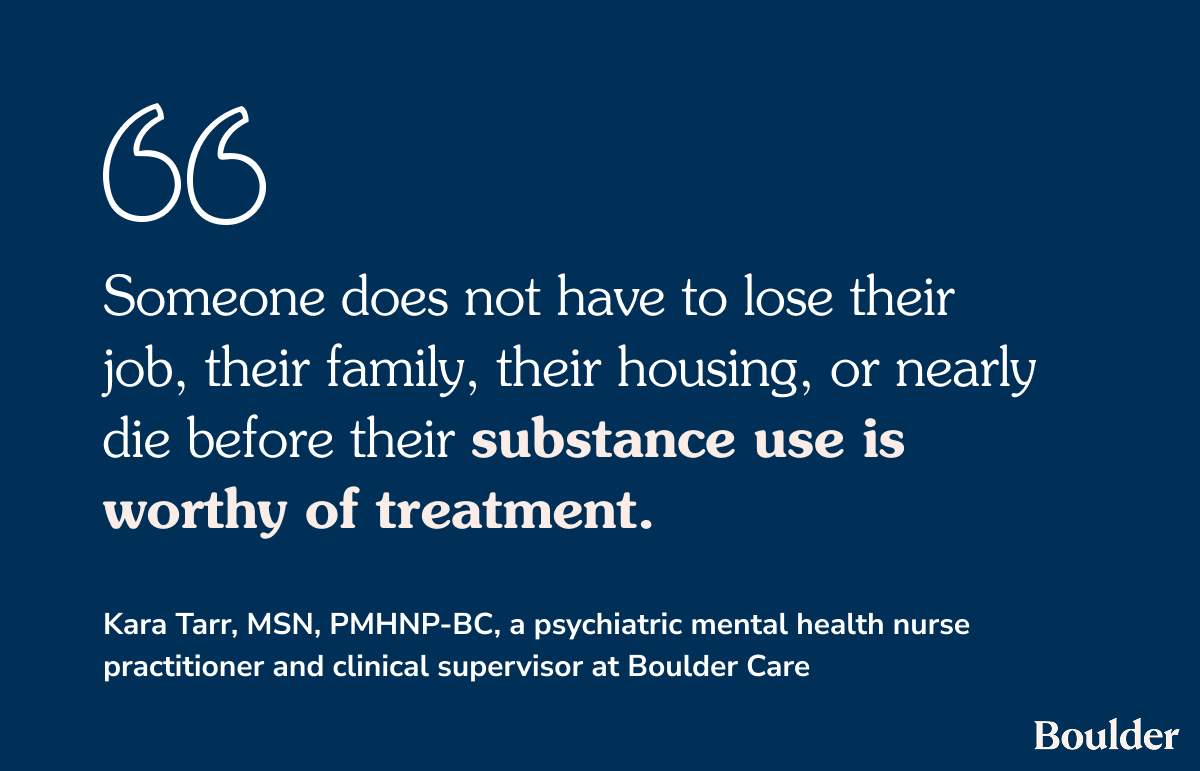
“Someone does not have to lose their job, their family, their housing, or nearly die before their substance use is worthy of treatment. We can intervene much earlier than that,” she adds.
The myth comes from various places. It’s perpetuated in film, television, novels, and other media portraying addiction narratives. It’s also present in 12-step literature. A related concept is “tough love.” The “tough love” approach encourages loved ones to “cut off” support for someone struggling with addiction so that they “hit rock bottom” and are “forced to change their behavior.”
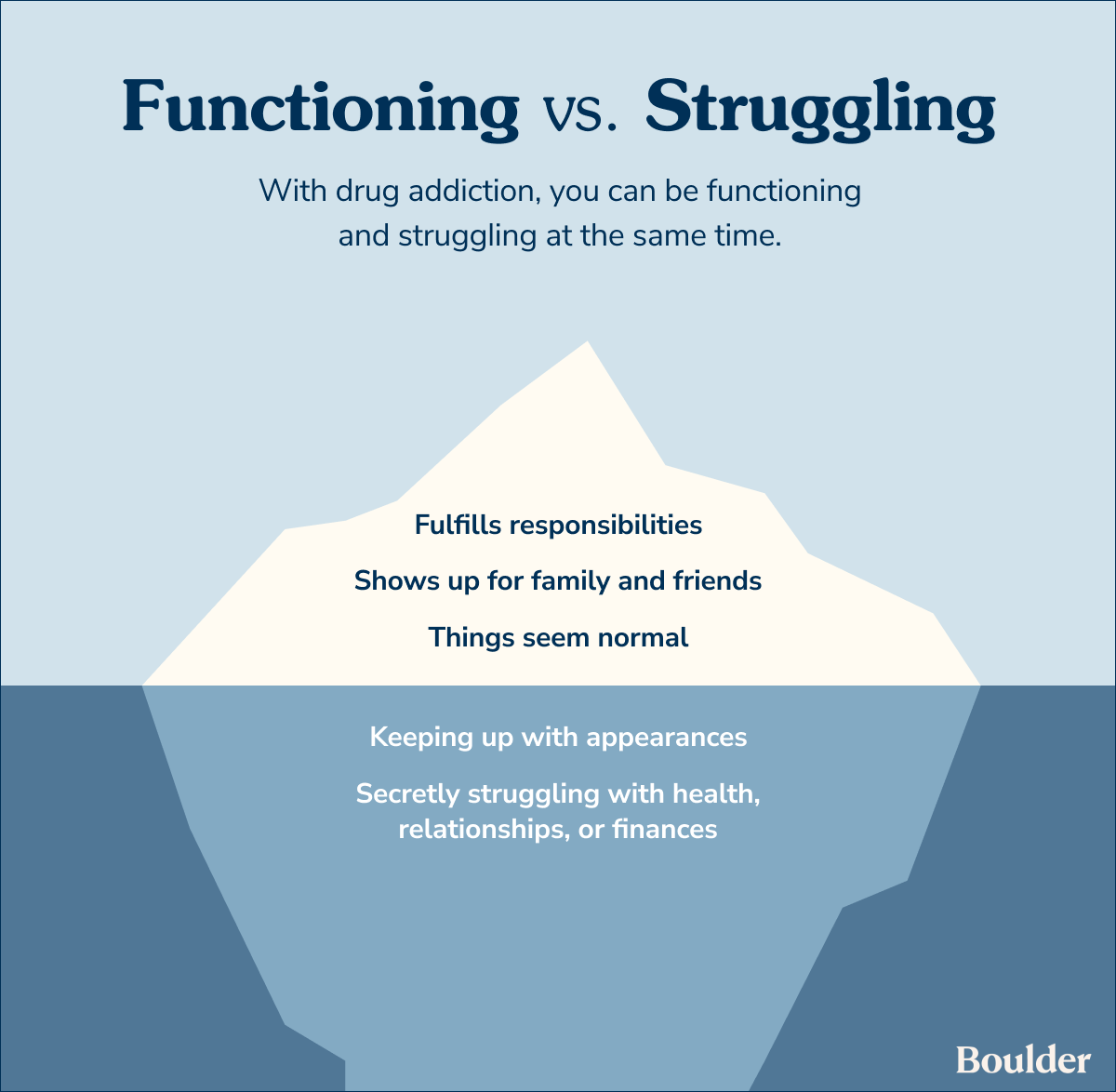
You might have heard the term “high-functioning addict” or “high-functioning alcoholic.” These terms describe someone who is using opioids or using alcohol (in excess) but maintaining or even excelling at their job, their relationships, and more.
The truth is that “functioning” and “struggling” can be true at the same time. You may be functioning well enough in general. But you may also be noticing that you’re unable to control your use. Maybe you’re even starting to notice problems with it, such as frequently calling in sick to school or work. Or maybe a loved one has become increasingly concerned or frustrated with you.
“People can be incredibly high functioning and still be struggling significantly,” Tarr says. “Someone can go to work every day, take care of their family, pay their bills, and appear completely put together from the outside while also having a substance use disorder that is affecting their health, relationships, or quality of life.”
She adds, “Functioning does not tell us how much someone is struggling [with drug use]. Often, people are putting an enormous amount of energy into maintaining that level of functioning while dealing with something very difficult behind the scenes.”
This was clearly the case for my friend. On the outside, he appeared to be thriving. He had started a new job he loved. He had lots of dear friends around him. He’d started a new relationship. But none of these things meant that he wasn’t struggling.
→
Waiting for rock bottom means waiting for things to reach their lowest point before seeking help. But delaying treatment means delaying relief from the cycle of addiction and the survival mode that addiction can place you or a loved one in.
The rock-bottom myth perpetuates the false idea that the worst point is the only turning point for you or a loved one. It suggests that you’ll descend into a pit and then finally decide to climb your way back out when you realize you’re there. But you don’t have to drop all the way into the pit in the first place to recognize that you want something different.
“I believe in rock bottom,” says Wesley Brewington, a peer support specialist at Boulder Care. “But I also believe our bottom is wherever we decide it is. I dug myself a pretty deep hole, but I could’ve kept digging. We get to choose when we put the shovel down.”
Addiction tends to progress rather than reverse without intervention. Seeking help with addiction earlier rather than later reduces the risk for emergency room visits and overdose deaths. But it can also help prevent further life complications, such as job, housing, relationship, or health concerns.
“For me, I reached a point where the fear of staying the same outweighed the fear of change,” Brewer says. “That’s when I decided to reach out for help. My rock bottom wasn’t the lowest I could’ve gone. It was the place where I decided I wasn’t willing to go any ‘lower.’”
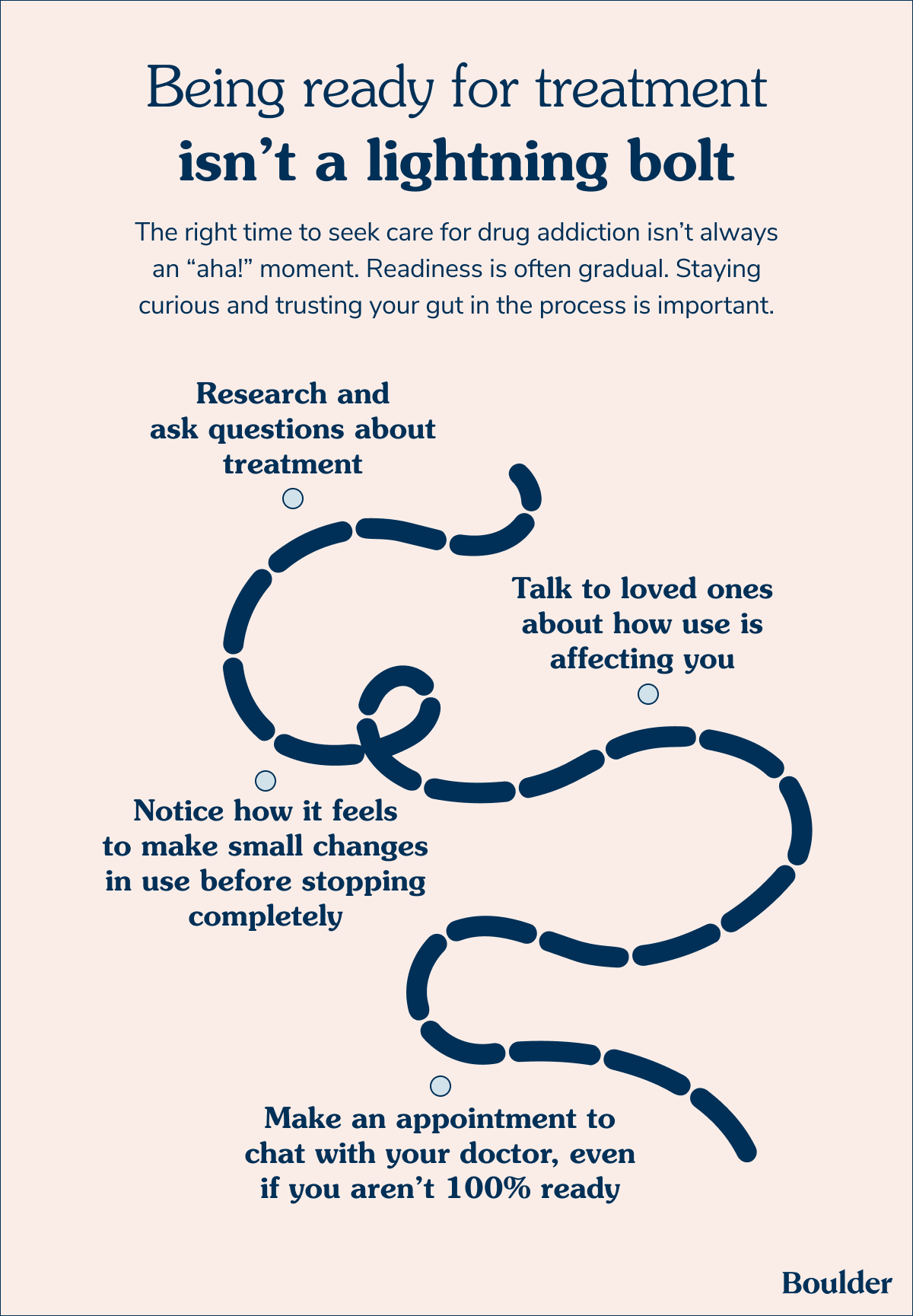
The rock-bottom myth also suggests that “readiness” for recovery occurs as a lightning-bolt moment. You hit rock bottom and suddenly realize that you’re ready for treatment. But a readiness for treatment can show up in subtle ways.
“Sometimes readiness starts with curiosity rather than commitment,” Tarr says. “A person might start asking questions about treatment, wondering what medications are available, talking about how their substance use is affecting them, or saying they are tired of certain consequences.”
Readiness can also look like taking baby steps. “They may start thinking about using less, using more safely, avoiding certain situations, or making small changes even if they are not ready to stop using completely,” Tarr adds.
Being ready also doesn't have to mean you're "all in" for treatment. And that’s OK. “Even showing up for an appointment while saying, ‘I’m not sure I want treatment,’ can be a sign of readiness,” she says. “Our job is not to demand full buy-in before helping someone. It is to recognize those small openings and meet the person there.”
No matter what stage of addiction, recovery, or recognition you're at, Boulder Care meets you where you are. Boulder Care does not have a sobriety requirement, and it doesn’t require you to hit rock bottom.
“Boulder Care recognizes that recovery does not look the same for everyone and that people do not have to reach a certain level of readiness before they deserve care,” Tarr says.
She adds, “We take a harm reduction approach, which means we work with the patient on the goals that matter to them right now. For one person, that may mean stopping opioid use completely. For someone else, it may mean reducing their use, preventing overdose, or simply becoming more stable.”
The goal of stability is woven into Boulder's model. Boulder’s care is virtual and is an alternative to rehab. Boulder Care includes the use of medications for OUD (MOUD), such as buprenorphine (a medication in Suboxone). Or medication-assisted treatment (MAT) for AUD, also called MAUD, such as naltrexone.
Taking MOUD does not mean that you’re “trading one drug for another.” That’s another myth about OUD. MOUD interrupts the cycle of OUD by helping to stabilize your brain chemistry, which gets you out of the survival mode that addiction places you in.
The newfound stability helps you engage with other aspects of treatment, such as therapy and more. Suboxone works at any stage of OUD. It’s not just for people who’ve hit rock bottom.
There is no expectation to prove that someone is "ready enough" for treatment. The focus is on keeping the door open, building trust, and encouraging safer or healthier choices over time.
“I personally was never ready to engage in recovery until I was ready,” says Elizabeth MacPherson, a peer support specialist at Boulder Care. “Forced treatment stays, family boundaries, and detachment never made me want to change. What worked was my desire for it and having the power to do something about it.”
If you feel ready to start your recovery or simply learn more about Suboxone and treatment options, you can call (888) 608-0836 to speak to a Boulder Care team member.
You can also get started here.
At Boulder Care, we’re committed to providing clear, evidence-based information about opioid and alcohol use disorder recovery. Learn more about our editorial standards and medical review process.

Our mission is to improve the lives of people with substance use disorders. We provide medication, resources, and support to help our patients succeed on their own terms, wherever they are.
Now covered by Medicaid in Oregon and Washington – Schedule an online visit.