Published:
November 3, 2026
|
Last Updated:
You've got people now.

If you or a loved one has made the decision to stop using opioids and seek medication during recovery, congrats, this is a significant step. The FDA approved Medications for Opioid Use Disorder (MOUD) are some of the best options for care while managing cravings and withdrawal symptoms, with Suboxone being one of the most popular formulations for treatment.
You might be seeking out Suboxone (a combination of buprenorphine and naloxone) for a variety of reasons. “There doesn't have to be a rock-bottom moment for someone to decide they want help,” says Danielle Bellosi, a peer recovery supervisor at Boulder Care, who took Suboxone from 2009 to 2011. “Sometimes it's about wanting to feel better, regain some control, or make a change. Recovery looks different for everyone, and the decision to seek care should always be met with compassion rather than judgment.”
Critically, Suboxone is available in several ways and accessing it doesn’t require seeing an in-clinic specialist or doing a rehab stay. You also are under no obligation to stop using opioids on your own before seeking care. A support team can guide you through the process and ensure you can take medication like Suboxone as soon after opioid use as is safe to do so.
With that said, read on for information on the main ways to get Suboxone, what your first appointment will look like, and how to overcome barriers to access.
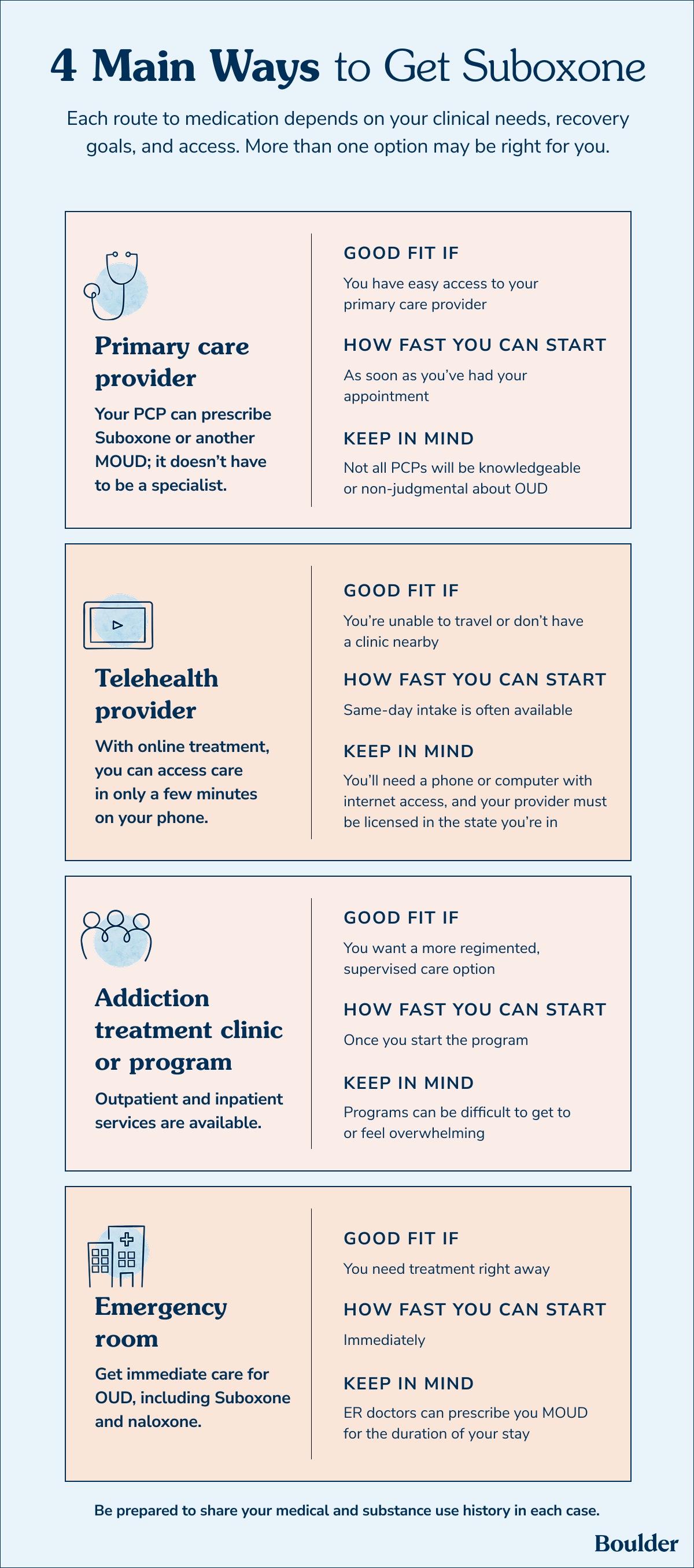
Suboxone is available via your primary care doctor, a telehealth provider, at addiction treatment clinics and programs, and in emergency rooms. Each option depends on a person’s access, current needs, and goals. These routes differ in speed of care, level of commitment, and how much ongoing support is available. The key here is that no single route is right for everyone.
You don’t have to see a specialist in order to access Suboxone. Your primary care doctor is allowed to prescribe Suboxone, along with any other MOUD. This route can be a great option if you have easy access to a primary care provider who is respectful and understanding.
The potential negative here could be working with someone less knowledgeable about opioid use who wrongly passes judgment.
Another way to access medication is through online Suboxone treatment. “Today, there are so many more options available, including telehealth, which I think is an absolute game changer. The idea that someone could connect with a Suboxone provider, receive support, and access treatment right from their phone was practically unheard of when I was seeking care.” Bellosi says.
Telehealth’s speed of care is a tremendous benefit. It can allow you to see a provider in less than three minutes, while accessing one through an outpatient substance use disorder clinic might take one to two weeks.
At Boulder Care, our goal is to make care as easy to get as possible. Boulder Care can quickly offer video visits, Medicaid coverage, and a dedicated care team to support you and your goals. We can accept patients across many states.
Notably, it can matter where you are geograpgically located during the telehealth appointment. A provider might only be licensed in a specific state and unable to see you or prescribe medicine if you’re traveling out-of-state, according to the U.S. Department of Health and Human Services (HHS). Additional barriers to telehealth use include lack of a phone or poor internet and data connectivity.
These options can be great if you want ongoing, supervised care. Addiction treatment clinics are available as outpatient and inpatient services, with a support team there to help you manage treatment. At the same time, Suboxone clinics and programs might feel overwhelming, be difficult to attend, or not align with your goals.
You can access care for opioid use in emergency rooms, including Suboxone and naloxone. Emergency room physicians are allowed to prescribe opioid withdrawal medication for a few days while you’re in there.
Anyone living with diagnosed opioid use disorder can qualify for Suboxone. As Eduard Breytman, a clinician supervisor at Boulder Care, explains, “You will be asked the DSM-5 [Diagnostic and Statistical Manual of Mental Disorders, 5th Edition] questions related to establishing the opioid use disorder diagnosis so that we can ensure we appropriately treat you.”
Part of this diagnosis is also to distinguish whether you’re experiencing opioid use disorder or physical dependence.
Signs of opioid use disorder include using more of a substance than directed and feeling unable to cut back on use even if it negatively affects your life.
On the other hand, physical dependence is different than addiction. It’s a predictable physiological adaptation that your body makes when it becomes used to a substance and shouldn’t involve any harmful behavioral changes. Physical dependence can occur while taking a medication exactly as prescribed, including Suboxone.
Breytman notes one caveat for accessing care: “You cannot be under current care by another provider for OUD or Chronic Pain — as in, you cannot have recent Suboxone or Sublocade from an outside provider that is still active, or actively being treated for chronic pain by another provider.”
A Suboxone provider will also want to know whether you live with co-occurring mental health conditions or use any other substances, including alcohol. These factors can help your care team tailor your treatment plan and provide the best level of care to you.
Similarly, they will want to know whether you take other drugs such as kratom, 7-Hydroxymitragynine (7-OH), or tianeptine. Suboxone can help treat a kratom addiction, according to the Journal of Drug and Alcohol Dependence. Further research in the Journal of Addiction Medication has also shown that Suboxone can support management of a 7-OH addiction. The Journal of Addictive Diseases demonstrates similar evidence of Suboxone’s benefits for treating tianeptine addiction.
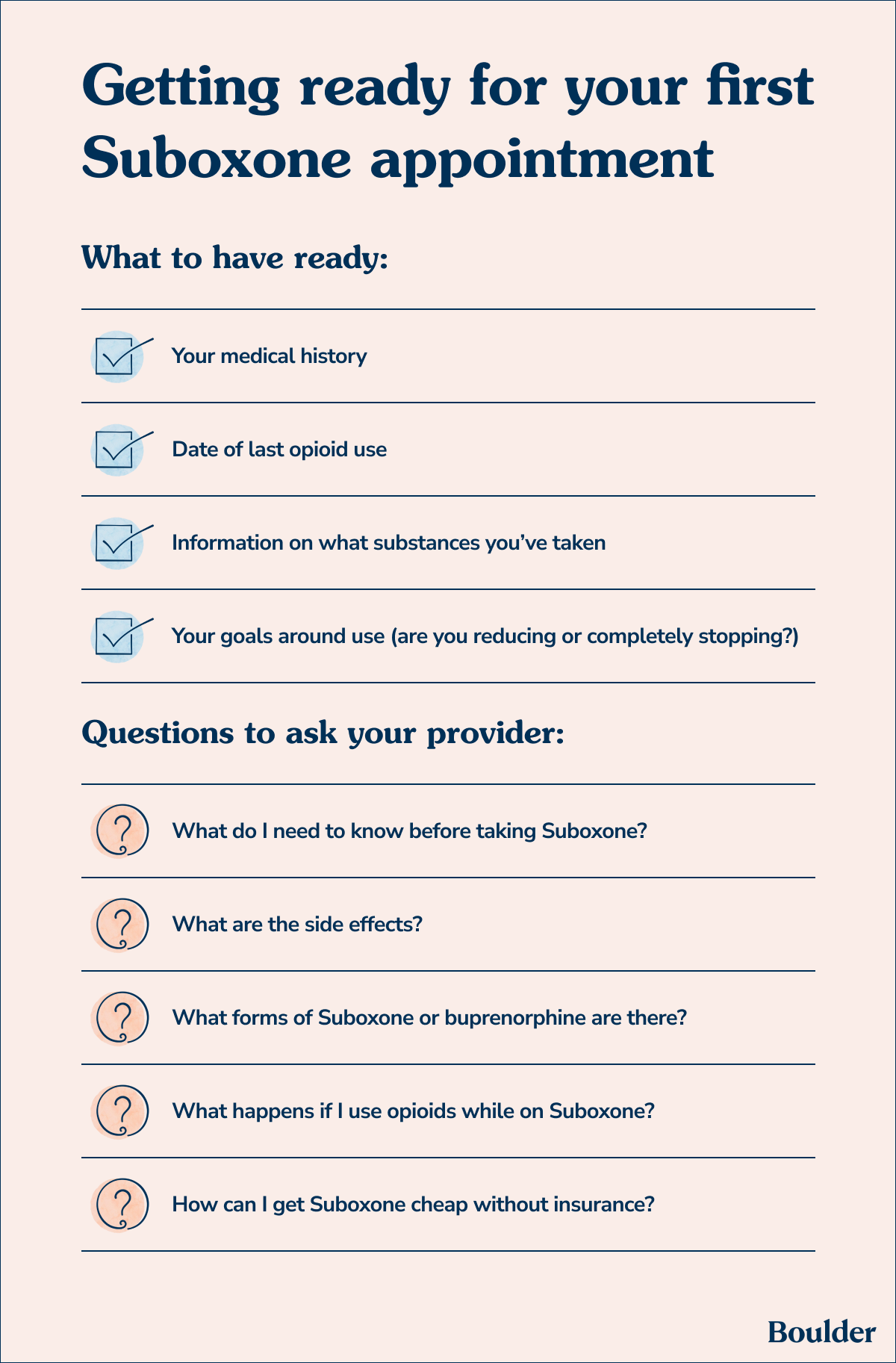
Your first Suboxone appointment is a chance for your care team to get to know you and prescribe Suboxone, if it’s the right fit. Your provider will ask you information about your medical history and dive into your substance use. This should be a judgment-free conversation with honest answers allowing providers to tailor safe care for you. Being truthful about your use should not be grounds for refusal.
“I think one of the biggest barriers to seeking care is fear of the unknown,” says Bellosi. “People may be nervous about being judged, unsure of what to expect, or worried about whether Suboxone is the right option for them.”
Bellosi continues, “That first appointment should be an opportunity to have an open and honest conversation about what someone is experiencing, their goals, their history, and what treatment options are available. It should be collaborative, person-centered, and focused on meeting someone where they are.
The key here is making sure you have all the information and support you need. “We would educate you on the way the medication works, different transition methods — such as slow start, quick start, macro dose — and comfort medications we can offer,” says Breytman. “We would ultimately come up with a treatment plan in a collaborative manner.”
According to Breytman, here are some of the questions a provider might ask at your first Suboxone appointment:
Your provider will also explain the importance of timing for your first Suboxone dose. Taking Suboxone too soon after using opioids can cause something called precipitated withdrawal. It can cause symptoms ranging from muscle aches to intense agitation. Being completely honest with your provider about when you last used opioids can help prevent precipitated withdrawal.
“I would encourage people to be open with their care team about what they've been using, when
they last used, and how they're feeling,” says Bellosi. “There shouldn't be any shame in those conversations. That information helps providers determine the safest approach.”
New options for starting Suboxone safely are also becoming available, including Boulder’s QuickStart. It can help if you’ve taken fentanyl — which can last in your symptom — longer than many other opioids — and allows you to start Suboxone immediately.
To be clear, additional support such as counseling might be an incredibly helpful part of your treatment plan, but they are not necessary for you to get a Suboxone prescription.
In 2023, the HHS and the Center for Drug Evaluation and Research (CDER) published a letter to providers which clarified that providing medication shouldn’t be dependent on whether a person engages in counseling or similar services.
The letter points out that the risk of fatal overdose is too high to allow for any delays in providing medication. It further states, “The decision as to when counseling and other services, such as case-management and peer support, are to be provided should be made in collaboration with the individual patient.”
Same-day Suboxone is possible to obtain, whether you’re starting it for the first time or have run out of the medication. For instance, a provider might be able to prescribe you Suboxone during your first appointment. According to Breytman, “The best thing you can do is try to get in for an intake appointment. We usually are able to get you the medication the same day.”
You can also try contacting your provider to get a refill if your Suboxone prescription has expired. Similarly, keep in mind that if your usual pharmacy is out of Suboxone then you will likely be able to get it from another pharmacy nearby.
There’s also the option of going to an emergency room. According to the National Institute on Drug Abuse, since 2002, emergency room physicians have been allowed to administer buprenorphine if you’re experiencing opioid withdrawal. They can also give you naloxone if you’re experiencing an overdose.
There’s something called the “three day rule” which lets you access emergency Suboxone. This stems from Public Law 116-215, which allows hospital practitioners “to dispense not more than a three-day supply of narcotic drugs to one person or for one person’s use at one time for the purpose of initiating maintenance treatment or detoxification treatment (or both).” The idea is that this keeps you safe while providing a time buffer for you to get a prescription.
Critically, there are risks if you stop Suboxone suddenly. For starters, you will likely have developed a lower tolerance to opioids while off of them. Using the same amount of opioids after this break can increase your chances of an overdose. Carry naloxone around as a protective measure and look out for signs of an opioid overdose.
Paying for Suboxone can involve private insurance, Medicare, Medicaid, or paying out-of-pocket. What Suboxone costs can vary tremendously based on which of these methods you use.
While paying on your own can drive up the cost of medication, there are ways to make it more affordable. Generic versions and prescription discount cards allow you to access a much lower price for the same medication. In the next section, we'll dive deeper into this and solutions to other barriers.
At Boulder, we verify your benefits before care starts to ensure everything moves quickly and smoothly. You can find information on what insurance Boulder takes in each state here.
You can overcome barriers to accessing Suboxone through methods such as generic prescriptions and telehealth.
Yes, obtaining medication might come with obstacles. “Cost, pharmacy availability, transportation, and finding a provider were all barriers that could make accessing treatment difficult,” says Bellosi, based on her own experience taking Suboxone.
For instance, if you run out of Suboxone early, know that insurance may not cover it until you are due to fill. While not ideal, you might also be able to pay out-of-pocket for enough medication until your insurance covers it again. For instance, Bellosi used Medicaid to pay for Suboxone but sometimes had to pay out-of-pocket if she needed an early refill. “I remember paying around $10 per pill, which adds up quickly,” she says.
Below, we’ve broken down some of the biggest barriers to coverage you might encounter and how you might be able to overcome them.
Barriers to coverage might include:
Facing any of these barriers can feel incredibly discouraging, but they don’t have to prevent you from accessing care. Most issues you encounter have workarounds that allow you to access care without compromising on quality.
Taking Suboxone is a big step that requires thought and, at times, flexibility. Doing what feels right for you should never be met with judgment. You deserve support and care as you navigate Suboxone treatment.
As Bellosi puts it, “If there's one thing I would want someone reading these articles to understand, it's that you don't have to hit rock bottom to deserve care, and you don't have to have everything figured out before reaching out for help.”
If you are interested in starting Suboxone via telehealth, or just want more information, you can call (888) 608-0836 to talk to a Boulder Care team member. Or learn about our services here.
Emergency room physicians are allowed to administer Suboxone and other MOUD for three days. This medication coverage helps keep you safe and, ideally, gives you time to access Suboxone through a prescription.
Yes, you need to stop using opioids before taking Suboxone. A break between using opioids and taking Suboxone is critical to avoid precipitated withdrawal.
Suboxone is available without private insurance. For starters, Medicaid and Medicare both offer Suboxone coverage to qualifying patients. However, there are ways to significantly lower the cost if you’re paying for Suboxone completely out-of-pocket. These methods include buying the generic versions of Suboxone (buprenorphine and naloxone) and using prescription discount cards at pharmacies.
At Boulder Care, we’re committed to providing clear, evidence-based information about opioid and alcohol use disorder recovery. Learn more about our editorial standards and medical review process.

Our mission is to improve the lives of people with substance use disorders. We provide medication, resources, and support to help our patients succeed on their own terms, wherever they are.
Now covered by Medicaid in Oregon and Washington – Schedule an online visit.