Naltrexone and Suboxone are both effective, evidence-based treatments for opioid use disorder, so how do you decide which one is right for you? You'll need to consider factors like your current opioid use, withdrawal status, and treatment goals to help your provider determine the right fit for you.
"Neither medication is 'better' than the other — they're simply different tools that can support different people at different points in their recovery," says Danielle Bellosi, a peer recovery specialist at Boulder Care who has lived experience with these medications throughout her recovery.
In this article, we'll compare naltrexone vs. Suboxone, including how each medication works, when each option is the best fit, what to know about the risks and benefits, and how to have an informed conversation with your prescriber about your treatment options.
The key difference between naltrexone and Suboxone is in how they work: naltrexone blocks opioid receptors to prevent you from feeling their effects, and Suboxone partially activates the receptors to reduce withdrawal symptoms and cravings, explains the National Institute on Drug Abuse.
While they work in different ways, both are types of medication-assisted treatment (MAT) prescribed for opioid use disorder.
A trial published in The Lancet found that both extended-release naltrexone and buprenorphine-naloxone can be effective during recovery. However, factors like readiness, withdrawal risk, and personal preference play a key role in choosing between the two options.
The following table offers a general comparison of naltrexone and Suboxone.
According to the ASAM National Practice Guideline, factors that influence eligibility, dosing, and treatment recommendations are unique to each person and should always be made by a qualified healthcare provider.
Naltrexone and Suboxone both act on opioid receptors in the brain, but they accomplish this in different ways, says the Substance Abuse and Mental Health Administration (SAMHSA). Naltrexone blocks the receptor almost completely, while Suboxone blocks them just enough to stabilize you without producing the same rush and sedation caused by full agonist opioids like heroin or fentanyl.
Naltrexone is an opioid antagonist, which means it attaches to the opioid receptors but doesn't activate them. Naltrexone blocks opioid receptors, which stops opioids from producing their usual effects, explains Cleveland Clinic.
That means that if someone takes an opioid while naltrexone is active in their body, they are much less likely to experience the rush that reinforces opioid use. Removing that reward can help reduce the risk of relapse. "Knowing that opioids won't produce the same effect while you're taking naltrexone can provide an added sense of accountability and help reduce the urge to return to use," Bellosi says.
That said, since it doesn't activate opioid receptors at all, it also doesn't help relieve symptoms of opioid withdrawal or drug cravings the way Suboxone does.
Naltrexone is available in two forms:
Both medications contain the active ingredient, but the injection lasts longer, per research published in the American Journal of Psychiatry. That makes it an appealing option for people who don't want to take a daily pill or have trouble remembering to take their doses.
Since naltrexone blocks the opioid receptors completely, people only start taking it after they have completely detoxed from opioids. Taking it too soon displaces opioids from the receptors and can cause precipitated withdrawal, or sudden, intense withdrawal symptoms.
Suboxone (partial agonist + antagonist)
Suboxone contains two medications: buprenorphine and naloxone. Buprenorphine is the active medication that is used to treat opioid use disorder by partially activating opioid receptors. This relieves withdrawal symptoms and reduces cravings without producing the rush and sedation that occur with full opioids.
"The naloxone is added to minimize misuse, as the naloxone can theoretically cause withdrawal if the medication is snorted or injected," explains Dr. Ilana Hull, MD, a collaborating physician at Boulder Care. However, when Suboxone is taken under the tongue as prescribed, very little naloxone is absorbed.
Buprenorphine also has a built-in safety feature called the ceiling effect. After reaching a certain dose, its effects level off, making respiratory depression and overdose much less likely.
By reducing cravings and preventing withdrawal, people feel stable enough to work toward recovery. For many people, that stability is exactly the goal. "Suboxone helped manage both withdrawal symptoms and cravings, which allowed me to function again," says Bellosi. "I was able to work, build relationships, and focus on my recovery instead of spending all of my energy trying to get through the day physically."
Naltrexone is FDA-approved to treat alcohol use disorder (AUD), while Suboxone is not approved for this use.
The National Institute on Alcohol Abuse and Alcoholism (NIAAA) says that by blocking opioid receptors involved in the brain's reward system, naltrexone can make drinking alcohol less rewarding for some people. It can help reduce alcohol consumption and support recovery, particularly when used alongside counseling and other evidence-based treatments.
While Suboxone acts on opioid receptors, it hasn't been shown to be an effective option for reducing alcohol use or cravings, which is why it has not been approved for this use.
For someone whose primary concern is treating alcohol use disorder, that's an important distinction between the two medications. Choosing an option specifically approved for treating alcohol use disorder means that the medication has been shown to have clinically significant benefits for treating that condition.
Dr. Hull notes that naltrexone can also be helpful for people who want to reduce their drinking but are not aiming for total abstinence. For people who don't want to take a daily pill, it allows them to take naltrexone on an as-needed basis to reduce the pleasurable and reinforcing effects of alcohol, which can reduce alcohol cravings over time.
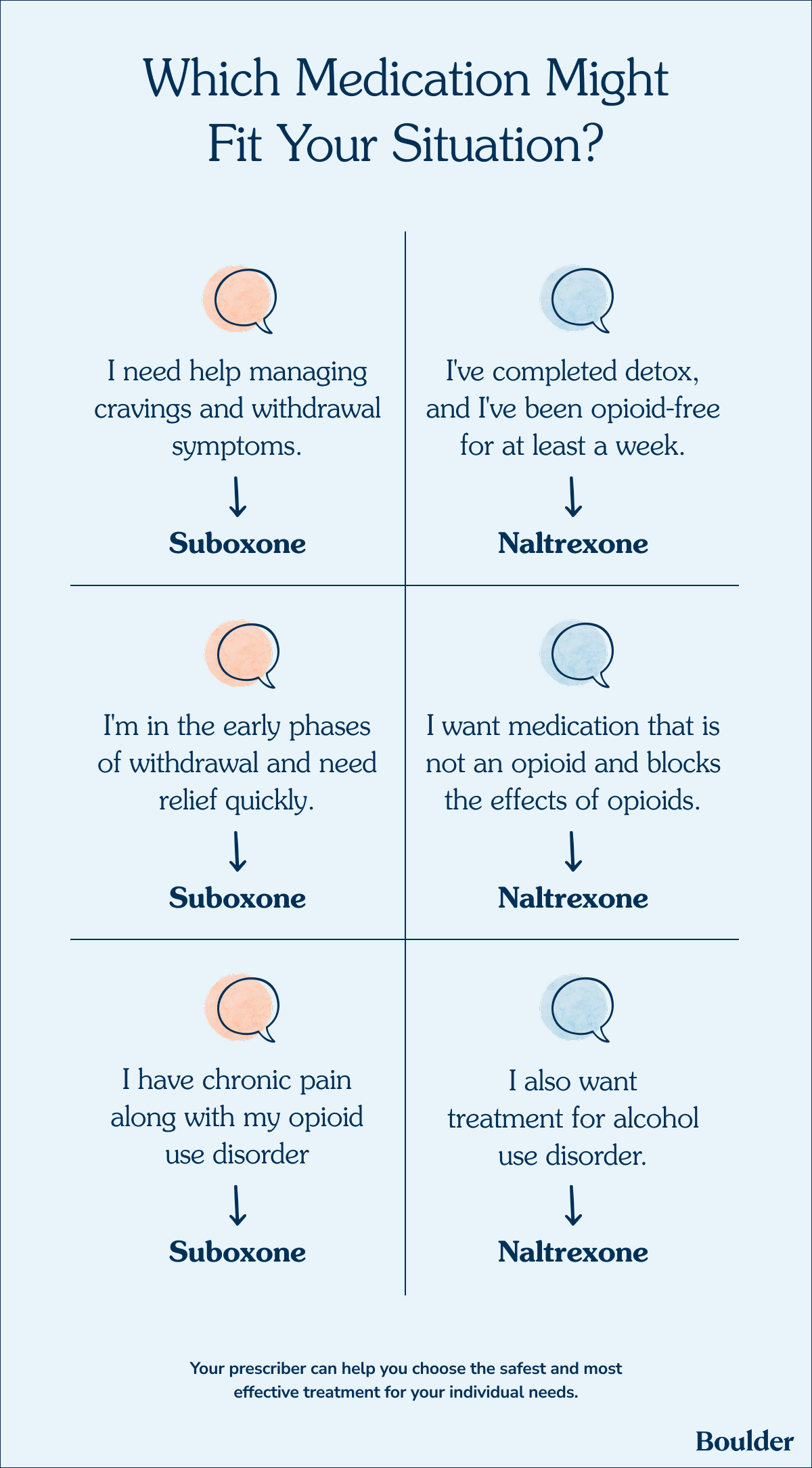
Finding the right medication isn't about one being "better" than the other. It depends on whether you've completed detox, your current opioid use, and your treatment goals. Because naltrexone and buprenorphine work differently, each may be a better fit for different circumstances and needs.
Naltrexone can be a good option for people who've already completed detox. "When used for alcohol use disorder without concurrent opioid use, it can be effective in those who both want to reduce their alcohol use or work towards complete cessation," Dr. Hull explains.
The Substance Abuse and Mental Health Services Administration (SAMHSA) says that a provider might recommend it if:
"Naltrexone will likely not be the right fit for people who are using opioids and have difficulty tolerating withdrawal, unless they are in a controlled environment with direct medical supervision and treatment," Dr. Hull says. She also notes that it's not the right choice for people who plan to reduce but not completely stop taking opioids.
Suboxone is often recommended if someone is stopping opioid use and wants relief from withdrawal and cravings as their body stabilizes, says a review in CNS Drugs. Your provider might recommend Suboxone if you:
The buprenorphine in Suboxone can help you feel more stable during recovery, while also reducing the risk of overdose. "Suboxone can be incredibly helpful for someone who is physically dependent on opioids because it helps reduce withdrawal and cravings," Bellosi explains.
Remember, no single medication is right for everyone. Your provider can look at your unique situation, including opioid use history, other medical conditions, treatment goals, and preferences, to better decide which medication would be the best fit.

Naltrexone and Suboxone are both considered safe and effective when taken as directed, but they carry different risks that your provider will consider and discuss with you before recommending a treatment.
A risk for precipitated withdrawal is a risk that Suboxone and naltrexone share, but this risk involves different circumstances. Both medications require careful timing when starting treatment.
Suboxone should only be started when moderate withdrawal has already started. As Dr. Hull explains, buprenorphine binds very tightly to the opioid receptors, so it can rapidly displace other opioids and cause sudden, severe withdrawal if started too early.
Naltrexone requires an even longer waiting period. Since it blocks the opioid receptors completely, it can cause severe precipitated withdrawal if opioids are still present in the body. For that reason, people must detox and be opioid-free before receiving their first dose.
Suboxone's ceiling effect lowers – but doesn't completely eliminate – the risk of overdose. The FDA's prescribing information says that this risk is higher if people take Suboxone with other substances, including alcohol, benzodiazepines, or medications that cause sedation and slow breathing.
Naltrexone isn't an opioid and won’t cause an overdose itself. But opioid tolerance drops quickly after even a short break from opioids, so if a person takes the same amount of opioids as before, it may cause a life-threatening overdose.
Recognizing an opioid overdose
Signs of an opioid overdose include slow or stopped breathing, blue or gray lips or fingertips, pinpoint pupils, inability to wake the person, or loss of consciousness.
If you think someone might be having an opioid overdose, call 911 immediately, administer naloxone (Narcan) if you have it, and stay with them until emergency responders arrive.
Yes, you can switch between naltrexone and Suboxone, but this transition should always be planned with a healthcare provider because timing is key.
Switching is actually relatively common when a medication isn't working as well as someone hoped, causes bothersome side effects, or a person's recovery needs change. How this switch happens depends on which medication you started with. Switching from Suboxone to naltrexone won't happen until you're experiencing mild to moderate withdrawal, explains SAMHSA's Buprenorphine Quick Start Guide. Withdrawal severity is often measured using the Clinical Opiate Withdrawal Scale (COWS), a checklist that helps providers determine when it's safe for someone to start treatment without triggering precipitated withdrawal.
"In order to start taking naltrexone, an individual has to have a period where they do not utilize any opioids," says Dr. Hull. That means that when switching to naltrexone, all opioids — including buprenorphine — have to be fully cleared from the body before starting the new medication. Your provider can help determine the timing to ensure a safe switch based on your medication history and treatment goals.
A conversation with your provider is the best way to decide whether naltrexone or Suboxone is a better fit for your recovery needs. Instead of trying to decide on your own, talk with your provider about:
.png)
Naltrexone and Suboxone work in different ways and have different roles in treating opioid use disorder. Both are effective, so figuring out which one is right for you comes down to your current situation and what you hope to get out of treatment.
Suboxone is a good choice if you need help with withdrawal and cravings, while naltrexone can help if you want to block opioids' effects or treat alcohol use disorder.
Understanding how these medications work and talking to your healthcare provider can help you make an informed decision about which is right for you. If you’re wondering whether naltrexone or Suboxone might be the right fit, call 888-608-0836 to talk to a Boulder Care team member and learn more about your treatment options.
Because naltrexone blocks opioids' effects, it should not be taken at the same time as Suboxone. Taking them at the same time can lead to precipitated withdrawal. If you need to switch between medications, you should work with your provider to stop using one and start using the other safely.
You should only begin taking naltrexone after buprenorphine has completely cleared your system and you've been opioid-free long enough to avoid precipitated withdrawal. The exact amount of time can depend on factors like your Suboxone dose and how long you've been taking it. Your provider can determine when it's safe to start naltrexone.
Neither medication is inherently safer than the other in every situation. Buprenorphine has a lower risk of overdose because of the ceiling effect, but it still has risks and side effects. Naltrexone is not an opioid, so it cannot lead to overdose, but it can increase overdose risk if you use opioids again after detoxing and developing a lower tolerance. Your provider can help determine which option might be safer for you based on your medical history and recovery goals.
At Boulder Care, we’re committed to providing clear, evidence-based information about opioid and alcohol use disorder recovery. Learn more about our editorial standards and medical review process.
Now covered by Medicaid in Oregon and Washington – Schedule an online visit.